
Understanding how artists applied paint and constructed their works offers incredible insights into historical techniques and materials. Traditional photography captures color and form, but it often flattens the crucial three-dimensional qualities of a painted surface. This is where reflectance transformation imaging surface texture pigment analysis truly shines for art conservation.
Reflectance Transformation Imaging (RTI) is a computational photographic method that reveals subtle surface details invisible to the naked eye or standard imaging. It works by capturing a series of images of an object, each illuminated from a different direction. These images are then combined to create an interactive file that allows researchers to relight the object virtually from any angle.
For those of us working with historical pigments and art conservation, RTI imaging conservation offers a powerful tool for non-invasive examination. It allows us to scrutinize brushstrokes, tool marks, and the texture of pigment layers with unprecedented clarity. This unique perspective helps us understand the physical history of an artwork without touching it.
The ability to manipulate light across an object’s surface provides a dynamic way to explore its topography. You can virtually move a light source around the artwork, highlighting peaks and valleys in the paint that tell a story. This detailed surface texture art analysis is invaluable for documenting an object’s condition and uncovering hidden features.
The Principle Behind RTI and How It Differs From Standard Photography
RTI’s core principle relies on capturing how light interacts with an object’s surface from multiple angles. When light hits an uneven surface, it creates shadows and highlights that define its three-dimensional form. Traditional photography captures only one fixed lighting condition, limiting our perception of depth.
With RTI, we are essentially recording a comprehensive map of how the surface reflects light under various illumination directions. Each pixel in the final image stores information about its normal vector, which describes the orientation of the surface at that point. This data is then used in polynomial texture mapping to reconstruct the surface appearance.
Standard photography, by contrast, gives you a flat, two-dimensional representation. You get color and shape, but the nuanced relief of paint application or the subtle signs of damage often disappear. RTI, however, makes these minute details pop out as you sweep the virtual light across the object.
This difference is particularly significant when examining paintings or polychrome sculptures where the artist’s hand is physically embedded in the material. RTI allows us to see the texture of the paint, the direction of the brushstrokes, and even the individual particles of pigment. It is like feeling the surface with your eyes.
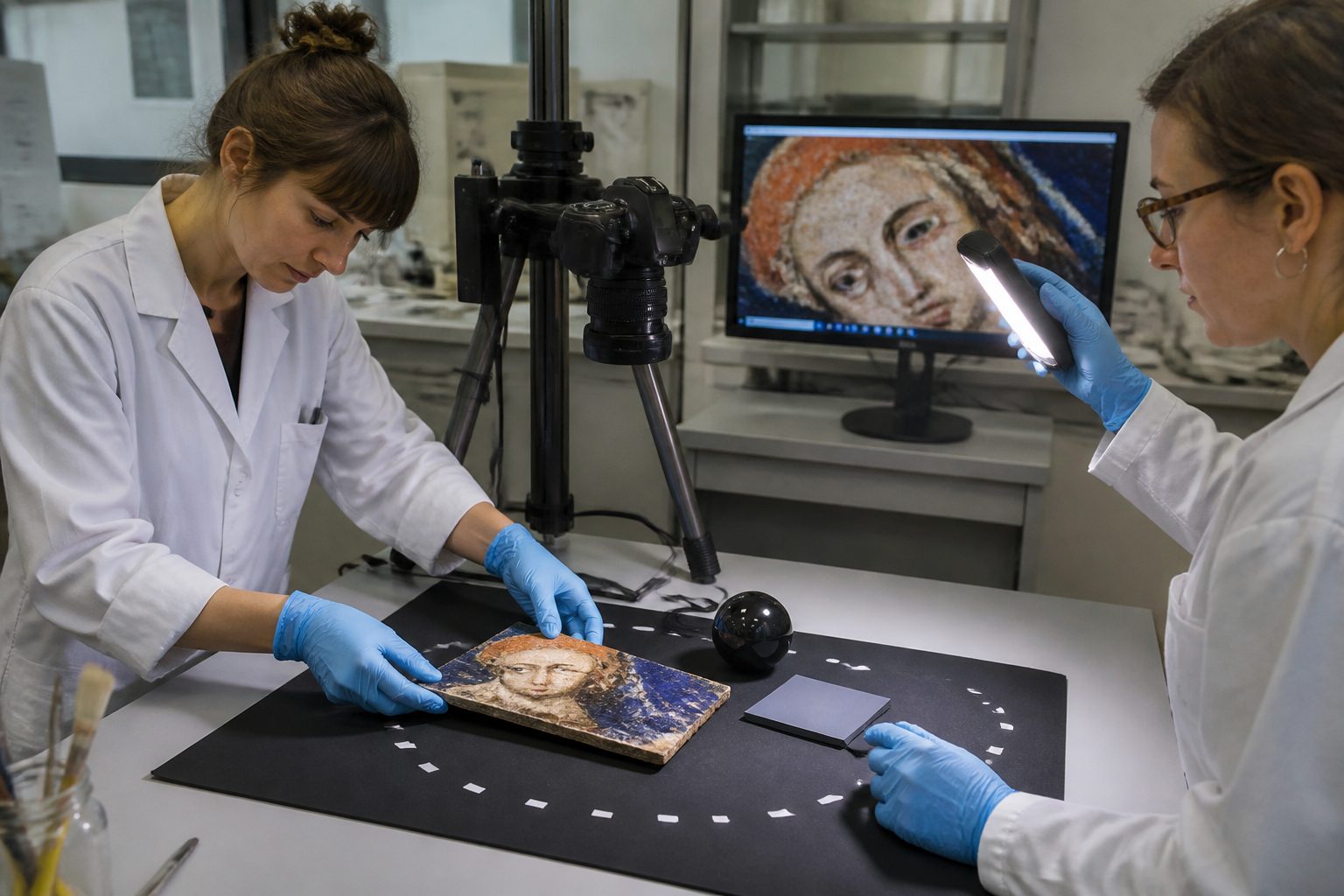
The interactive nature of RTI is another key differentiator from static images. Instead of just looking at a picture, you are engaging with a data set that responds to your input. This active exploration of reflectance transformation imaging surface texture pigment information makes discoveries far more likely.
The process captures the intricate relationship between light, material, and form in a way no single photograph ever could. This comprehensive data set becomes an enduring record of the object’s physical state. It also offers a baseline for future comparisons, which is essential for long-term conservation monitoring.
Equipment Setup: Dome vs. Highlight RTI Methods
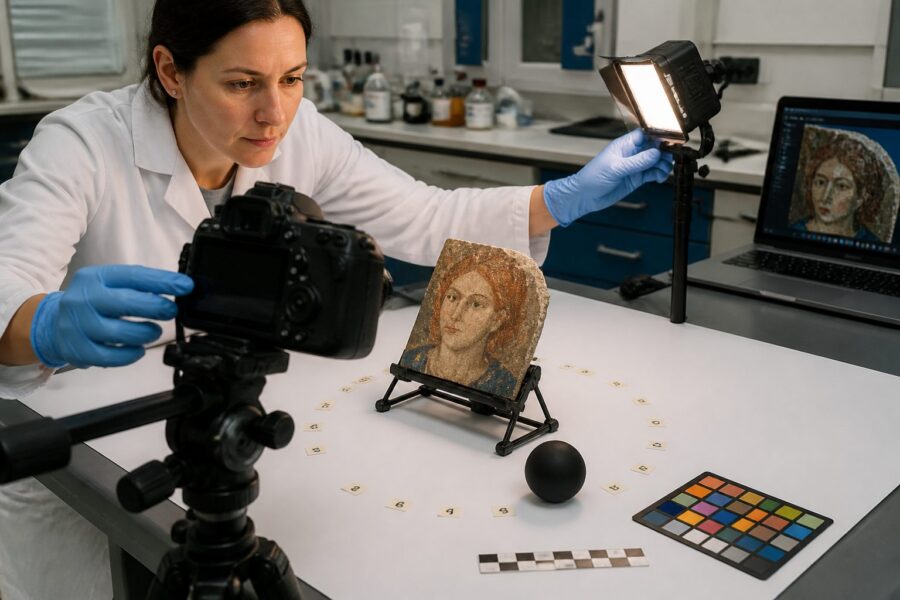
There are two primary methods for capturing RTI data: the dome method and the highlight method. Each has specific advantages and is chosen based on the object’s size, shape, and portability. Both techniques aim to capture images under controlled, varied lighting conditions.
The dome method uses a fixed camera and an array of lights arranged in a hemispherical dome around the object. This setup ensures highly consistent and repeatable lighting angles for each shot. The highlight method, conversely, uses a single handheld light source that moves around the object while the camera remains stationary.
| Feature | Dome RTI Method | Highlight RTI Method | Best Use Case |
|---|---|---|---|
| Lighting Control | Highly precise, automated | Manual, requires careful positioning | Small, delicate objects; lab settings |
| Portability | Low, fixed setup | High, minimal equipment | Large objects; on-site conservation |
| Setup Time | Longer initial setup | Faster, more flexible | Detailed surface texture art analysis |
| Data Quality | Very high, consistent | Good, depends on operator skill | Examining fine pigment texture |
| Cost | Higher initial investment | Lower cost, accessible | Initial surveys, rapid documentation |
| Skill Level | Moderate to high | Moderate, practice needed | RTI imaging conservation projects |
What RTI Reveals About Paint Application and Surface Condition
RTI provides an unparalleled view into the artist’s technique, showing us exactly how the paint was applied. We can clearly see the direction and force of individual brushstrokes, revealing the artist’s hand at work. This level of detail is often impossible to discern with standard photography.
The technique allows us to distinguish between different layers of paint based on their texture and relief. For example, a thick impasto layer will cast different shadows than a thin glaze, providing clues about the painting process. This helps build a comprehensive understanding of the reflectance transformation imaging surface texture pigment composition.
Beyond artistic technique, RTI is also exceptional at documenting the current condition of an artwork. It makes subtle abrasions, losses, and areas of wear immediately visible. These details can be easily overlooked when the light source is fixed, but RTI brings them into sharp relief.
We can identify areas where the paint has lifted or flaked, even if the damage is microscopic. By manipulating the light, these tiny imperfections cast shadows that expose their presence and extent. This capability is absolutely essential for proactive conservation planning.
The way light reflects off different pigments can also reveal their unique physical properties. Some pigments create a smoother surface, while others have a more granular texture that RTI captures beautifully. This specific surface texture art analysis helps characterize the materials used in the artwork.
RTI is particularly useful for paintings with dark or matte surfaces, where traditional photography often struggles to capture texture. The dynamic relighting helps to pull out the subtle relief from these challenging areas. You can truly appreciate the craftsmanship in ways you couldn’t before.
Using RTI to Detect Retouching, Abrasion, and Cracking
One of the most powerful applications of RTI is its ability to reveal interventions and damage that might otherwise go unnoticed. Retouching, for instance, often involves applying new paint over original layers, creating subtle textural differences. RTI makes these distinctions clear by emphasizing changes in surface topography.
When conservators examine an artwork for past repairs, RTI imaging conservation provides invaluable evidence. Areas of overpaint or infill often have a slightly different surface sheen or texture compared to the surrounding original material. The dynamic lighting feature of RTI can highlight these discrepancies, making restoration efforts visible.
Abrasion, which is surface wear caused by rubbing or cleaning, also becomes strikingly apparent with RTI. The slight flattening or erosion of the original paint layer creates a change in the way light reflects off the surface. This allows conservators to map out areas of damage with precision.
Cracking patterns, known as craquelure, are natural signs of aging in paintings, but their presence and characteristics can also indicate past trauma or structural issues. RTI helps to visualize the depth and morphology of these cracks. We can see if they are superficial or extend deeper into the paint layers.
The ability to differentiate between original craquelure and cracks caused by later damage is extremely important for dating and authenticating artworks. RTI provides the visual evidence needed to make these critical assessments. It offers a clear picture of the painting’s long-term stability.
Furthermore, RTI can sometimes reveal hidden inscriptions or marks that have been painted over. The change in surface texture from an underlying text can still be visible even if the top layer of paint obscures the color. This has led to exciting discoveries in numerous historical objects.
This method offers a non-destructive way to monitor the progression of damage over time. By taking RTI captures at different intervals, conservators can track how cracks propagate or how surface abrasions worsen. This provides objective data for long-term preservation strategies.
Combining RTI With Spectral Imaging for Richer Pigment Data
While RTI excels at revealing surface texture and topography, it doesn’t provide information about the chemical composition of pigments. To get a complete picture, combining RTI with spectral imaging techniques is a powerful approach. This multi-modal analysis offers both physical and chemical insights.
Spectral imaging, such as X-ray fluorescence (XRF) or hyperspectral imaging, identifies the elemental or molecular composition of the pigments. When you layer this chemical data over the detailed surface information from RTI, you gain a much richer understanding of the artwork. This combination really pushes the boundaries of art analysis.
- Identify specific pigments used by the artist
- Map pigment distribution across the surface
- Detect underlying preparatory sketches or changes
- Uncover hidden layers of paint or previous compositions
- Characterize the material properties of the paint
- Distinguish original pigments from later additions
- Assess pigment degradation and alteration over time
File Formats, Viewer Software, and Data Sharing Protocols
After capturing the series of images, specialized software processes them to create the interactive RTI file. The most common output format for RTI is the .ptm (Polynomial Texture Map) file, which stores the reflectance information for each pixel. This file is what allows for the dynamic relighting.
There are several viewer software options available, with the most widely used being the RTIViewer, developed by Cultural Heritage Imaging (CHI). This free software allows anyone to open and interact with .ptm files, exploring the surface details by moving a virtual light source. It is surprisingly intuitive to use.
Another popular format is the .hsh (Hemispherical Harmonics) file, which is often used for high-quality, research-grade RTI data. Both .ptm and .hsh files encapsulate the complex lighting information in a compact and efficient manner. These formats are crucial for preserving the integrity of the data.
Data sharing protocols are essential for collaboration and long-term preservation of RTI data. Researchers often host their RTI files on institutional repositories or dedicated cultural heritage platforms. This ensures that the valuable surface texture art analysis can be accessed and studied by others.
When sharing RTI data, it’s important to include metadata such as object identification, capture date, equipment used, and any specific conservation notes. This context helps other researchers interpret the data correctly. Without proper metadata, even the best RTI capture loses some of its value.
The open-source nature of many RTI tools and viewers promotes wider adoption and accessibility. This community-driven development helps to refine the techniques and make reflectance transformation imaging surface texture pigment studies more widespread. It is a fantastic example of collaborative science.
Limitations and When to Use RTI vs. Other Surface Imaging Tools
While RTI is incredibly powerful for surface texture and pigment study, it is important to understand its limitations. RTI primarily captures surface relief and how light reflects off it, meaning it provides little to no information about what lies beneath the surface. You won’t see through paint layers with RTI alone.
For sub-surface analysis, other imaging techniques are far more appropriate. X-radiography, for example, can reveal underlying structural elements, changes in composition, or hidden original sketches. Infrared reflectography is excellent for peering through paint layers to uncover preparatory drawings.
RTI is also less effective on perfectly flat, specular (mirror-like) surfaces where there is little topographic variation. If a surface is extremely smooth and uniformly reflective, the dynamic lighting effect will be minimal. The technique thrives on surfaces with texture and relief.
Another consideration is the size of the object. While the highlight RTI method offers flexibility for larger objects, very expansive murals or extremely complex, multi-faceted sculptures can be challenging to capture comprehensively. Each section needs careful, consistent lighting.
The time and computational resources required for RTI can also be a factor. Capturing a high-resolution RTI dataset involves many individual images, which then need significant processing. This can be time-consuming, especially for large projects or when working with limited equipment.
Therefore, when deciding whether to use RTI, consider what specific questions you want to answer about the artwork. If your focus is on brushwork, craquelure, surface damage, or the physical application of reflectance transformation imaging surface texture pigment, RTI is an excellent choice. It provides unique insights into surface texture art analysis that other methods simply cannot.
However, if you need to identify hidden layers, underlying materials, or the chemical composition of pigments, you will need to complement RTI with other analytical techniques. RTI works best as part of a comprehensive suite of imaging and analysis tools. It is a specialized tool with a specific, powerful function.
Conclusion
Reflectance Transformation Imaging has truly revolutionized how we approach the study and conservation of historical pigments and artworks. Its ability to capture and dynamically relight an object’s surface reveals a wealth of information that remains hidden from conventional photography. This non-invasive technique offers an incredible window into an object’s physical history.
From discerning the artist’s subtle brushwork to identifying minute signs of damage or previous restorations, RTI empowers conservators and researchers with objective, detailed data. The interactive nature of the resulting files allows for deep exploration and documentation of surface texture art analysis. It makes the invisible visible.
As technology continues to advance, RTI imaging conservation will undoubtedly become an even more integral part of cultural heritage science. Its complementary role with other spectral imaging techniques provides a holistic approach to understanding complex historical objects. Embracing these advanced tools allows us to protect and interpret our shared past more effectively.
The insights gained from detailed reflectance transformation imaging surface texture pigment studies are not just academic; they directly inform conservation treatments and public understanding. This method helps us preserve these precious artifacts for future generations. It is a powerful testament to the ingenuity of modern science applied to ancient art.