

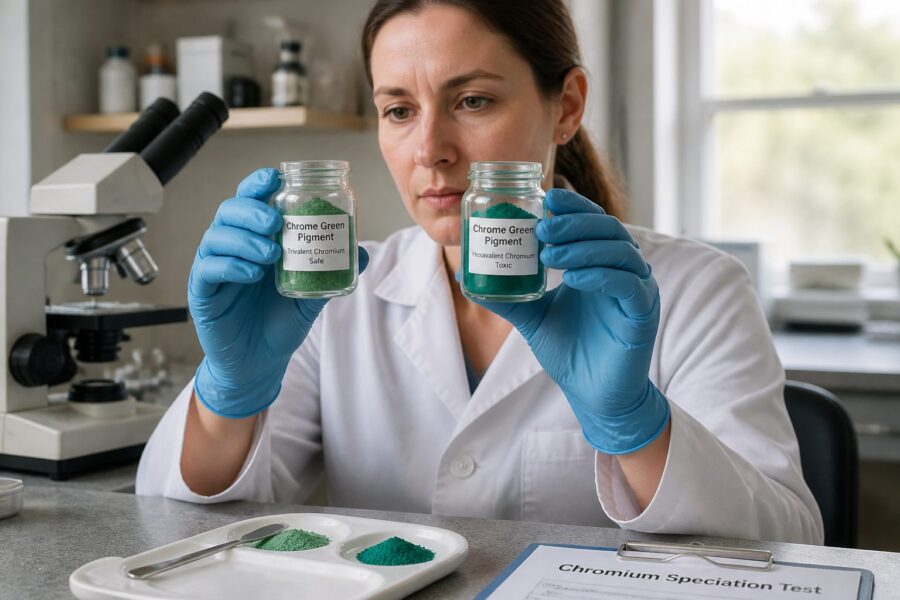
Working with historical pigments presents unique challenges, particularly regarding safety and long-term conservation. Among the colors found in art and historical objects, chrome green pigments stand out due to their complex chemistry and varying toxicity. Understanding the distinctions between different chromium forms is essential for conservators, researchers, and anyone handling these materials.
The term “chrome green” can be misleading, encompassing compounds with vastly different health implications. Some chromium forms are relatively benign, while others are potent carcinogens, necessitating accurate identification and careful handling. This article clarifies these differences, focusing on the safety aspects of chrome green pigments and providing practical management guidance.
This article aims to equip conservators, researchers, and handlers with knowledge for safe work. Many historical artworks contain chrome green pigments, making this topic highly relevant to chemical analysis and conservation. Knowing whether you are dealing with a harmless compound or a dangerous one dictates your approach to analysis, storage, and restoration, forming the bedrock of responsible conservation practice.
The nuances of chrome green toxicity are often overlooked or oversimplified, leading to potential mishandling or unnecessary alarm. We provide precise, actionable information to help professionals navigate these complexities confidently. Let’s explore the chemical identities and safety profiles of these intriguing yet challenging pigments.
The Two Main Chrome Green Pigments and Their Chemical Identities
Chrome green pigments primarily refer to two distinct types with different chemical compositions and safety profiles. The first, generally safer, is chromium(III) oxide, also known as viridian or opaque chromium oxide green, valued for its permanence and intense green color.
Chromium(III) oxide (Cr2O3), used in artworks since the 19th century, is insoluble in water and most acids, making it a durable pigment. Safety concerns often center on distinguishing viridian from other chrome greens.
The second type, often called “chrome green,” mixes chrome yellow (lead chromate) and Prussian blue (ferric ferrocyanide). This vibrant green mixture carries significant health risks from chromium(VI) compounds in lead chromate, which is the primary safety concern regarding toxic chromium forms.
Popular for its low cost and strong tinting power, this mixed pigment was widely used in 19th and 20th-century paints, inks, and industrial coatings. Its widespread application means conservators frequently encounter it, making understanding its composition key to risk assessment.
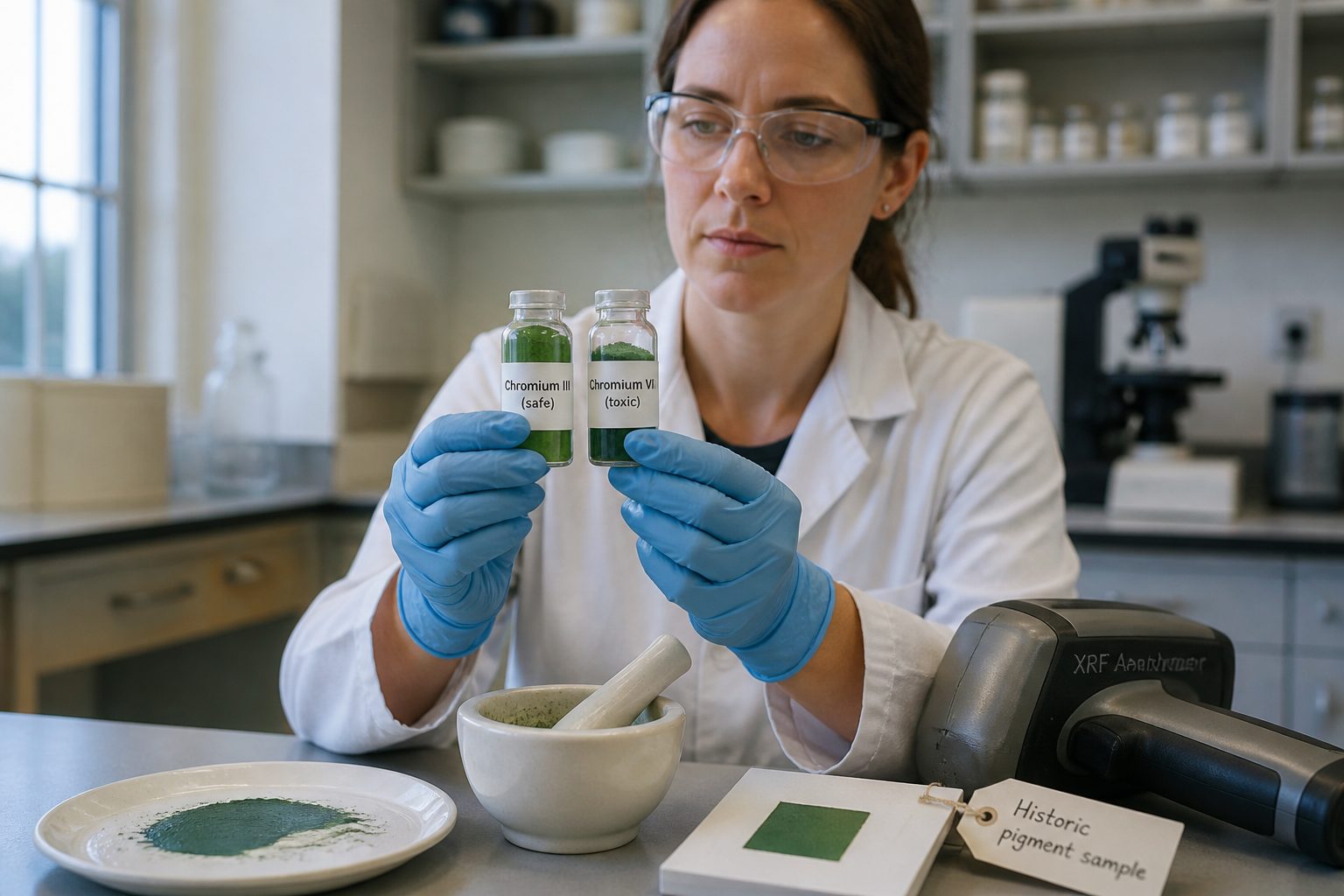
Lead chromate in mixed chrome green is a chromium(VI) compound (PbCrO4), highly problematic due to chromium’s +6 oxidation state, which is significantly more toxic than chromium(III).
Viridian (hydrated chromium(III) oxide, Cr2O3·nH2O) is a much safer alternative. Its chromium is in the +3 oxidation state, an essential trace element for humans in small quantities. This stark difference drives the safety discussion around chromium III vs VI pigments.
The distinction between these two chrome green types is not merely academic; it has direct implications for conservation lab health and safety. Misidentifying a lead chromate-based chrome green as viridian could lead to inadequate safety, while over-cautious handling of viridian might be inefficient.
Knowing an artifact’s exact pigment identity allows for targeted conservation treatments and informs future exhibition and storage solutions. Accurate chemical analysis is fundamental in any conservation project involving green pigments.
Historical context informs pigment presence: lead chromate-based chrome greens were cheaper and common in industrial/decorative applications, while viridian, though more expensive, was prized by artists for its purity and brilliance.
This historical usage pattern helps conservators anticipate pigment types. Provenance and period study offer valuable clues before invasive analysis, vital for risk assessment.
Why Chromium(VI) Compounds Are Classified as Carcinogens
Hexavalent chromium, Cr(VI), poses the most significant health risks due to its unique chemical reactivity, making it highly dangerous to living organisms. It is classified as a known human carcinogen by international health organizations.
Cr(VI)’s danger lies in its ability to readily cross cell membranes and undergo intracellular reduction, producing reactive oxygen species and unstable intermediates. These interact with cellular components like DNA, proteins, and lipids, causing oxidative damage and genetic mutations, explaining severe chrome green toxicity concerns.
| Characteristic | Chromium(III) [Cr(III)] | Chromium(VI) [Cr(VI)] | Lead Chromate (Mixed Chrome Green) |
|---|---|---|---|
| Oxidation State | +3 | +6 | Contains +6 Chromium |
| Toxicity Level | Low (essential trace element) | High (carcinogenic, mutagenic) | High (due to Cr(VI) and lead) |
| Solubility in Water | Generally low | Moderate to high | Low (but Cr(VI) can leach) |
| Cellular Uptake | Poor | High (readily crosses membranes) | Cr(VI) component readily absorbed |
| Health Effects | Minimal, essential nutrient | Respiratory cancers, skin ulcers, kidney damage | Similar to Cr(VI), plus lead poisoning effects |
| Pigment Example | Viridian (hydrated chromium(III) oxide) | Chromium yellow (lead chromate) | Mixture of lead chromate and Prussian blue |
How to Distinguish Between Cr(III) and Cr(VI) in Pigment Samples
Accurately distinguishing Cr(III) and Cr(VI) in pigment samples is critical for risk assessment and conservation. Visual inspection is insufficient, as both forms can appear green; scientific analysis provides necessary precision.
X-ray Fluorescence (XRF) spectroscopy is a common non-destructive technique, identifying elemental composition like chromium and lead, which suggests mixed chrome green containing lead chromate. However, XRF cannot directly determine chromium’s oxidation state, limiting assessment of toxic chromium forms.
More advanced techniques are necessary to determine oxidation state. Raman spectroscopy differentiates viridian from lead chromate-based chrome greens by analyzing their unique vibrational fingerprints, allowing clear identification without artifact damage.
Fourier-Transform Infrared (FTIR) spectroscopy is another highly effective method. FTIR identifies specific chemical bonds and functional groups, providing insights into molecular structure. This technique helps confirm chromate ions (CrO4^2-) characteristic of Cr(VI) compounds, distinguishing them from Cr(III) oxides.
For definitive results, especially with small samples, micro-analytical techniques like micro-Raman and micro-FTIR are invaluable, allowing individual pigment particle analysis. This precision is useful when pigments are layered or mixed.
Sampling for analysis must always be minimal, properly documented, and follow strict conservation ethics. Even a tiny sample can provide enough material for techniques like Scanning Electron Microscopy with Energy Dispersive X-ray Spectroscopy (SEM-EDS), offering elemental analysis and morphological information.
Chemical spot tests, while less precise and often destructive, can offer quick preliminary indications (e.g., a diphenylcarbazide test produces a purple-red color in the presence of Cr(VI)). However, these tests require extreme caution, used only when non-destructive methods are infeasible or to confirm initial hypotheses.
The presence of lead alongside chromium strongly suggests lead chromate, indicating Cr(VI) and a clear red flag for potential chrome green toxicity. Always prioritize comprehensive analysis.
A multi-analytical approach, combining several techniques, often provides the most robust identification. Starting with non-destructive methods and moving to micro-destructive analysis only when necessary preserves object integrity, ensuring accuracy and ethical handling.
Collaboration with cultural heritage analytical chemists is often the best strategy, as their expertise with sophisticated instrumentation ensures reliable results. This partnership is crucial for informed decisions about object care and personal safety.
Exposure Routes and Health Effects Associated With Chrome Green
Understanding potential exposure routes to chrome green pigments, especially toxic chromium forms, is essential for effective safety. Primary routes in conservation or research include inhalation, ingestion, and skin contact, each carrying distinct human health risks.
Inhalation of airborne particles is arguably the most dangerous route for Cr(VI) compounds. When dry pigments are disturbed (e.g., during cleaning, sampling, sanding), fine dust containing Cr(VI) can become airborne and inhaled deep into the lungs, causing significant damage.
Inhaled Cr(VI) causes severe, well-documented health effects. Long-term exposure is strongly linked to respiratory cancers (e.g., lung, nasal cavity/sinus cancer). Short-term exposure can cause respiratory tract irritation, nosebleeds, and nasal septum ulcers.
Ingestion is another potential route, often occurring inadvertently via hand-to-mouth transfer if workers handle pigments without gloves, then touch their face, eat, drink, or smoke without proper handwashing. Contaminated workspace surfaces also contribute.
Ingested Cr(VI) can lead to stomach upset, ulcers, and kidney/liver damage. Though less common in controlled labs than inhalation, ingestion risk should not be underestimated; strict hygiene protocols are paramount.
Skin contact with Cr(VI) compounds can cause localized irritation and allergic reactions, manifesting as contact dermatitis (itching, redness, rashes). Severe, prolonged, or repeated exposure can lead to chromate ulcers—slow-healing lesions that penetrate deep into the skin.
Chromium(VI) is a known sensitizer; repeated exposure can lead to allergic reactions even at low concentrations once sensitization occurs. This makes minor skin contact a long-term health concern, mandating protective gloves.
Lead in mixed chrome green pigments adds another health risk. Lead poisoning can affect nearly every body system (nervous system, kidneys, blood-forming organs), with symptoms ranging from fatigue and headaches to cognitive impairment and reproductive issues.
Children and pregnant women are particularly vulnerable to lead exposure, even at low levels. Thus, handling historical objects with lead-based pigments concerns conservators, museum visitors, and anyone in the vicinity. Comprehensive risk assessments must consider all potential contaminants.
It is important to distinguish these severe effects from the relatively benign nature of chromium(III) oxide (viridian). While viridian is generally non-toxic, inhaling any fine dust, even from inert pigments, can cause respiratory irritation. Good general laboratory practices are always advisable.
Understanding each pigment type’s specific chrome green toxicity allows a tailored risk management approach. Conservators must assume the worst-case scenario until definitive analysis proves otherwise, guiding all safe handling protocols.
The long-term health of chemical analysis and conservation professionals depends on strict safety guideline adherence. Ignoring these risks can have devastating consequences. Prioritizing safety is not just a regulatory requirement; it is a moral imperative.
Regulatory Limits and Workplace Standards for Chromate Pigments
Given chromium(VI) compounds’ significant health risks, regulatory bodies worldwide have established strict handling and exposure limits and workplace standards. These regulations protect workers from Cr(VI)’s carcinogenic and toxic effects, making compliance a legal requirement.
In the United States, OSHA has specific standards for hexavalent chromium (Cr(VI)). The permissible exposure limit (PEL) for Cr(VI) is very low: typically 5 micrograms per cubic meter of air (5 µg/m3) as an 8-hour time-weighted average, reflecting the substance’s extreme potency.
- Maintain air concentration below 5 µg/m3
- Implement engineering controls (e.g., local exhaust ventilation)
- Provide appropriate personal protective equipment (PPE)
- Establish clear hygiene facilities and practices
- Conduct regular medical surveillance for exposed workers
- Offer comprehensive training on Cr(VI) hazards and controls
- Develop a written exposure control plan
- Ensure proper waste disposal procedures
- Label all Cr(VI) containing materials clearly
- Restrict access to areas where Cr(VI) is present
Safe Handling Protocols for Historical Objects Containing Chrome Green
Working with historical objects potentially containing chrome green pigments, especially toxic chromium forms, demands rigorous safe handling protocols. These minimize worker exposure and prevent workspace contamination; a proactive, cautious approach is always best.
Identification is the first step. Before any handling or conservation, identify the specific chrome green pigment type using non-destructive analytical techniques. Assume Cr(VI) presence until proven otherwise, especially if the object dates from the 19th or early 20th century when lead chromate mixtures were common.
All work involving suspected or confirmed Cr(VI) pigments must occur in a designated, well-ventilated area, preferably under a certified fume hood or local exhaust ventilation. This engineering control is crucial for preventing airborne particle buildup and protecting workers from inhaling hazardous dust.
Personal Protective Equipment (PPE) is essential, including appropriate gloves (nitrile or neoprene), a lab coat or dedicated protective clothing, and eye protection. For dust-generating tasks like dry cleaning or sampling, a respirator with appropriate filters (e.g., P100) is mandatory.
Preventing dust generation is a primary goal. Use wet methods whenever possible for cleaning or consolidation to suppress airborne particles. If dry cleaning is unavoidable, use low-power vacuum cleaners with HEPA filters to capture dust at the source. Avoid abrasive techniques that release significant pigment particles.
Strict hygiene practices are non-negotiable. Workers must wash hands thoroughly with soap and water immediately after handling objects and before eating, drinking, or leaving the work area. Do not eat, drink, smoke, or apply cosmetics in areas where chrome green pigments are handled; these steps significantly reduce ingestion risks.
Contaminated waste materials (gloves, disposable lab coats, used cleaning supplies) must be collected in clearly labeled hazardous waste containers. These require proper disposal according to local and national regulations; never dispose of chromate-containing waste in general trash.
Regular cleaning of the work area is vital. Surfaces should be cleaned with wet methods or HEPA-filtered vacuums to remove settled dust. Avoid dry sweeping or compressed air, as these methods can re-suspend hazardous particles. A clean workspace is a safe workspace.
Storage of objects containing chrome green should follow specific guidelines. Store artifacts in stable environmental conditions to prevent pigment degradation and potential release of harmful particles. Clearly label storage containers or locations to alert future handlers to hazardous materials.
Training is a continuous process. All personnel handling or working near these objects must receive comprehensive training on chrome green pigment hazards, proper handling, PPE usage, emergency procedures, and waste disposal, ensuring everyone understands risks and responsibilities.
Emergency procedures for spills or accidental exposure should be clearly established and communicated. Know eyewash station and emergency shower locations, and understand first aid protocols for skin or eye contact; rapid response can mitigate severe health outcomes.
Adhering to these rigorous safe handling protocols protects conservators and colleagues while preserving invaluable cultural heritage. Chrome green pigments’ toxic chromium forms safety concerns should never be taken lightly; our responsibility is to both the artifact and its handlers.
Replacement Options for Conservation Work Requiring Green Pigments
When conservation work requires new green pigments, especially for infills or retouching, using historical chrome green pigments is inadvisable due to health risks. Conservators must select safer, stable, and aesthetically appropriate alternatives, aligning with ethical conservation principles to match appearance without introducing new hazards.
One of the safest replacements for traditional chrome green is viridian (hydrated chromium(III) oxide, Cr2O3·nH2O). As discussed, it contains chromium in its non-toxic +3 oxidation state, offering excellent lightfastness and chemical stability, making it a reliable choice for conservation.
Phthalocyanine green is another excellent option. This non-toxic synthetic organic pigment offers a wide range of brilliant green hues, exceptional lightfastness, and chemical inertness. It is a standard green pigment in modern art and conservation due to its superior properties, providing a strong, clean green mixable to many shades.
For more muted or earthy greens, particularly when matching older, degraded chrome greens, conservators might consider mixtures of stable yellow and blue pigments. Iron oxide yellows (e.g., yellow ochre) combined with ultramarine blue or cobalt blue can create various naturalistic greens. These inorganic pigments are generally very stable and safe.
Cobalt green, a mixture of cobalt(II) oxide and zinc oxide, provides a beautiful, stable, and non-toxic green pigment. It offers good covering power and lightfastness, suitable for delicate retouching. However, its higher cost and specific hue might not always be an exact match for chrome green.
When selecting replacement pigments, conservators must consider factors beyond color match: compatibility with original materials, reversibility, and long-term stability are crucial. The chosen pigment should not react negatively with the artwork or degrade over time, altering the restoration’s appearance.
Custom pigment mixtures are often necessary to achieve precise shade and opacity for seamless integration with original artwork. This requires a deep understanding of color theory and individual pigment properties. Experimentation on test samples is always good practice before applying to the actual artifact.
Documentation of all replacement materials and methods used is vital for future conservation efforts. This includes recording exact pigments, binders, solvents, and precise application locations, ensuring transparency and aiding future object assessments.
Conservation science continually develops new and safer materials. Staying informed about the latest research and commercially available conservation-grade pigments is important. Attending workshops and conferences helps conservators keep knowledge current on best practices and new products.
Ultimately, replacement pigment choice should prioritize safety, stability, and aesthetic integrity. While historical chrome green pigments’ toxic chromium forms safety issues cannot be undone, future conservation interventions can actively avoid introducing new hazards. This commitment extends to all new restoration materials.
Conservators have a responsibility to protect both the artwork and its interactors. Opting for non-toxic, stable green pigment alternatives clearly demonstrates this commitment; many excellent options are available today that were not accessible in previous centuries.
Careful selection of replacement pigments testifies to evolving conservation standards, emphasizing preservation and protection. This thoughtful approach ensures cultural heritage longevity for generations and safeguards the health of professionals dedicated to this important work.
Conclusion
Navigating chrome green pigments requires a nuanced understanding of their chemical identities and health risks. The distinction between benign chromium(III) oxide (viridian) and hazardous chromium(VI) compounds in mixed chrome greens is critical, forming the foundation for responsible handling and conservation.
Chromium(VI) compounds are known carcinogens, posing significant dangers via inhalation, ingestion, and skin contact, leading to severe health effects like respiratory cancers and skin ulcers. Lead chromate, a component of many historical chrome green mixtures, further compounds these risks with lead poisoning concerns. Acknowledging these grave potentials is crucial for chrome green pigments’ toxic chromium forms safety.
Accurate identification through advanced analytical techniques like Raman, FTIR, and XRF spectroscopy is the first line of defense. Conservators must rely on scientific analysis to determine the exact chromium oxidation state, not visual cues alone, as this rigor directly informs safety protocols.
Implementing strict safe handling protocols—including proper ventilation, comprehensive PPE, rigorous hygiene, and appropriate waste disposal—is paramount. Regulatory limits set by bodies like OSHA underscore Cr(VI) exposure’s seriousness and provide clear workplace safety guidelines, which are in place for a reason.
When conservation treatments necessitate new green pigments, choosing safer, stable alternatives like viridian, phthalocyanine green, or non-toxic inorganic pigment mixtures is the ethical and practical choice. This ensures restoration integrity without introducing new hazards to the object or its handlers, with many excellent options available today.
Chemical analysis and conservation holds a dual responsibility: preserving cultural heritage and safeguarding professionals’ health. Balancing these means prioritizing safety through informed decisions and best practices, protecting both people and objects.
By continually educating ourselves on chrome green pigment risks and embracing advanced analytical tools and safety protocols, we can confidently navigate challenges presented by historical art and artifacts. This proactive approach ensures a safer, more sustainable future for conservation science, allowing duties to be performed without unnecessary risk.
The journey of understanding and mitigating historical pigment dangers is ongoing. With careful attention to detail and a commitment to safety, we can continue to preserve our shared cultural legacy. The critical difference between chromium III vs VI pigments should always guide our actions, as our collective well-being depends on it.


