

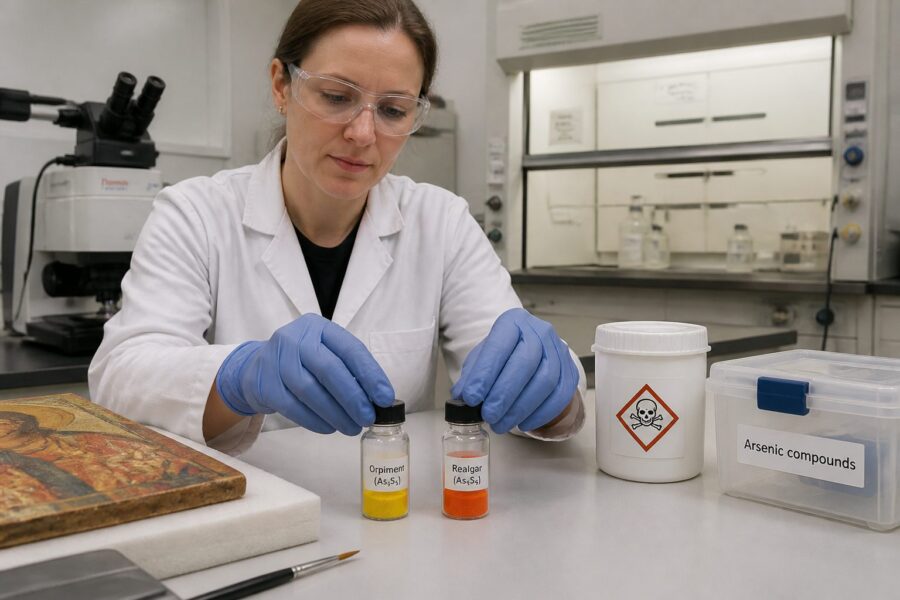
Orpiment and realgar, two striking arsenic sulfide pigments, have captivated artists and artisans for millennia with their brilliant yellow and orange hues. These minerals, chemically distinct but often found together, offered an unparalleled intensity of color that was highly prized across ancient civilizations. However, their beauty comes with a significant caveat: both pigments contain arsenic, a potent toxin that poses considerable risks to human health.
Understanding the history, chemistry, and hazard profile of orpiment realgar arsenic sulfide pigments is essential for anyone working with historical artworks. This knowledge helps conservators, curators, and researchers appreciate the materials’ artistic legacy while prioritizing safety and responsible handling. Ignoring the inherent dangers of these historical pigments would be a serious oversight in any conservation practice.
This article will explore the fascinating world of arsenic sulfide historical pigments, from their ancient applications to the modern challenges they present in conservation. We will discuss their chemical properties, potential exposure pathways, and the analytical techniques used for their identification. We will also cover the critical safety protocols and regulatory considerations necessary for managing these hazardous materials in cultural heritage settings.
The Historical Use of Orpiment and Realgar in Art and Decoration
Orpiment, known for its radiant golden yellow, and realgar, with its intense reddish-orange, held a special place in ancient and medieval art palettes. These arsenic sulfide pigments were among the most vivid colors available before the advent of modern synthetic alternatives. Their use spans diverse cultures, from Egyptian tomb paintings to illuminated manuscripts in Europe and intricate murals in Asia.
Ancient Egyptians employed orpiment extensively in funerary art and hieroglyphics, valuing its ability to mimic gold. Roman artists also utilized these pigments, though perhaps with some awareness of their toxicity, often restricting their use to less accessible areas. The Byzantine Empire continued this tradition, incorporating the bright yellows and oranges into religious icons and mosaics.
In medieval Europe, orpiment was a favored pigment for illustrating manuscripts, where its luminosity brought figures and decorative elements to life. Its rich color made it a popular choice for depicting drapery, halos, and other details requiring striking yellow or orange accents. Realgar, with its fiery hue, often provided strong contrasts and dramatic effects in these same artworks.
Asian art also showcases the widespread application of these arsenic sulfide pigments, particularly in China and India. Chinese painters used orpiment to create brilliant yellow landscapes and intricate textile patterns, while realgar found favor in Buddhist murals and decorative arts. These pigments were not just aesthetically pleasing; they often carried symbolic meanings, such as wealth or divinity.
The appeal of these pigments lay in their unique optical properties and their resistance to fading from light exposure, at least under certain conditions. Artists tolerated their inherent dangers because no other materials could achieve the same depth and brilliance of color. This historical reliance on orpiment toxicity art is a stark reminder of the compromises artists made for visual impact.
Beyond fine art, orpiment and realgar also found applications in cosmetics, medicine, and even as insecticides, highlighting their versatility and danger. Their use in cosmetics, particularly as depilatories, speaks to a lesser understanding of arsenic’s long-term effects. The historical record shows a complex relationship with these materials, balancing their utility with their known hazards.
Chemical Properties That Determine Their Toxicity and Stability
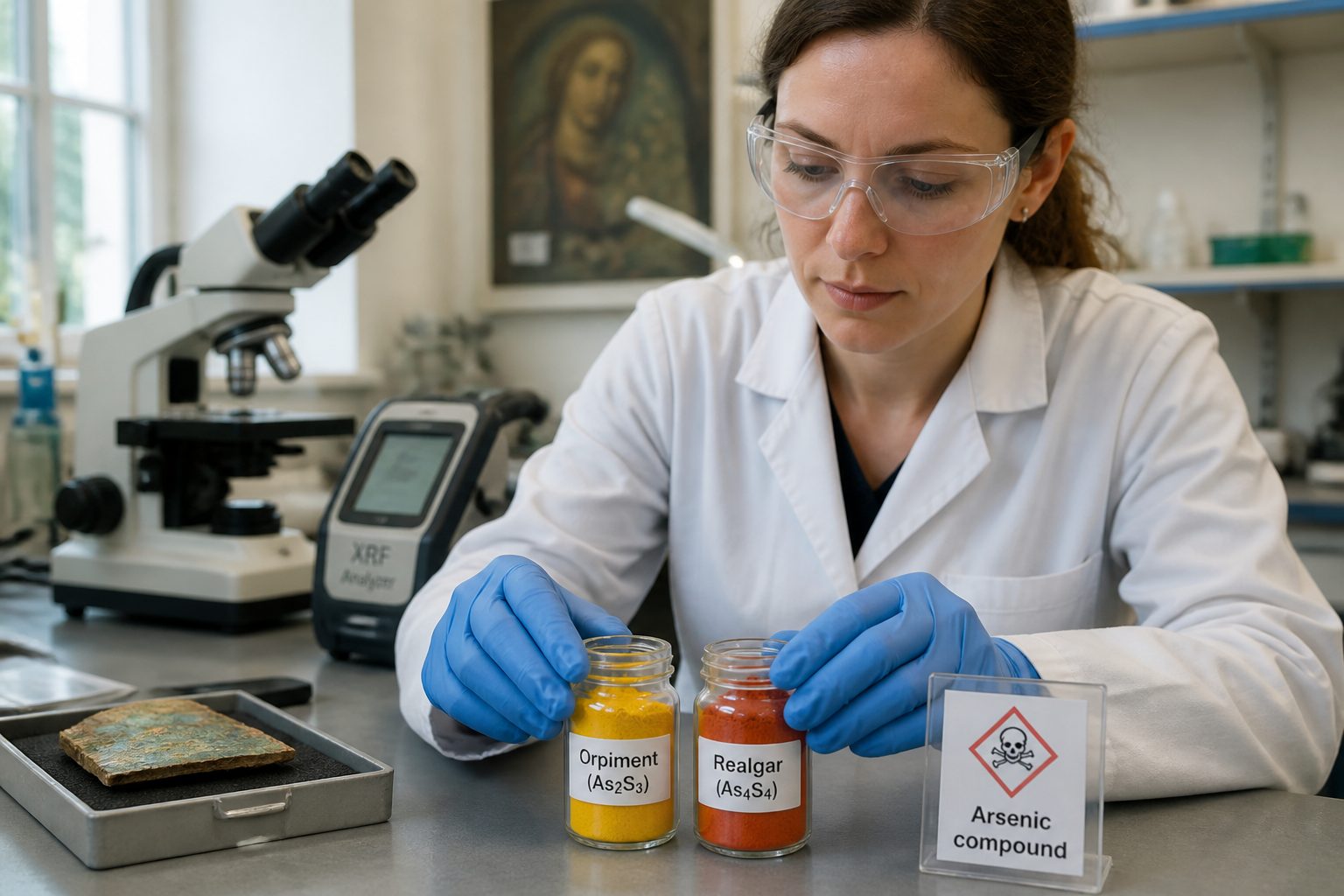
Orpiment (As₂S₃) and realgar (As₄S₄) are both arsenic sulfide minerals, but their distinct stoichiometries result in different crystal structures and chemical behaviors. Orpiment presents as a lemon-yellow mineral, while realgar typically appears as a vivid reddish-orange. Both are relatively soft minerals, which makes them easy to grind into fine pigments, unfortunately also increasing their potential for dust creation.
The primary concern with these pigments stems from their arsenic content, which is inherently toxic. Arsenic compounds can be absorbed into the body through various pathways, causing acute and chronic health issues. The stability of the arsenic-sulfur bond in these pigments affects their reactivity and thus their immediate hazard, but it does not eliminate the risk.
| Property | Orpiment (As₂S₃) | Realgar (As₄S₄) | Common Hazard |
|---|---|---|---|
| Color | Lemon-yellow to golden-yellow | Reddish-orange to scarlet | Arsenic toxicity |
| Chemical Formula | Arsenic trisulfide | Arsenic monosulfide | Dust inhalation |
| Crystal System | Monoclinic | Monoclinic | Skin absorption |
| Hardness (Mohs) | 1.5–2 | 1.5–2 | Degradation products |
| Photosensitivity | Low to moderate | High (transforms to pararealgar) | Environmental contamination |
Arsenic Exposure Pathways: Dust, Skin Contact, and Photodegradation
Working with orpiment realgar arsenic sulfide pigments presents several clear routes for arsenic exposure, making careful handling absolutely necessary. The most significant pathway is inhalation of fine dust particles generated during pigment handling, grinding, or any mechanical disturbance of an artwork. These airborne particles can easily enter the respiratory system and be absorbed into the bloodstream.
Direct skin contact also represents a notable exposure risk, particularly for conservators and researchers handling artworks without adequate personal protective equipment. While intact skin offers some barrier, prolonged contact or exposure to abraded skin can lead to arsenic absorption. Accidental ingestion, though less common, can occur if contaminated hands touch the mouth, highlighting the need for strict hygiene protocols.
Photodegradation introduces another complex exposure pathway, especially with realgar arsenic pigment. Exposure to light can cause realgar (As₄S₄) to transform into pararealgar (also As₄S₄ but with a different crystal structure) and eventually to arsenolite (As₂O₃), a highly toxic and water-soluble arsenic oxide. This transformation changes the pigment’s physical and chemical properties, often leading to powdering.
The powdery degradation products of realgar are far more easily dispersed as airborne dust and more readily absorbed through skin or ingestion. This makes aged artworks containing realgar particularly hazardous, as the original, relatively stable pigment may have converted into a more dangerous form. Understanding this degradation process is vital for assessing risk and planning conservation interventions.
Environmental factors like humidity and temperature can also influence the rate of degradation for these arsenic sulfide pigments. A humid environment might accelerate the formation of more soluble arsenic compounds, increasing the risk of leaching and spread. Consequently, the storage and display conditions of artworks containing these pigments must be carefully controlled to minimize degradation and associated hazards.
The long-term exposure to low levels of arsenic, even from seemingly stable pigments, can accumulate in the body and lead to chronic health issues. These include skin lesions, neurological damage, cardiovascular problems, and an increased risk of various cancers. This makes continuous vigilance and adherence to safety guidelines paramount when engaging with orpiment toxicity art.
Identifying Orpiment and Realgar in Artworks Through Chemical Analysis
Accurately identifying orpiment and realgar in historical artworks is a cornerstone of responsible conservation and research. Non-invasive analytical techniques are generally preferred to avoid damaging the valuable artworks. These methods allow conservators to confirm the presence of arsenic sulfide historical pigments without taking samples.
Raman spectroscopy is one of the most powerful tools for identifying these pigments in situ, as it provides specific molecular fingerprints for orpiment and realgar. This technique uses a laser to excite molecules, which then scatter light at different wavelengths characteristic of their chemical bonds. The resulting spectrum allows for unambiguous identification, even in mixed pigment layers.
X-ray fluorescence (XRF) spectroscopy is another widely used non-invasive method, though it provides elemental rather than molecular information. XRF detects the presence of arsenic, sulfur, and other elements within the pigment layer. While it confirms the elemental composition, it cannot definitively distinguish between different arsenic compounds without complementary techniques.
Scanning electron microscopy with energy dispersive X-ray spectroscopy (SEM-EDS) offers both morphological and elemental information, often requiring minute samples. This technique provides high-resolution images of pigment particles and elemental maps, revealing the distribution of arsenic and sulfur. It helps characterize the pigment’s physical state, which is particularly useful for identifying degradation products.
For more detailed chemical speciation, especially to differentiate between orpiment and realgar or their degradation products, micro-Fourier transform infrared (micro-FTIR) spectroscopy can be employed. This technique identifies functional groups present in the pigment, providing insights into its molecular structure. It is particularly useful for detecting the presence of arsenic oxides formed through photodegradation.
In some cases, especially when degradation is suspected, a small cross-section sample might be necessary for polarized light microscopy (PLM) or micro-Raman mapping. These invasive techniques provide layer-by-layer analysis, revealing the stratigraphy of pigments and binders. This level of detail helps conservators understand the pigment’s condition and how it interacts with surrounding materials.
The combination of these analytical methods allows for a comprehensive understanding of the arsenic sulfide pigments within an artwork. Accurate identification is the first critical step in developing appropriate conservation strategies and implementing effective hazard control measures. Knowing exactly what materials are present guides decisions about display, storage, and handling of the artwork.
Conservation Challenges: Realgar’s Photosensitivity and Powdering
The conservation of artworks containing orpiment and realgar presents unique and often complex challenges, primarily due to their inherent chemical instability, particularly realgar’s photosensitivity. Realgar arsenic pigment is notorious for its tendency to degrade upon exposure to light, transforming from its vibrant orange into a pale yellow powder. This transformation is not merely aesthetic; it significantly alters the pigment’s stability and increases its hazard potential.
The degradation process, often referred to as “realgar disease,” involves the conversion of realgar (As₄S₄) to pararealgar and eventually to arsenolite (As₂O₃), a highly toxic and friable white powder. This powdering effect can compromise the structural integrity of the paint layer, leading to loss of pigment and damage to the artwork’s surface. Preventing this degradation is a major focus for conservators.
- Strict light control in display and storage
- Monitoring of UV and visible light levels
- Maintaining stable humidity and temperature
- Isolation of affected areas to prevent spread
- Consolidation of powdery paint layers
- Documentation of degradation progress
- Minimizing physical handling of fragile areas
- Educating staff on specific risks
- Regular condition assessments
Safe Handling Procedures and PPE Requirements in Conservation
Safe handling of orpiment realgar arsenic sulfide pigments is non-negotiable in any conservation or research setting. Conservators must approach these materials with the utmost caution, understanding that even minor exposures can pose long-term health risks. Strict protocols are essential to protect personnel and prevent contamination of the workspace.
Personal Protective Equipment (PPE) forms the first line of defense against exposure to arsenic-containing pigments. This includes wearing appropriate gloves, such as nitrile or latex, to prevent skin contact. Gloves should be changed frequently, especially after touching contaminated surfaces, and hands must be thoroughly washed after removal.
Respiratory protection is absolutely critical when there is any risk of airborne dust, such as during examination, sampling, or treatment. A minimum of an N95 respirator is recommended, but for higher risk activities, a half-face or full-face respirator with P100 cartridges provides superior protection. Local exhaust ventilation, like a fume hood or down-draft table, should always be used to capture dust at the source.
Protective clothing, such as lab coats or disposable overalls, should be worn to prevent contamination of personal clothing. These garments should be removed before leaving the work area and laundered separately or disposed of as hazardous waste. Eye protection, such as safety glasses or goggles, is also necessary to shield eyes from dust and accidental splashes.
Work areas must be clearly designated, labeled, and isolated from general circulation. Surfaces should be covered with disposable bench paper, which can be easily and safely discarded after use. Regular cleaning of the workspace with HEPA-filtered vacuums, not brooms or compressed air, is essential to prevent the resuspension of arsenic-containing dust.
Training for all personnel working with these materials is mandatory, covering the hazards, proper PPE use, emergency procedures, and waste disposal protocols. Regular medical surveillance for staff who routinely handle arsenic-containing materials can also be a prudent measure. These comprehensive safety measures ensure a secure environment when dealing with orpiment toxicity art and realgar arsenic pigment.
Disposal and Regulatory Framework for Arsenic-Containing Materials
The disposal of arsenic-containing materials, including samples, residues, contaminated PPE, and degraded paint fragments, requires strict adherence to hazardous waste regulations. Improper disposal can lead to environmental contamination and pose severe public health risks. Institutions must establish clear procedures for classifying, storing, and disposing of these materials.
Arsenic is classified as a hazardous waste under various national and international regulations, such as the Resource Conservation and Recovery Act (RCRA) in the United States. This means that waste containing arsenic must be managed from “cradle to grave,” with detailed documentation of its generation, transport, treatment, and final disposal. Ignoring these regulations can result in heavy fines and legal penalties.
All waste materials contaminated with orpiment realgar arsenic sulfide pigments must be collected in clearly labeled, sealed containers. These containers should be impervious to leakage and stored securely in a designated hazardous waste accumulation area. Waste streams should be segregated to avoid mixing incompatible materials, which could create additional hazards.
Disposal typically involves contracting with licensed hazardous waste disposal companies that specialize in treating and landfilling arsenic-containing waste. These companies have the expertise and facilities to ensure the waste is handled safely and in compliance with all applicable laws. Documentation, including waste manifests, must be meticulously maintained for regulatory audits.
Beyond direct waste, regulatory frameworks also influence the exhibition and storage of artworks containing arsenic sulfide historical pigments. Institutions must consider visitor safety, especially in public display areas, and implement measures to prevent accidental exposure. This might include protective glazing, environmental controls, and clear informational signage.
The long-term stewardship of collections containing these hazardous pigments also requires ongoing risk assessment and management. Regular reviews of safety protocols, staff training, and compliance with evolving regulations are essential. This proactive approach helps mitigate risks and ensures the responsible care of both cultural heritage and human health.
Conclusion
Orpiment and realgar, with their captivating colors, have left an undeniable mark on the history of art and decoration. These arsenic sulfide pigments, once prized for their brilliance, now serve as powerful reminders of the complex relationship between artistic expression and material hazards. Their presence in historical artworks demands a sophisticated understanding of both their aesthetic value and their inherent toxicity.
The challenges presented by orpiment toxicity art are considerable, ranging from chemical instability and photodegradation to the ever-present risk of arsenic exposure. Conservators and researchers must navigate these complexities with a blend of scientific rigor, meticulous safety practices, and a deep respect for both the artwork and human well-being. This balance is not always easy to strike, but it remains absolutely necessary.
Through advanced chemical analysis, we can accurately identify these pigments, informing targeted conservation strategies and effective risk management. Implementing stringent safe handling procedures, including comprehensive PPE and controlled work environments, is paramount to protect those who interact with these materials. The responsible disposal of arsenic-containing waste further underscores the need for unwavering diligence.
Ultimately, the story of orpiment and realgar is a testament to how our understanding of materials evolves over time. What was once a celebrated pigment is now a hazardous substance requiring careful management and respect. By embracing scientific knowledge and adhering to best practices, we can continue to preserve these magnificent artworks safely for future generations, honoring their history without compromising health.
The ongoing study of realgar arsenic pigment and other historical hazardous materials is a critical field, constantly adapting to new research and regulatory changes. This continuous learning ensures that cultural heritage institutions can fulfill their mission of preservation while prioritizing the safety of their staff and the public. We must remain vigilant and informed.


