
Imagine walking into a gallery, admiring a magnificent 16th-century painting, only to notice that the brilliant blues in a Madonna’s robe or a distant landscape have faded to a dull, muted grey. This isn’t just the natural darkening of varnish or dirt accumulation; often, it’s a specific pigment called smalt undergoing a profound chemical transformation.
For centuries, conservators and art historians have puzzled over this phenomenon, where once-striking azure tones have seemingly vanished, leaving behind a ghost of the artist’s original intent. Understanding this process, particularly the smalt degradation 16th century oil paintings analysis reveals, is crucial for preserving these historical treasures.
The problem of smalt fading oil paint is a persistent challenge in art conservation, affecting numerous masterpieces across European collections. We’re talking about a blue pigment 16th century artists relied on heavily, especially when ultramarine was too expensive or unavailable.
This article will explore the fascinating chemistry behind smalt’s deterioration, focusing on its use in oil paintings of the 16th century. We will examine why this beautiful pigment, a cobalt blue glass pigment degradation victim, has proven so unstable in certain environments.
By looking at specific case studies and the analytical techniques employed, we can better appreciate the complexities involved in conserving these vulnerable works and reconstructing their lost brilliance.
What Smalt Is and How It Was Manufactured in the Renaissance
Smalt is essentially a potassium-cobalt glass, crushed into a fine powder to be used as a pigment. Its blue color comes from cobalt ions incorporated into the glass matrix during its manufacture.
This pigment offered a more affordable alternative to the costly ultramarine, derived from lapis lazuli, making it a popular choice for artists across Europe, especially in the 16th century. Its widespread availability and relatively low cost made it accessible for large areas of blue in paintings.
The manufacturing process involved fusing silica (sand), potash (potassium carbonate), and a cobalt mineral ore at high temperatures. This mixture created a deep blue glass, which workers then ground to various degrees of fineness.
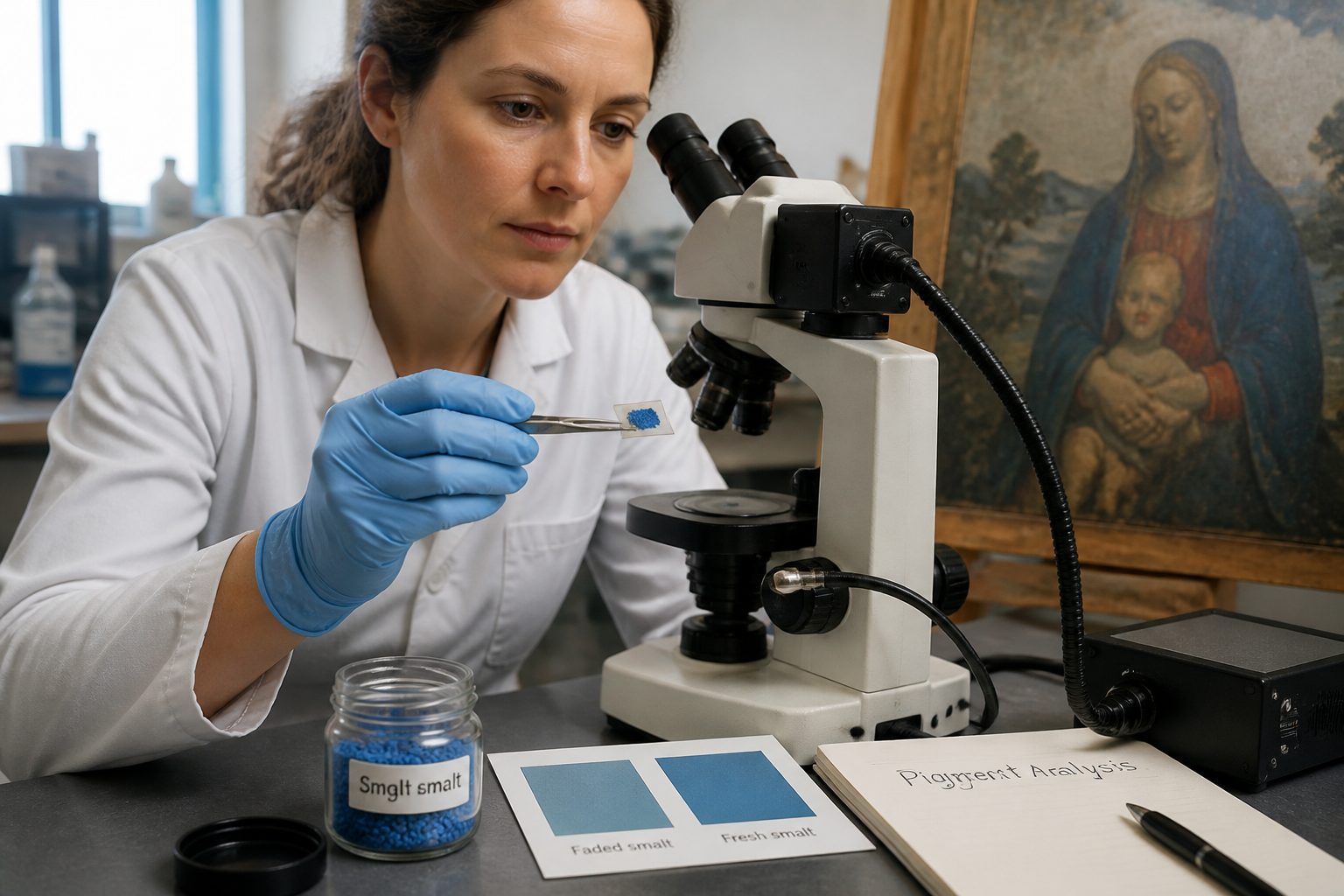
The quality and shade of the smalt depended heavily on the purity of the ingredients and the precise firing conditions. Different cobalt ores, often containing impurities like nickel or iron, produced slightly varied blue hues.
Renaissance artists received smalt in powdered form, ranging from coarse particles that imparted a gritty texture to finer powders for smoother applications. The coarser particles usually retained their blue color better, as the grinding process exposed more surface area to potential degradation.
Smalt’s historical use extends beyond painting, appearing in ceramics, enamels, and stained glass. Its versatility as a blue colorant made it a significant material in many artistic and decorative applications for centuries.
The pigment’s unique composition, a glass rather than a mineral, holds the key to both its initial brilliance and its eventual downfall. Understanding its origins helps us grasp why smalt degradation 16th century oil paintings analysis remains a critical field of study.
Why Smalt Loses Color in Oil Compared to Other Binding Media
The instability of smalt is particularly pronounced when mixed with oil binding media, a stark contrast to its behavior in fresco or tempera. This difference points to specific interactions between the pigment and the oil that accelerate its degradation.
Oil paint, typically linseed oil, undergoes a complex drying process involving oxidation and polymerization. This chemical environment is surprisingly aggressive towards the delicate glass structure of smalt.
In contrast, smalt often remains stable in aqueous media like fresco or glair (egg white) tempera, where these oxidative processes are absent. The water-based binders do not react with the glass in the same detrimental way.
The oil medium creates an acidic environment over time as it ages and oxidizes, which can leach out components from the smalt pigment. This acidic attack breaks down the glass matrix, releasing the cobalt ions responsible for the blue color.
Furthermore, the refractive index of the oil binder changes as it ages, becoming more yellow and transparent. This shift can visually alter the perception of the blue pigment, contributing to the appearance of smalt fading oil paint.
The particle size of the smalt also plays a role; finely ground smalt has a larger surface area exposed to the oil, making it more susceptible to chemical attack. Coarser particles generally fare better, retaining their color for longer periods.
This differential stability highlights the importance of the binding medium in the long-term preservation of pigments. For a blue pigment 16th century artists thought durable, its susceptibility to oil paints was an unforeseen flaw.
The Ion Migration Mechanism Behind Smalt Fading
The primary reason smalt turns grey is a process called ion migration, where cobalt ions leave the glass matrix and potassium ions move into the oil binder. This chemical exchange directly affects the pigment’s color.
When cobalt ions migrate out of the glass, the remaining glass becomes colorless, and the blue hue disappears. The cobalt blue glass pigment degradation is a slow but irreversible process, fundamentally changing the pigment’s structure.
| Element Involved | Original Location | Migration Direction | Impact on Smalt Color |
|---|---|---|---|
| Cobalt (Co²⁺) | Within glass matrix | Out of glass into oil | Loss of blue color, leads to grey appearance |
| Potassium (K⁺) | Within glass matrix | Out of glass into oil | Weakens glass structure, accelerates cobalt loss |
| Silicon (Si⁴⁺) | Main glass network | Remains in glass | Forms a silica-rich residue, contributing to grey |
| Oxygen (O²⁻) | Main glass network | Remains in glass | Part of the stable silica network |
| Hydroxyl (OH⁻) | From oil/environment | Into glass surface | Attacks glass network, facilitates ion exchange |
Case Studies: Flemish and Italian Paintings With Documented Smalt Loss
Numerous European masterpieces show clear evidence of smalt degradation, offering concrete examples of this phenomenon. These case studies provide invaluable insights into the extent and nature of smalt fading oil paint.
In Flemish painting, particularly works from the 16th century, smalt was a common blue pigment for draperies, skies, and distant landscapes. Artists like Pieter Bruegel the Elder often used it, and many of his blues now appear dull or grey.
For example, in Bruegel’s “The Fall of Icarus,” areas that were likely painted with smalt now show significant fading, altering the overall color balance and mood of the scene. This change affects how we perceive the artist’s original palette and intentions.
Italian Renaissance artists also employed smalt, especially in Venice, where it was readily available through trade routes. Titian and Veronese, for instance, sometimes used smalt for large blue areas, though often reserving ultramarine for more precious details.
Veronese’s “The Wedding at Cana” is a prime example, where extensive analysis has confirmed smalt’s presence in large blue passages now exhibiting discoloration. The once-rich blues in the sky and some garments have taken on a faded, purplish-grey tone.
The widespread use of this blue pigment 16th century artists embraced means that smalt degradation 16th century oil paintings analysis is a global concern for art conservation. It impacts how we understand and display these works.
These case studies underscore the challenge of preserving the original chromatic impact of these historical works. They force us to confront the reality of how materials change over time, even in carefully controlled museum environments.
Techniques Used to Identify Degraded Smalt Beneath Surface Changes
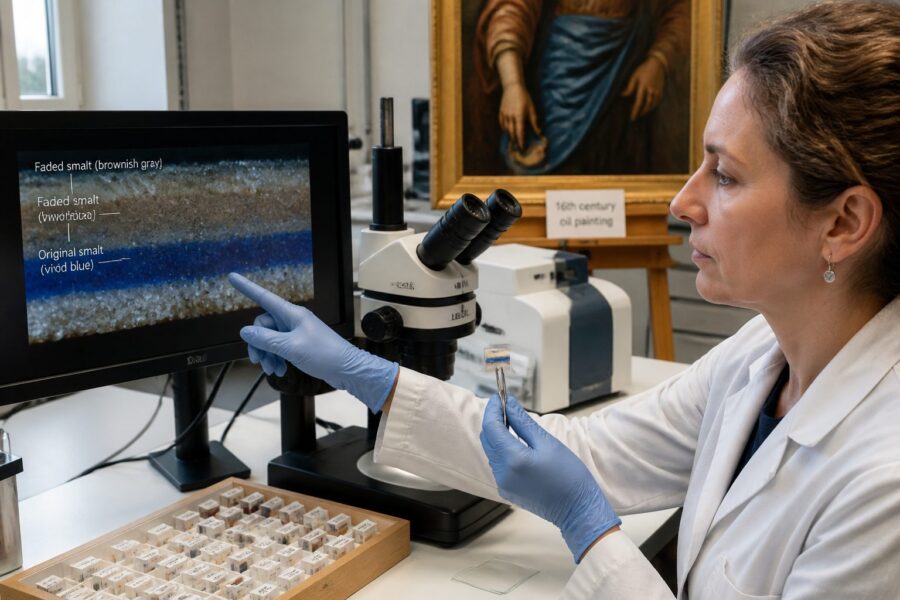
Identifying degraded smalt requires a combination of non-invasive and micro-invasive analytical techniques, allowing conservators to understand the pigment’s composition and condition. These methods go beyond visual inspection to reveal the underlying chemical changes.
Advanced scientific tools help researchers confirm the presence of smalt and characterize its degradation products, even when surface appearance is misleading. This allows for precise diagnosis of smalt degradation 16th century oil paintings analysis.
- X-ray Fluorescence (XRF) Spectroscopy: Detects cobalt and potassium, key elements of smalt, non-destructively.
- Scanning Electron Microscopy-Energy Dispersive X-ray Spectroscopy (SEM-EDS): Provides elemental mapping and morphology of smalt particles in cross-sections.
- Raman Spectroscopy: Identifies molecular vibrations characteristic of glass and its degradation products.
- Fourier-Transform Infrared (FTIR) Spectroscopy: Helps identify the binding medium and any potassium-rich degradation products.
- Micro-X-ray Diffraction (µ-XRD): Reveals the crystalline structure of pigments and any newly formed compounds.
- Cross-sectional Analysis: Physical samples embedded in resin for microscopic examination of paint layers.
- Neutron Activation Analysis (NAA): Highly sensitive for trace elements, confirming cobalt presence.
- Visible Light Reflectance Spectroscopy: Measures color changes and pigment distribution.
Implications for Reconstructing Original Color Intent
The smalt degradation in 16th century oil paintings analysis has profound implications for how we understand and interpret historical artworks. When blues fade to grey, the entire chromatic balance of a painting shifts dramatically.
Artists carefully chose their pigments for specific visual effects, and a faded blue can alter the emotional tone, spatial depth, and narrative emphasis of a work. Reconstructing this original color intent becomes a complex challenge.
Art historians must consider the impact of smalt fading oil paint when studying an artist’s palette or technique. We cannot assume that the current appearance accurately reflects what the artist intended centuries ago.
Digital imaging and scientific analysis offer tools to create virtual reconstructions of original colors, based on what we know about smalt’s initial appearance. These reconstructions help us visualize the lost vibrancy.
However, any reconstruction is still an interpretation, relying on assumptions about the original pigment quality and application. The precise shade of a blue pigment 16th century artists used could vary widely depending on the smalt batch.
This challenge forces us to acknowledge the dynamic nature of artworks, which are not static objects but rather materials that change over time. Our perception of history is directly tied to the physical state of these objects.
Understanding the original context and the material science behind the changes helps us appreciate the artists’ original choices, even if we can only imagine the full impact of their initial brilliance.
Conservation Limitations When Dealing With Faded Smalt Layers
Conservators face significant limitations when dealing with the effects of smalt degradation; reversing the chemical change is currently impossible. Once the cobalt ions migrate, the blue color is lost permanently.
There is no known treatment that can restore the original blue hue to a faded smalt layer without altering the authenticity of the artwork. This presents an ethical dilemma for conservation professionals.
Overpainting or inpainting the faded areas with modern, stable blue pigments would technically restore the color, but it would compromise the integrity of the original paint layer. This goes against core conservation principles.
Therefore, the primary approach involves stabilizing the environment to prevent further smalt fading oil paint. This includes controlling light, humidity, and temperature in museum settings to slow down any ongoing chemical reactions.
Researchers are exploring new avenues, such as nanotechnologies or encapsulation methods, but these are still in experimental stages and years away from practical application on historical artworks. The challenge of the cobalt blue glass pigment degradation remains.
For now, documentation, scientific analysis, and careful environmental control remain the best tools in a conservator’s arsenal. Accepting the altered state of the artwork is often the most respectful approach.
This reality underscores the fragility of artistic materials and the relentless march of time. We learn to appreciate the history of the object, including its changes, rather than trying to freeze it in an impossible original state.
Conclusion
The story of smalt degradation in 16th century oil paintings offers a compelling look at the intersection of art, history, and material science. It reminds us that even the most beautiful creations are subject to the laws of chemistry and time.
From its Renaissance origins as an affordable blue pigment 16th century artists loved, to its eventual transformation into a muted grey, smalt’s journey reflects the dynamic nature of artistic materials. We see how the choice of binding medium profoundly impacts a pigment’s longevity.
The ion migration mechanism, where cobalt ions leach from the glass, is a subtle yet powerful force that has altered countless masterpieces. This chemical process is a silent testament to the ongoing life of a painting.
Through rigorous smalt degradation 16th century oil paintings analysis, scientists and conservators continue to uncover the secrets of this widespread issue. Their work helps us understand not just what happened, but why.
The challenge of smalt fading oil paint impacts our ability to fully appreciate the original aesthetic impact of these works. It forces a re-evaluation of how we perceive historical color palettes and artistic intent.
While reversing the cobalt blue glass pigment degradation remains beyond our current capabilities, ongoing research offers hope for future solutions. For now, careful preservation and scientific documentation are our best defense.
Ultimately, understanding smalt’s fate enriches our appreciation for these historical objects, acknowledging their vulnerability and the complex narratives they carry. It encourages a deeper, more informed engagement with the art of the past.