
Advantages and Limitations of MSI
Like any analytical technique, MSI has its own advantages and limitations. Understanding these factors is crucial for interpreting MSI data and for making informed decisions about its use in art conservation.
One of the main advantages of MSI is its ability to provide spatially resolved information about the chemical composition of a sample. This is particularly valuable for analyzing complex materials like paintings, where the distribution of different compounds can vary significantly across the surface.
- High spatial resolution
- Simultaneous detection of multiple compounds
- Minimal sample preparation required for some techniques (e.g., DESI)
- Ability to analyze a wide range of materials
- Provides insights into degradation processes
Despite its advantages, MSI also has some limitations. The sensitivity of MSI can be limited, particularly for certain types of molecules.
Additionally, MSI data can be complex and challenging to interpret, requiring specialized expertise. The cost of MSI instrumentation and analysis can also be a barrier for some institutions.
The size of the sample that can be analyzed by MSI is also limited. This can be a constraint when dealing with large artworks or objects.
The ionization process used in MSI can sometimes cause fragmentation of the molecules being analyzed. This can make it difficult to identify the original compounds.
The interpretation of MSI data can be affected by matrix effects, which are caused by the interaction between the matrix and the analyte molecules. These effects can be difficult to predict and control.
The availability of reference standards for all of the compounds that may be present in artwork is limited. This can make it difficult to accurately identify unknown compounds.
Future Directions in MSI for Art Conservation
The field of MSI is constantly evolving, with new developments promising to expand its capabilities and applications in art conservation. One area of active research is the development of new ionization techniques that are more sensitive, less destructive, and better suited for analyzing specific types of molecules.
For example, researchers are exploring the use of laser ablation inductively coupled plasma mass spectrometry (LA-ICP-MS) for high-resolution elemental mapping of artwork. This technique can provide detailed information about the distribution of trace elements, which can be useful for provenance studies and for identifying forgeries.
Another area of development is the use of MSI in combination with other analytical techniques, such as Raman spectroscopy and X-ray fluorescence (XRF). By combining data from multiple techniques, conservators can obtain a more comprehensive understanding of the chemical composition and physical properties of artwork.
Furthermore, advances in data processing and visualization are making it easier to interpret MSI data and to generate informative images that can be used to communicate findings to a wider audience. This will help to promote the use of MSI in art conservation and to ensure that its benefits are realized for the preservation of cultural heritage.
The development of more user-friendly MSI instrumentation and software is also a priority. This will make the technique more accessible to a wider range of conservators and scientists.
Research is also focused on developing new matrices that are better suited for analyzing specific types of molecules found in artwork. This will improve the sensitivity and accuracy of MSI analysis.
The use of MSI in preventive conservation is also being explored. This involves using MSI to identify potential threats to artwork before they cause significant damage.
The development of standardized protocols for MSI analysis of artwork is also important. This will ensure that data from different laboratories can be compared and that the results are reliable and reproducible.
Conclusion
Mass spectrometry imaging pigments represents a significant advancement in the field of art conservation, offering a powerful tool for understanding the chemical composition and spatial distribution of materials in artwork. By providing detailed information about the pigments, binding media, and degradation products present, MSI can help conservators to make informed decisions about how to preserve and restore these objects.
While MSI has some limitations, its advantages make it an invaluable technique for a wide range of applications, from the identification of pigments to the evaluation of conservation treatments. As the field of MSI continues to evolve, it is likely to play an increasingly important role in the preservation of cultural heritage for future generations.
The continued development and application of MSI will undoubtedly lead to new discoveries about the materials and techniques used by artists throughout history. This will enhance our understanding and appreciation of cultural heritage.
The collaborative efforts of scientists, conservators, and art historians are essential for realizing the full potential of MSI in art conservation. By working together, these experts can ensure that MSI is used effectively to preserve and protect our cultural heritage for future generations.
The world of art conservation is constantly evolving, with new technologies offering deeper insights into the materials and techniques used by artists throughout history. One such advancement that has revolutionized the field is mass spectrometry imaging, or MSI. This powerful analytical technique allows conservators and scientists to visualize the distribution of pigments and other compounds within a work of art, providing invaluable information for preservation and restoration efforts.
By using mass spectrometry imaging pigments can be identified non-destructively. This approach offers unprecedented detail for spatial analysis and a deeper understanding of an artwork’s composition and history.
Understanding the capabilities and applications of mass spectrometry imaging (MSI) is crucial for anyone involved in the conservation of cultural heritage. This article will explore the principles of MSI, its applications in art conservation, and its advantages and limitations.
Understanding Mass Spectrometry Imaging (MSI)
Mass spectrometry imaging (MSI) is an analytical technique used to determine the spatial distribution of molecules within a sample. Unlike traditional mass spectrometry, which provides information about the overall composition of a sample, MSI retains spatial information, creating a “map” of the molecules present.
The process involves ionizing molecules from the sample surface and then measuring their mass-to-charge ratio. This data is then used to generate an image showing the location and abundance of each molecule.
Several ionization techniques can be used in MSI, each with its own advantages and limitations. Two of the most common techniques are Matrix-Assisted Laser Desorption/Ionization (MALDI) and Desorption Electrospray Ionization (DESI).
MALDI involves applying a matrix to the sample, which helps to ionize the molecules when a laser is applied. DESI, on the other hand, uses a spray of charged droplets to ionize the molecules directly from the surface, making it a gentler, and often non-destructive, method.
MSI is a powerful tool because it provides a visual representation of the molecular composition of a sample. This visual representation is invaluable for understanding complex systems, such as biological tissues or, in our case, works of art.
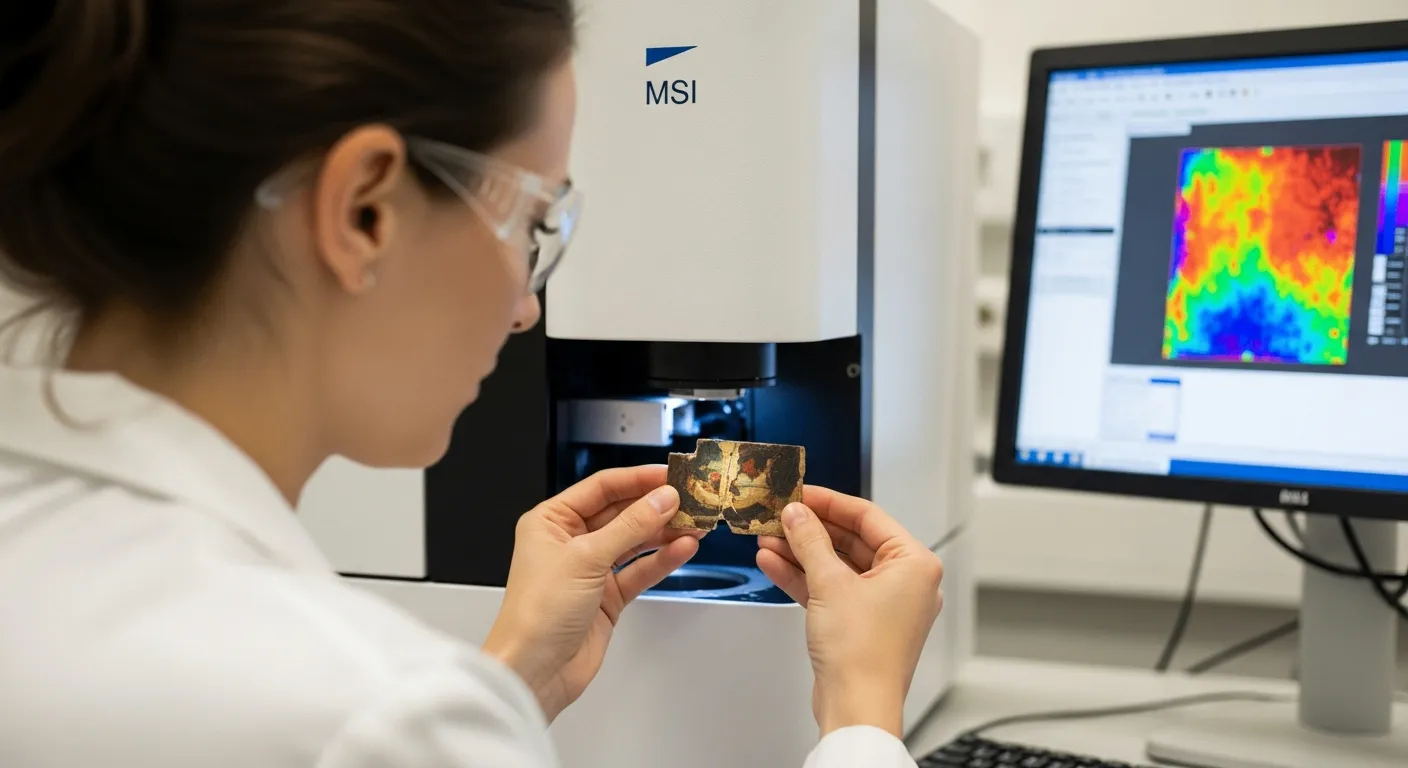
The resulting images from MSI can reveal patterns and relationships that would be difficult or impossible to detect with other analytical techniques. It allows researchers and conservators to see how different molecules are distributed and how they interact with each other.
The mass-to-charge ratio measured in MSI is a fundamental property of each molecule. This allows for the identification of specific compounds based on their unique mass signatures.
The spatial resolution of MSI, which refers to the level of detail that can be visualized, is constantly improving. Newer instruments and techniques are pushing the boundaries of what can be seen, allowing for even more detailed analysis of artworks.
Sample Preparation for MSI Analysis
Proper sample preparation is essential for successful MSI analysis. The specific preparation method depends on the type of sample, the molecules of interest, and the ionization technique being used.
For artwork analysis, the goal is to minimize any damage to the object while still obtaining a representative sample. This often involves taking small samples from areas of damage or loss, or using non-invasive techniques to analyze the surface directly.
For MALDI MSI, the sample is typically coated with a matrix solution. The matrix assists in the ionization process by absorbing the laser energy and transferring it to the analyte molecules.
The choice of matrix is crucial and depends on the type of molecules being analyzed. For pigments, common matrices include sinapinic acid and 2,5-dihydroxybenzoic acid (DHB).
The matrix must be applied evenly and in a way that does not interfere with the analysis. This often involves optimizing the concentration of the matrix solution and the method of application, such as spraying or spotting.
For non-invasive techniques, such as DESI, sample preparation is often minimal or non-existent. This is a significant advantage when dealing with valuable or fragile artworks.
However, even with non-invasive techniques, it is important to ensure that the surface is clean and free of contaminants that could interfere with the analysis. This may involve gentle cleaning with a soft brush or solvent.
In some cases, it may be necessary to embed the sample in a resin before sectioning it for analysis. This provides support for the sample and allows for the creation of thin, uniform sections that can be easily analyzed by MSI.
Mapping Pigment Distribution on Artwork
One of the most powerful applications of MSI in art conservation is mapping the distribution of pigments within a painting or other artwork. This can reveal valuable information about the artist’s technique, the materials used, and any alterations or restorations that have been carried out over time.
By analyzing the spatial distribution of different pigments, conservators can gain insights into how the artist created the image and how the artwork has changed over time. This information can then be used to inform conservation decisions and ensure that the artwork is preserved for future generations.
| Pigment Name | Chemical Composition | Color | MSI Detection |
|---|---|---|---|
| Ultramarine | Na₇Al₆Si₆O₂₄S₃ | Blue | Detection of sulfur and sodium ions |
| Vermilion | HgS | Red | Detection of mercury ions |
| Lead White | 2PbCO₃·Pb(OH)₂ | White | Detection of lead ions |
| Malachite | Cu₂CO₃(OH)₂ | Green | Detection of copper ions |
| Orpiment | As₂S₃ | Yellow | Detection of arsenic and sulfur ions |
MSI can reveal the presence of pigments that are not visible to the naked eye. This can be due to the pigment being present in very small amounts or being covered by other layers of paint.
The distribution maps generated by MSI can show how the artist layered different pigments to create specific colors or effects. This can provide insights into the artist’s working process and their understanding of color theory.
MSI can also be used to identify areas where the original pigments have been altered or degraded over time. This can help conservators to understand the causes of deterioration and to develop strategies for preventing further damage.
By comparing the pigment distribution in different areas of the artwork, conservators can identify areas that have been retouched or restored. This can help to distinguish between the original artwork and later additions.
Identifying Pigment Mixtures and Layering
Artists often mix pigments to create a wider range of colors and effects. MSI can be used to identify these pigment mixtures and to determine the relative proportions of each pigment present.
This information can be particularly useful for understanding the artist’s technique and for identifying areas where the original colors have been altered by degradation or restoration.
In addition to identifying pigment mixtures, MSI can also be used to analyze the layering of pigments in a painting. By analyzing cross-sections of the paint layers, conservators can determine the order in which the pigments were applied and how the different layers interact with each other.
This can provide valuable insights into the artist’s working process and can help to explain the appearance and condition of the painting.
Understanding pigment layering is crucial for accurately interpreting the artist’s intent. The order in which pigments are applied can significantly impact the final appearance of the artwork.
MSI can differentiate between a deliberate pigment mixture and a later addition or alteration. This distinction is vital for making informed conservation decisions.
The identification of pigment mixtures can also help to authenticate artworks. Certain pigment combinations may be characteristic of a particular artist or period.
By analyzing the interfaces between different paint layers, MSI can reveal information about the adhesion and compatibility of the pigments. This can help to predict the long-term stability of the artwork.
Applications of MSI in Art Conservation
MSI has a wide range of applications in art conservation, including the identification of pigments, the detection of degradation products, and the evaluation of conservation treatments. By providing detailed information about the chemical composition and spatial distribution of materials in artwork, MSI can help conservators to make informed decisions about how to preserve and restore these objects.
One important application is the identification of pigments in historical paintings. Knowing the exact pigments used by an artist can provide insights into their techniques, the historical context of the artwork, and potential degradation pathways.
MSI can also be used to detect degradation products, such as those formed by the breakdown of organic binders or the corrosion of metals. Identifying these degradation products can help conservators to understand the causes of deterioration and to develop strategies for preventing further damage.
Furthermore, MSI can be used to evaluate the effectiveness of conservation treatments. By analyzing the chemical composition of the artwork before and after treatment, conservators can determine whether the treatment has been successful in removing harmful substances or in consolidating weakened areas.
MSI can be used to study the effects of environmental factors on artwork degradation. This includes factors such as light, humidity, and air pollution.
The technique can also be applied to the analysis of other types of cultural heritage objects, such as textiles, ceramics, and archaeological artifacts.
MSI can aid in the detection of forgeries by identifying the presence of modern pigments or materials that were not available at the time the artwork was supposedly created.
It allows for the non-destructive analysis of artwork surfaces, preserving the integrity of the object while providing valuable scientific data.
Analyzing Binding Media with MSI
While often applied to pigment analysis, mass spectrometry imaging pigments is also effective for analyzing binding media. Binding media, such as oils, egg tempera, and gums, are essential components of paint that hold the pigment particles together and adhere them to the support.
Identifying the binding media used in a painting can provide valuable information about the artist’s technique and the historical context of the artwork. MSI can be used to identify the different types of organic compounds present in the binding media, such as lipids, proteins, and carbohydrates.
Different binding media have different chemical compositions, which can be used to distinguish between them. For example, oil-based paints contain triglycerides, while egg tempera contains proteins and lipids.
By analyzing the spatial distribution of these compounds, conservators can gain insights into how the artist applied the paint and how the binding media has degraded over time. This can be particularly useful for understanding the condition of the painting and for developing appropriate conservation treatments.
The degradation of binding media can lead to cracking, flaking, and other forms of deterioration. MSI can help to identify the specific degradation products that are present, providing clues about the causes of deterioration.
MSI can also be used to study the interactions between the binding media and the pigments. This can help to understand how the binding media affects the color and stability of the pigments.
The identification of binding media can also provide information about the provenance of the artwork. Certain binding media were more commonly used in certain regions or during certain periods.
By analyzing the distribution of binding media, conservators can gain insights into the artist’s brushwork and painting technique. This can help to understand how the artist created the image and how they manipulated the paint.
Evaluating Conservation Treatments with MSI
MSI is a valuable tool for evaluating the effectiveness of conservation treatments applied to artwork. Conservation treatments aim to stabilize the artwork, remove harmful substances, or consolidate weakened areas.
MSI can be used to assess whether these treatments have been successful and whether they have had any unintended consequences. Before a treatment is applied, MSI can be used to map the distribution of pigments, binding media, and degradation products within the artwork.
After the treatment, MSI can be used to reassess the distribution of these compounds and to determine whether the treatment has achieved its intended goals. For example, if a treatment is intended to remove a surface coating, MSI can be used to verify that the coating has been completely removed and that no residues remain.
Similarly, if a treatment is intended to consolidate a weakened area, MSI can be used to assess whether the consolidant has penetrated the paint layers and has effectively strengthened the area. This helps to ensure that the treatment is effective and does not cause any further damage to the artwork.
MSI can also be used to monitor the long-term effects of conservation treatments. This can help to identify any potential problems that may arise over time, such as the degradation of the treatment materials.
The technique can be used to assess the compatibility of different conservation materials with the artwork. This is important to ensure that the treatment does not cause any further damage or deterioration.
MSI can help to optimize conservation treatments by providing detailed information about the distribution of treatment materials within the artwork. This can help to ensure that the treatment is applied effectively and efficiently.
It allows conservators to make evidence-based decisions about conservation treatments, rather than relying solely on visual inspection or intuition.
Advantages and Limitations of MSI
Like any analytical technique, MSI has its own advantages and limitations. Understanding these factors is crucial for interpreting MSI data and for making informed decisions about its use in art conservation.
One of the main advantages of MSI is its ability to provide spatially resolved information about the chemical composition of a sample. This is particularly valuable for analyzing complex materials like paintings, where the distribution of different compounds can vary significantly across the surface.
- High spatial resolution
- Simultaneous detection of multiple compounds
- Minimal sample preparation required for some techniques (e.g., DESI)
- Ability to analyze a wide range of materials
- Provides insights into degradation processes
Despite its advantages, MSI also has some limitations. The sensitivity of MSI can be limited, particularly for certain types of molecules.
Additionally, MSI data can be complex and challenging to interpret, requiring specialized expertise. The cost of MSI instrumentation and analysis can also be a barrier for some institutions.
The size of the sample that can be analyzed by MSI is also limited. This can be a constraint when dealing with large artworks or objects.
The ionization process used in MSI can sometimes cause fragmentation of the molecules being analyzed. This can make it difficult to identify the original compounds.
The interpretation of MSI data can be affected by matrix effects, which are caused by the interaction between the matrix and the analyte molecules. These effects can be difficult to predict and control.
The availability of reference standards for all of the compounds that may be present in artwork is limited. This can make it difficult to accurately identify unknown compounds.
Future Directions in MSI for Art Conservation
The field of MSI is constantly evolving, with new developments promising to expand its capabilities and applications in art conservation. One area of active research is the development of new ionization techniques that are more sensitive, less destructive, and better suited for analyzing specific types of molecules.
For example, researchers are exploring the use of laser ablation inductively coupled plasma mass spectrometry (LA-ICP-MS) for high-resolution elemental mapping of artwork. This technique can provide detailed information about the distribution of trace elements, which can be useful for provenance studies and for identifying forgeries.
Another area of development is the use of MSI in combination with other analytical techniques, such as Raman spectroscopy and X-ray fluorescence (XRF). By combining data from multiple techniques, conservators can obtain a more comprehensive understanding of the chemical composition and physical properties of artwork.
Furthermore, advances in data processing and visualization are making it easier to interpret MSI data and to generate informative images that can be used to communicate findings to a wider audience. This will help to promote the use of MSI in art conservation and to ensure that its benefits are realized for the preservation of cultural heritage.
The development of more user-friendly MSI instrumentation and software is also a priority. This will make the technique more accessible to a wider range of conservators and scientists.
Research is also focused on developing new matrices that are better suited for analyzing specific types of molecules found in artwork. This will improve the sensitivity and accuracy of MSI analysis.
The use of MSI in preventive conservation is also being explored. This involves using MSI to identify potential threats to artwork before they cause significant damage.
The development of standardized protocols for MSI analysis of artwork is also important. This will ensure that data from different laboratories can be compared and that the results are reliable and reproducible.
Conclusion
Mass spectrometry imaging pigments represents a significant advancement in the field of art conservation, offering a powerful tool for understanding the chemical composition and spatial distribution of materials in artwork. By providing detailed information about the pigments, binding media, and degradation products present, MSI can help conservators to make informed decisions about how to preserve and restore these objects.
While MSI has some limitations, its advantages make it an invaluable technique for a wide range of applications, from the identification of pigments to the evaluation of conservation treatments. As the field of MSI continues to evolve, it is likely to play an increasingly important role in the preservation of cultural heritage for future generations.
The continued development and application of MSI will undoubtedly lead to new discoveries about the materials and techniques used by artists throughout history. This will enhance our understanding and appreciation of cultural heritage.
The collaborative efforts of scientists, conservators, and art historians are essential for realizing the full potential of MSI in art conservation. By working together, these experts can ensure that MSI is used effectively to preserve and protect our cultural heritage for future generations.