
Case Study: A Specific Piece of Antique Painted Furniture
To illustrate the complexities of painted furniture conservation, let’s consider the case of a 18th-century painted chest from Bavaria. This particular piece features intricate floral motifs and scenes of pastoral life, rendered in a variety of pigments including lead white, vermilion, and azurite. The chest had suffered significant damage over the years, including flaking paint, surface grime, and structural instability, making it a prime candidate for painted furniture conservation.
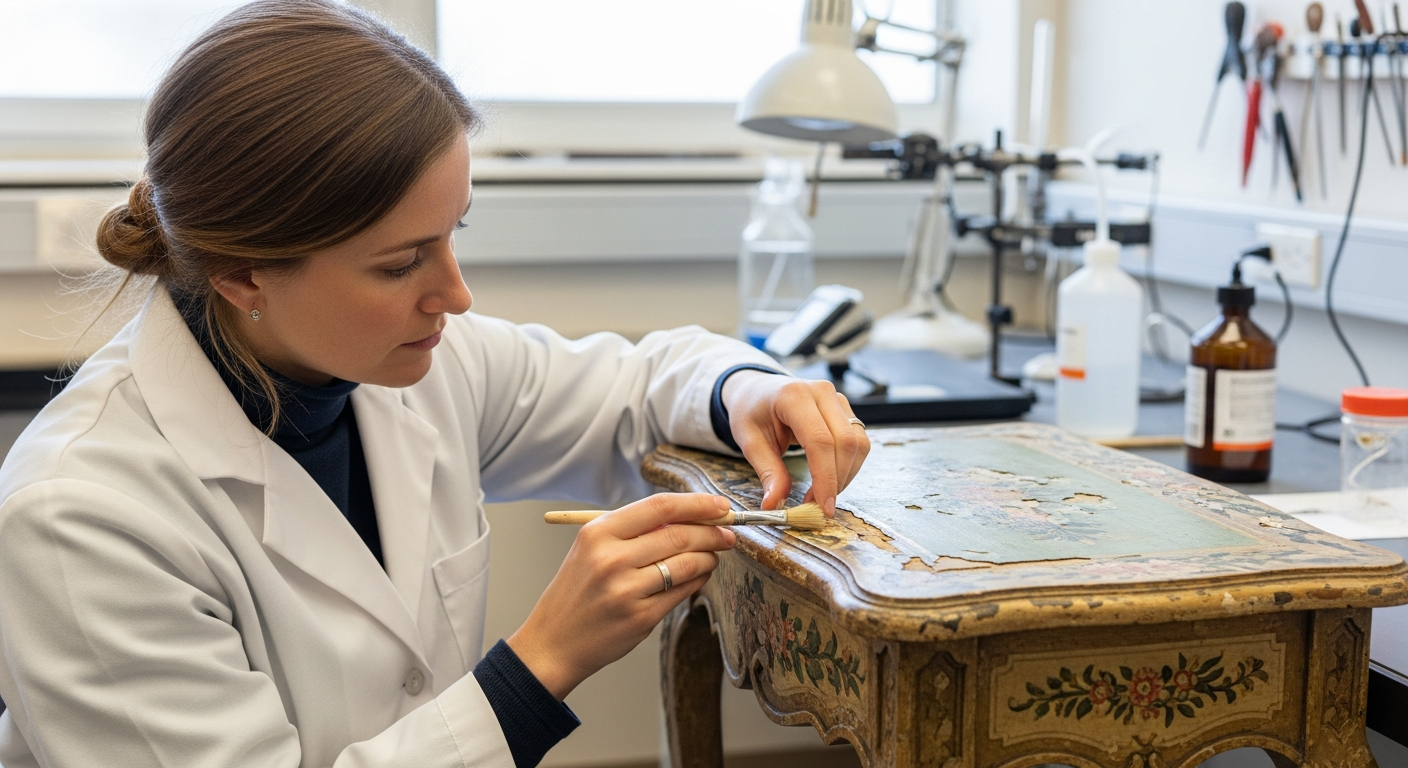
The initial assessment revealed that the lead white pigment had darkened due to exposure to sulfur-containing pollutants, while the vermilion had faded in areas exposed to direct sunlight. The azurite pigment, known for its instability, had also undergone some degree of alteration, resulting in a dulling of its original vibrant blue color. This case highlights the importance of understanding the specific vulnerabilities of antique pigments.
Further examination revealed that the chest had been revarnished several times, resulting in a thick, discolored layer that obscured the original paint surface. This varnish layer not only detracted from the aesthetic appeal of the piece but also posed a challenge for cleaning and consolidation. Removing the varnish without damaging the underlying paint required careful testing and the use of appropriate solvents, all while conserving pigments in painted furniture.
In addition to the pigment and surface issues, the chest also exhibited structural problems, including loose joints and warping of the wooden panels. These structural issues had to be addressed before any conservation treatment could be applied to the painted surface, ensuring the long-term stability of the piece. This comprehensive approach is vital for successful painted furniture conservation.
Assessing Pigment Degradation and Surface Condition
A thorough assessment of pigment degradation and surface condition is a critical first step in any painted furniture conservation project. This assessment involves a combination of visual examination, scientific analysis, and documentation to determine the extent and nature of the damage. The goal is to gather as much information as possible about the materials, techniques, and condition of the painted surface before any treatment is undertaken, aiding in conserving pigments in painted furniture.
Visual examination involves a careful inspection of the painted surface under different lighting conditions to identify areas of flaking, cracking, fading, or discoloration. This examination can also reveal the presence of surface grime, old varnish layers, and previous repairs. A detailed photographic record is essential to document the condition of the piece before, during, and after conservation, allowing for a clear understanding of the changes that occur throughout the process of painted furniture conservation.
| Assessment Technique | Purpose | Example |
|---|---|---|
| Visual Examination | Identify surface damage and alterations | Documenting flaking paint and varnish layers |
| Microscopy | Examine pigment structure and layer composition | Identifying pigment particle size and distribution |
| X-ray Fluorescence (XRF) | Determine elemental composition of pigments | Identifying lead, mercury, or copper-based pigments |
| Fourier Transform Infrared Spectroscopy (FTIR) | Identify organic materials like binders and varnishes | Analyzing the composition of varnish layers |
| Colorimetry | Measure color changes and fading | Quantifying the degree of color loss in specific areas |
Scientific analysis plays a crucial role in identifying the specific pigments and binding media used in the painted surface. Techniques such as X-ray fluorescence (XRF) and Fourier transform infrared spectroscopy (FTIR) can provide valuable information about the elemental and molecular composition of the materials. This information is essential for understanding the causes of pigment degradation and for selecting appropriate conservation treatments, especially when conserving pigments in painted furniture.
Cleaning and Consolidation Techniques for Painted Surfaces
Once the assessment is complete, the next step in painted furniture conservation is cleaning and consolidation. Cleaning involves the removal of surface grime, dust, and discolored varnish layers, while consolidation aims to stabilize flaking or powdery paint layers. Both of these processes require careful consideration of the materials and techniques used to avoid further damage to the painted surface, making it a delicate part of conserving pigments in painted furniture.
Cleaning is typically carried out using a combination of mechanical and chemical methods. Mechanical cleaning involves the use of soft brushes, cotton swabs, and scalpels to gently remove loose dirt and debris. Chemical cleaning involves the use of solvents or solvent mixtures to dissolve and remove surface coatings such as varnish. The choice of solvent depends on the nature of the coating and the sensitivity of the underlying paint layer, with conservators often opting for the least aggressive solvent that will effectively remove the grime.
Consolidation is the process of stabilizing flaking or powdery paint layers to prevent further loss. This is typically achieved by applying a consolidant, which is a dilute adhesive that penetrates the paint layer and binds the loose particles together. The choice of consolidant depends on the type of paint and the extent of the damage, with conservators often using synthetic resins or protein-based adhesives. These materials are carefully selected to ensure compatibility with the original pigments and binding media, aiding in painted furniture conservation.
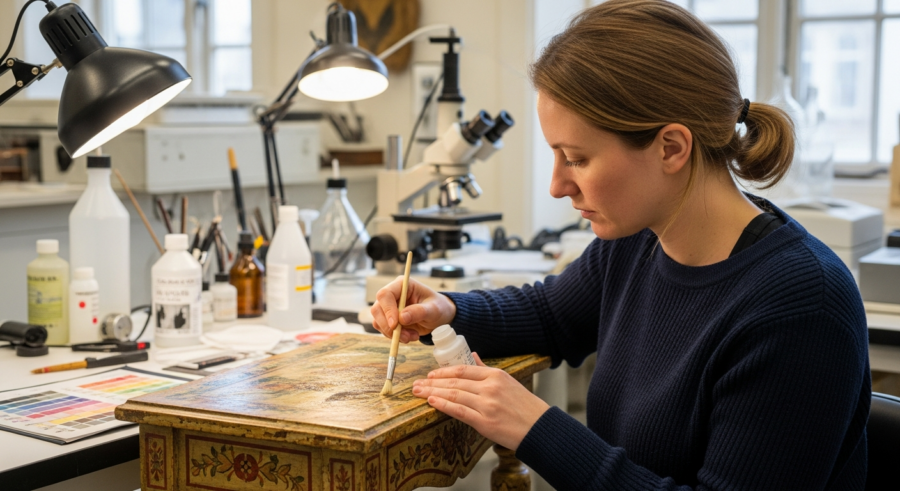
The application of the consolidant is a delicate process that requires careful control to avoid over-saturation or alteration of the paint surface. Conservators often use fine brushes or syringes to apply the consolidant in small amounts, allowing it to penetrate the paint layer slowly and evenly. The consolidated area is then gently pressed or weighted to ensure good contact between the paint and the substrate, ensuring the stabilization of antique pigments.
Retouching and Protective Coatings
After cleaning and consolidation, retouching and the application of protective coatings are often necessary to complete the conservation treatment. Retouching involves the careful application of paint to fill in losses or correct areas of discoloration, while protective coatings provide a barrier against future damage. These steps are crucial for preserving the aesthetic integrity of the piece while conserving pigments in painted furniture.
Retouching is typically carried out using pigments that are similar in composition and appearance to the original paints. Conservators often use reversible paints, such as watercolors or acrylics, to allow for future removal or adjustment if necessary. The goal of retouching is not to create a perfect replica of the original paint surface but rather to visually integrate the losses and create a cohesive appearance, aiding in painted furniture conservation.
The application of protective coatings is intended to provide a barrier against environmental factors such as light, humidity, and pollutants. These coatings can also help to reduce the risk of abrasion or scratching during handling and display. Conservators often use synthetic varnishes or waxes that are specifically formulated for use on painted surfaces, ensuring compatibility with the original pigments and binding media, which is vital for conserving pigments in painted furniture.
The choice of protective coating depends on the type of paint and the intended use of the furniture. For example, a piece of furniture that is frequently handled may require a more durable coating than a piece that is displayed in a museum setting. The application of the coating is carefully controlled to ensure an even, thin layer that does not alter the appearance of the painted surface.
Ethical Considerations in Furniture Conservation
Ethical considerations play a central role in the field of furniture conservation, guiding conservators in their decision-making process. The primary ethical principle is to preserve the authenticity and historical integrity of the object while minimizing any intervention that could alter its original character. This requires a careful balance between the desire to restore the piece to its former glory and the responsibility to respect its age and history, especially when conserving pigments in painted furniture.
One of the key ethical considerations is the principle of reversibility, which states that any conservation treatment should be reversible whenever possible. This allows future conservators to undo or modify the treatment if necessary, without causing further damage to the object. The use of reversible materials and techniques is essential for ensuring the long-term preservation of antique furniture, playing a key role in painted furniture conservation.
- Respect the original materials and techniques
- Minimize intervention to preserve authenticity
- Use reversible materials and methods
- Document all treatments thoroughly
- Consult with experts and stakeholders
Another important ethical consideration is the principle of documentation, which requires conservators to keep a detailed record of all treatments performed on the object. This documentation should include photographs, written reports, and analytical data that describe the condition of the object before, during, and after conservation. Thorough documentation ensures that future conservators have access to the information they need to understand the history of the object and make informed decisions about its care, contributing to painted furniture conservation.
The Role of Chemical Analysis in Pigment Conservation
Chemical analysis is an indispensable tool in the conservation of historical pigments, providing crucial information about their composition, degradation mechanisms, and interaction with the surrounding materials. By employing various analytical techniques, conservators can gain a deeper understanding of the pigments and make informed decisions about their preservation. This scientific approach is essential for the long-term survival of these valuable artifacts, especially when conserving pigments in painted furniture.
One of the primary roles of chemical analysis is to identify the specific pigments used in a work of art or historical object. This information is essential for understanding the original appearance of the object and for selecting appropriate conservation treatments. Techniques such as X-ray fluorescence (XRF), Raman spectroscopy, and gas chromatography-mass spectrometry (GC-MS) can provide detailed information about the elemental and molecular composition of the pigments, allowing conservators to accurately identify them.
Chemical analysis also plays a crucial role in understanding the degradation mechanisms of historical pigments. Many pigments are unstable and prone to deterioration when exposed to light, humidity, or pollutants. By studying the chemical changes that occur in these pigments over time, conservators can develop strategies to slow down or prevent their degradation. This proactive approach is essential for ensuring the long-term preservation of historical pigments, a key aspect of painted furniture conservation.
Furthermore, chemical analysis can help conservators assess the compatibility of different conservation materials and treatments. The use of inappropriate materials or techniques can sometimes cause further damage to historical pigments. By analyzing the interaction between the pigments and the conservation materials, conservators can select the most appropriate and least harmful treatments, aiding in conserving pigments in painted furniture.
Preventive Measures for Long-Term Preservation
While conservation treatments can help to stabilize and restore damaged painted furniture, preventive measures are essential for ensuring their long-term preservation. By controlling environmental conditions, handling practices, and display methods, we can minimize the risk of future damage and extend the lifespan of these valuable cultural artifacts. These proactive steps are vital for painted furniture conservation.
One of the most important preventive measures is to control the environmental conditions in which the furniture is stored or displayed. Fluctuations in temperature and humidity can cause the wood to expand and contract, leading to cracking and delamination of the painted surface. High levels of light, especially ultraviolet (UV) radiation, can cause pigments to fade or discolor. Maintaining stable temperature and humidity levels, as well as minimizing exposure to light, can significantly reduce the rate of deterioration, helping with conserving pigments in painted furniture.
Proper handling practices are also essential for preventing damage to painted furniture. Furniture should be lifted and carried rather than dragged or pushed, to avoid scratching or abrading the painted surface. When moving furniture, it is important to use padding or blankets to protect it from bumps and collisions. Training staff and visitors on proper handling techniques can help to minimize the risk of accidental damage, aiding in painted furniture conservation.
Display methods can also play a role in the long-term preservation of painted furniture. Furniture should be placed away from direct sunlight and sources of heat or moisture. The use of barriers or covers can help to protect the furniture from dust and other pollutants. Regular cleaning with soft brushes and cloths can remove surface grime and prevent it from becoming ingrained in the painted surface, contributing to conserving pigments in painted furniture.
The Impact of Technology on Pigment Analysis
Technological advancements have revolutionized the field of pigment analysis, providing conservators with increasingly sophisticated tools to study and understand historical pigments. These technologies enable more accurate identification, characterization, and monitoring of pigments, leading to more effective conservation strategies. The integration of technology is crucial for the future of painted furniture conservation.
One of the most significant technological advancements is the development of non-destructive analytical techniques, such as X-ray fluorescence (XRF) and Raman spectroscopy. These techniques allow conservators to analyze the composition of pigments without having to take samples, minimizing the risk of damage to the object. Non-destructive analysis is particularly valuable for fragile or rare objects where sampling is not possible, aiding in conserving pigments in painted furniture.
Another important technological development is the use of digital imaging and image processing techniques. Digital photography and microscopy allow conservators to capture high-resolution images of painted surfaces, revealing details that are not visible to the naked eye. Image processing techniques can be used to enhance these images, making it easier to identify areas of damage or discoloration, playing a key role in painted furniture conservation.
Furthermore, computer modeling and simulation are increasingly being used to study the behavior of pigments and conservation materials. These models can help conservators predict how pigments will respond to different environmental conditions or conservation treatments, allowing them to make more informed decisions. The use of technology is transforming the field of pigment analysis and conservation, leading to more effective and sustainable preservation strategies, especially when conserving pigments in painted furniture.
Conclusion
The conservation of pigments in painted furniture is a complex and multifaceted endeavor that requires a deep understanding of art history, materials science, and conservation ethics. By combining scientific analysis, skilled craftsmanship, and ethical considerations, conservators can ensure that these valuable cultural artifacts are preserved for future generations. These skills are essential for painted furniture conservation.
As technology continues to advance and our understanding of pigment degradation mechanisms deepens, we can expect to see even more effective and sustainable conservation strategies emerge. The ongoing commitment to research, education, and collaboration within the conservation community will be essential for meeting the challenges of preserving our painted furniture heritage, continuing the important work of conserving pigments in painted furniture.
The realm of antique painted furniture offers a captivating glimpse into history and artistry. These pieces, adorned with delicate brushstrokes and carefully chosen hues, provide invaluable insights into past cultures, aesthetics, and craftsmanship. However, the passage of time inevitably takes its toll, leading to pigment degradation and structural damage that threaten the integrity of these irreplaceable artifacts. This is where the meticulous work of conserving pigments in painted furniture becomes not just important, but essential.
Conserving these pieces requires a deep understanding of both the materials used and the historical context in which they were created. By employing advanced analytical techniques and conservation methods, we can ensure that these cultural treasures endure for generations to come. This article will explore the challenges, techniques, and ethical considerations involved in painted furniture conservation, with a focus on conserving pigments in painted furniture.
From assessing pigment degradation to applying protective coatings, each step in the conservation process demands precision and care. The goal is to preserve the original beauty and historical significance of these decorative arts, while also respecting their inherent fragility. We aim to delve into the fascinating world of antique pigments and the methods used to safeguard them.
The Challenges of Conserving Pigments on Painted Furniture
Conserving pigments on painted furniture presents a unique set of challenges that conservators must carefully navigate. The materials used in antique furniture, such as wood, gesso, and various types of paint, all react differently to environmental changes and conservation treatments. This differential response can lead to cracking, flaking, and fading of the painted surfaces, making the process of painted furniture conservation very complex.
One of the primary challenges is identifying the specific pigments used in a piece of furniture. Many historical pigments are unstable and prone to degradation when exposed to light, humidity, or pollutants. Knowing the exact composition of the pigments helps conservators choose appropriate cleaning and consolidation methods that will minimize further damage while conserving pigments in painted furniture.
Another significant hurdle is the presence of multiple layers of paint or varnish, which can complicate the conservation process. Over time, furniture may have been repainted or revarnished, obscuring the original decoration and making it difficult to access and treat the underlying layers. Removing these later additions without harming the original paint requires skill and precision, especially when conserving pigments in painted furniture.
Furthermore, the structural condition of the furniture itself can pose additional challenges. Warping, cracking, or insect damage can compromise the stability of the painted surface, making it more vulnerable to deterioration. Addressing these structural issues is often a necessary first step before any conservation treatment can be applied to the pigments, ensuring a holistic approach to painted furniture conservation.
Case Study: A Specific Piece of Antique Painted Furniture
To illustrate the complexities of painted furniture conservation, let’s consider the case of a 18th-century painted chest from Bavaria. This particular piece features intricate floral motifs and scenes of pastoral life, rendered in a variety of pigments including lead white, vermilion, and azurite. The chest had suffered significant damage over the years, including flaking paint, surface grime, and structural instability, making it a prime candidate for painted furniture conservation.
The initial assessment revealed that the lead white pigment had darkened due to exposure to sulfur-containing pollutants, while the vermilion had faded in areas exposed to direct sunlight. The azurite pigment, known for its instability, had also undergone some degree of alteration, resulting in a dulling of its original vibrant blue color. This case highlights the importance of understanding the specific vulnerabilities of antique pigments.
Further examination revealed that the chest had been revarnished several times, resulting in a thick, discolored layer that obscured the original paint surface. This varnish layer not only detracted from the aesthetic appeal of the piece but also posed a challenge for cleaning and consolidation. Removing the varnish without damaging the underlying paint required careful testing and the use of appropriate solvents, all while conserving pigments in painted furniture.
In addition to the pigment and surface issues, the chest also exhibited structural problems, including loose joints and warping of the wooden panels. These structural issues had to be addressed before any conservation treatment could be applied to the painted surface, ensuring the long-term stability of the piece. This comprehensive approach is vital for successful painted furniture conservation.
Assessing Pigment Degradation and Surface Condition
A thorough assessment of pigment degradation and surface condition is a critical first step in any painted furniture conservation project. This assessment involves a combination of visual examination, scientific analysis, and documentation to determine the extent and nature of the damage. The goal is to gather as much information as possible about the materials, techniques, and condition of the painted surface before any treatment is undertaken, aiding in conserving pigments in painted furniture.
Visual examination involves a careful inspection of the painted surface under different lighting conditions to identify areas of flaking, cracking, fading, or discoloration. This examination can also reveal the presence of surface grime, old varnish layers, and previous repairs. A detailed photographic record is essential to document the condition of the piece before, during, and after conservation, allowing for a clear understanding of the changes that occur throughout the process of painted furniture conservation.
| Assessment Technique | Purpose | Example |
|---|---|---|
| Visual Examination | Identify surface damage and alterations | Documenting flaking paint and varnish layers |
| Microscopy | Examine pigment structure and layer composition | Identifying pigment particle size and distribution |
| X-ray Fluorescence (XRF) | Determine elemental composition of pigments | Identifying lead, mercury, or copper-based pigments |
| Fourier Transform Infrared Spectroscopy (FTIR) | Identify organic materials like binders and varnishes | Analyzing the composition of varnish layers |
| Colorimetry | Measure color changes and fading | Quantifying the degree of color loss in specific areas |
Scientific analysis plays a crucial role in identifying the specific pigments and binding media used in the painted surface. Techniques such as X-ray fluorescence (XRF) and Fourier transform infrared spectroscopy (FTIR) can provide valuable information about the elemental and molecular composition of the materials. This information is essential for understanding the causes of pigment degradation and for selecting appropriate conservation treatments, especially when conserving pigments in painted furniture.
Cleaning and Consolidation Techniques for Painted Surfaces
Once the assessment is complete, the next step in painted furniture conservation is cleaning and consolidation. Cleaning involves the removal of surface grime, dust, and discolored varnish layers, while consolidation aims to stabilize flaking or powdery paint layers. Both of these processes require careful consideration of the materials and techniques used to avoid further damage to the painted surface, making it a delicate part of conserving pigments in painted furniture.
Cleaning is typically carried out using a combination of mechanical and chemical methods. Mechanical cleaning involves the use of soft brushes, cotton swabs, and scalpels to gently remove loose dirt and debris. Chemical cleaning involves the use of solvents or solvent mixtures to dissolve and remove surface coatings such as varnish. The choice of solvent depends on the nature of the coating and the sensitivity of the underlying paint layer, with conservators often opting for the least aggressive solvent that will effectively remove the grime.
Consolidation is the process of stabilizing flaking or powdery paint layers to prevent further loss. This is typically achieved by applying a consolidant, which is a dilute adhesive that penetrates the paint layer and binds the loose particles together. The choice of consolidant depends on the type of paint and the extent of the damage, with conservators often using synthetic resins or protein-based adhesives. These materials are carefully selected to ensure compatibility with the original pigments and binding media, aiding in painted furniture conservation.
The application of the consolidant is a delicate process that requires careful control to avoid over-saturation or alteration of the paint surface. Conservators often use fine brushes or syringes to apply the consolidant in small amounts, allowing it to penetrate the paint layer slowly and evenly. The consolidated area is then gently pressed or weighted to ensure good contact between the paint and the substrate, ensuring the stabilization of antique pigments.
Retouching and Protective Coatings
After cleaning and consolidation, retouching and the application of protective coatings are often necessary to complete the conservation treatment. Retouching involves the careful application of paint to fill in losses or correct areas of discoloration, while protective coatings provide a barrier against future damage. These steps are crucial for preserving the aesthetic integrity of the piece while conserving pigments in painted furniture.
Retouching is typically carried out using pigments that are similar in composition and appearance to the original paints. Conservators often use reversible paints, such as watercolors or acrylics, to allow for future removal or adjustment if necessary. The goal of retouching is not to create a perfect replica of the original paint surface but rather to visually integrate the losses and create a cohesive appearance, aiding in painted furniture conservation.
The application of protective coatings is intended to provide a barrier against environmental factors such as light, humidity, and pollutants. These coatings can also help to reduce the risk of abrasion or scratching during handling and display. Conservators often use synthetic varnishes or waxes that are specifically formulated for use on painted surfaces, ensuring compatibility with the original pigments and binding media, which is vital for conserving pigments in painted furniture.
The choice of protective coating depends on the type of paint and the intended use of the furniture. For example, a piece of furniture that is frequently handled may require a more durable coating than a piece that is displayed in a museum setting. The application of the coating is carefully controlled to ensure an even, thin layer that does not alter the appearance of the painted surface.
Ethical Considerations in Furniture Conservation
Ethical considerations play a central role in the field of furniture conservation, guiding conservators in their decision-making process. The primary ethical principle is to preserve the authenticity and historical integrity of the object while minimizing any intervention that could alter its original character. This requires a careful balance between the desire to restore the piece to its former glory and the responsibility to respect its age and history, especially when conserving pigments in painted furniture.
One of the key ethical considerations is the principle of reversibility, which states that any conservation treatment should be reversible whenever possible. This allows future conservators to undo or modify the treatment if necessary, without causing further damage to the object. The use of reversible materials and techniques is essential for ensuring the long-term preservation of antique furniture, playing a key role in painted furniture conservation.
- Respect the original materials and techniques
- Minimize intervention to preserve authenticity
- Use reversible materials and methods
- Document all treatments thoroughly
- Consult with experts and stakeholders
Another important ethical consideration is the principle of documentation, which requires conservators to keep a detailed record of all treatments performed on the object. This documentation should include photographs, written reports, and analytical data that describe the condition of the object before, during, and after conservation. Thorough documentation ensures that future conservators have access to the information they need to understand the history of the object and make informed decisions about its care, contributing to painted furniture conservation.
The Role of Chemical Analysis in Pigment Conservation
Chemical analysis is an indispensable tool in the conservation of historical pigments, providing crucial information about their composition, degradation mechanisms, and interaction with the surrounding materials. By employing various analytical techniques, conservators can gain a deeper understanding of the pigments and make informed decisions about their preservation. This scientific approach is essential for the long-term survival of these valuable artifacts, especially when conserving pigments in painted furniture.
One of the primary roles of chemical analysis is to identify the specific pigments used in a work of art or historical object. This information is essential for understanding the original appearance of the object and for selecting appropriate conservation treatments. Techniques such as X-ray fluorescence (XRF), Raman spectroscopy, and gas chromatography-mass spectrometry (GC-MS) can provide detailed information about the elemental and molecular composition of the pigments, allowing conservators to accurately identify them.
Chemical analysis also plays a crucial role in understanding the degradation mechanisms of historical pigments. Many pigments are unstable and prone to deterioration when exposed to light, humidity, or pollutants. By studying the chemical changes that occur in these pigments over time, conservators can develop strategies to slow down or prevent their degradation. This proactive approach is essential for ensuring the long-term preservation of historical pigments, a key aspect of painted furniture conservation.
Furthermore, chemical analysis can help conservators assess the compatibility of different conservation materials and treatments. The use of inappropriate materials or techniques can sometimes cause further damage to historical pigments. By analyzing the interaction between the pigments and the conservation materials, conservators can select the most appropriate and least harmful treatments, aiding in conserving pigments in painted furniture.
Preventive Measures for Long-Term Preservation
While conservation treatments can help to stabilize and restore damaged painted furniture, preventive measures are essential for ensuring their long-term preservation. By controlling environmental conditions, handling practices, and display methods, we can minimize the risk of future damage and extend the lifespan of these valuable cultural artifacts. These proactive steps are vital for painted furniture conservation.
One of the most important preventive measures is to control the environmental conditions in which the furniture is stored or displayed. Fluctuations in temperature and humidity can cause the wood to expand and contract, leading to cracking and delamination of the painted surface. High levels of light, especially ultraviolet (UV) radiation, can cause pigments to fade or discolor. Maintaining stable temperature and humidity levels, as well as minimizing exposure to light, can significantly reduce the rate of deterioration, helping with conserving pigments in painted furniture.
Proper handling practices are also essential for preventing damage to painted furniture. Furniture should be lifted and carried rather than dragged or pushed, to avoid scratching or abrading the painted surface. When moving furniture, it is important to use padding or blankets to protect it from bumps and collisions. Training staff and visitors on proper handling techniques can help to minimize the risk of accidental damage, aiding in painted furniture conservation.
Display methods can also play a role in the long-term preservation of painted furniture. Furniture should be placed away from direct sunlight and sources of heat or moisture. The use of barriers or covers can help to protect the furniture from dust and other pollutants. Regular cleaning with soft brushes and cloths can remove surface grime and prevent it from becoming ingrained in the painted surface, contributing to conserving pigments in painted furniture.
The Impact of Technology on Pigment Analysis
Technological advancements have revolutionized the field of pigment analysis, providing conservators with increasingly sophisticated tools to study and understand historical pigments. These technologies enable more accurate identification, characterization, and monitoring of pigments, leading to more effective conservation strategies. The integration of technology is crucial for the future of painted furniture conservation.
One of the most significant technological advancements is the development of non-destructive analytical techniques, such as X-ray fluorescence (XRF) and Raman spectroscopy. These techniques allow conservators to analyze the composition of pigments without having to take samples, minimizing the risk of damage to the object. Non-destructive analysis is particularly valuable for fragile or rare objects where sampling is not possible, aiding in conserving pigments in painted furniture.
Another important technological development is the use of digital imaging and image processing techniques. Digital photography and microscopy allow conservators to capture high-resolution images of painted surfaces, revealing details that are not visible to the naked eye. Image processing techniques can be used to enhance these images, making it easier to identify areas of damage or discoloration, playing a key role in painted furniture conservation.
Furthermore, computer modeling and simulation are increasingly being used to study the behavior of pigments and conservation materials. These models can help conservators predict how pigments will respond to different environmental conditions or conservation treatments, allowing them to make more informed decisions. The use of technology is transforming the field of pigment analysis and conservation, leading to more effective and sustainable preservation strategies, especially when conserving pigments in painted furniture.
Conclusion
The conservation of pigments in painted furniture is a complex and multifaceted endeavor that requires a deep understanding of art history, materials science, and conservation ethics. By combining scientific analysis, skilled craftsmanship, and ethical considerations, conservators can ensure that these valuable cultural artifacts are preserved for future generations. These skills are essential for painted furniture conservation.
As technology continues to advance and our understanding of pigment degradation mechanisms deepens, we can expect to see even more effective and sustainable conservation strategies emerge. The ongoing commitment to research, education, and collaboration within the conservation community will be essential for meeting the challenges of preserving our painted furniture heritage, continuing the important work of conserving pigments in painted furniture.