
Ancient Roman mosaics are captivating works of art, offering a glimpse into the past. The intricate designs and vivid colors have fascinated historians and art enthusiasts for centuries.
But beyond their aesthetic appeal, these mosaics hold a wealth of information about the materials and techniques used by Roman artists. Analyzing Pigments in Roman Mosaics can unlock secrets about their creation, origin, and the society that produced them.
This article will explore the world of analyzing pigments in Roman mosaics, uncovering the history, methods, and significance of this fascinating field. From understanding the historical context to tackling conservation challenges, we will explore how pigment analysis contributes to our understanding of ancient Roman art.
Historical Context of Roman Mosaics and Artistic Techniques
Mosaics emerged as a popular art form in the Roman world, adorning floors, walls, and ceilings of both public and private spaces. Their widespread use reflects the Roman Empire’s wealth, artistic innovation, and cultural exchange.
The earliest Roman mosaics, dating back to the 3rd century BC, were simple pebble pavements with basic geometric patterns. Over time, mosaic techniques evolved, incorporating smaller, more precisely cut pieces called tesserae.
These tesserae, made from materials like stone, glass, and ceramic, allowed for increasingly complex and detailed designs. Roman artists skillfully arranged tesserae to create stunning images, ranging from mythological scenes and portraits to geometric patterns and everyday life depictions.
The creation of Roman mosaics was a labor-intensive process, requiring skilled artisans and specialized workshops. The process began with preparing the surface, laying a mortar bed, and then carefully setting the tesserae into the mortar.
Artists meticulously selected and arranged tesserae to achieve the desired color, tone, and visual effect. The use of color was a crucial element in Roman mosaics, with artists employing a wide range of pigments to create realistic and expressive images.
The mosaic tradition was adopted from the Greeks, but the Romans expanded its use dramatically. They used mosaics to decorate not only floors but also walls, ceilings, and even fountains.
This widespread adoption speaks to the Roman appreciation for art and their desire to showcase their wealth and power. Mosaics became a symbol of Roman civilization, found throughout the vast empire, from Britain to North Africa.
The subjects depicted in Roman mosaics provide valuable insights into Roman culture and beliefs. Mythological scenes were common, reflecting the importance of Roman religion and mythology.
Scenes of everyday life, such as hunting, fishing, and agricultural activities, offer glimpses into the daily routines and occupations of the Roman people. Portraits of emperors, senators, and other prominent figures served as symbols of power and authority.
Geometric patterns, often intricate and elaborate, were used to create decorative borders and backgrounds. These patterns reflect the Roman fascination with order and symmetry.
The development of opus sectile, a technique using larger, shaped pieces of colored stone or marble, further expanded the artistic possibilities. This allowed for even more detailed and naturalistic representations.
The use of glass tesserae, particularly in wall mosaics, added brilliance and luminosity to the artwork. Glass tesserae could be produced in a wider range of colors than stone, allowing for greater artistic expression.
Skilled artisans, often working in specialized workshops, were responsible for creating these masterpieces. These workshops likely employed a hierarchy of workers, with master mosaicists overseeing the design and execution of the artwork.
The creation of a mosaic was a collaborative effort, involving the skills of stonecutters, glassmakers, and mortar specialists. The success of a mosaic depended on the coordination and expertise of all these individuals.
The legacy of Roman mosaics continues to inspire artists and craftspeople today. Their enduring beauty and historical significance make them a valuable part of our cultural heritage.
Methods for Analyzing Pigments in Mosaic Tesserae
Analyzing Pigments in Roman Mosaics involves a range of scientific techniques, each offering unique insights into the composition and properties of the materials. Non-destructive methods are favored to preserve the integrity of these fragile artworks.
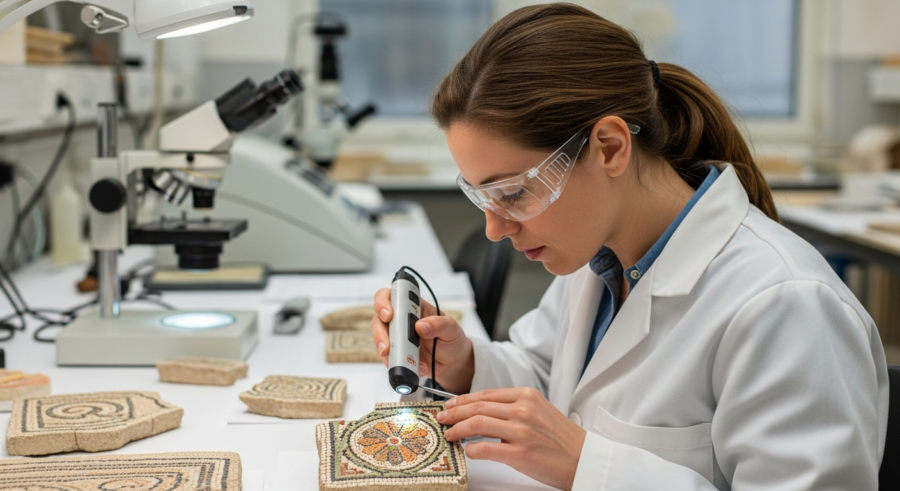
Microscopy, including optical and electron microscopy, allows researchers to examine the surface and cross-sections of tesserae at high magnification. This can reveal the texture, layering, and distribution of pigments within the material.
Spectroscopic techniques, such as X-ray fluorescence (XRF) and Raman spectroscopy, are used to identify the elemental composition and molecular structure of pigments. XRF is particularly useful for determining the presence of metallic elements, while Raman spectroscopy provides information about the chemical bonds and crystalline phases of the pigments.
Another valuable technique is X-ray diffraction (XRD), which helps identify the crystalline compounds present in the tesserae. XRD can reveal the specific minerals used as pigments, such as hematite for red or azurite for blue.
In some cases, small samples may be taken for more detailed analysis using techniques like gas chromatography-mass spectrometry (GC-MS). GC-MS is used to identify organic components, such as binders or additives, that may have been used in the mosaic’s creation.
Optical microscopy is often the first step in pigment analysis, providing a visual overview of the tesserae. Different types of microscopy, such as polarized light microscopy, can reveal information about the crystalline structure of the pigments.
Electron microscopy, including scanning electron microscopy (SEM) and transmission electron microscopy (TEM), offers much higher magnification capabilities. SEM can be used to image the surface of tesserae at the nanoscale, while TEM can be used to examine the internal structure of pigments.
X-ray fluorescence (XRF) is a non-destructive technique that can be used to identify the elemental composition of a material. It works by bombarding the sample with X-rays and measuring the energy of the emitted fluorescent X-rays.
Each element emits X-rays at a characteristic energy, allowing researchers to identify the elements present in the sample. XRF is particularly useful for identifying metallic elements, such as iron, copper, and lead, which are common components of pigments.
Raman spectroscopy is another non-destructive technique that provides information about the molecular structure of pigments. It works by shining a laser beam on the sample and measuring the Raman scattering of the light.
The Raman spectrum is a unique fingerprint of the molecules present in the sample, allowing researchers to identify the pigments. Raman spectroscopy is particularly useful for identifying organic pigments and for distinguishing between different crystalline forms of the same pigment.
X-ray diffraction (XRD) is a technique that provides information about the crystalline structure of materials. It works by bombarding the sample with X-rays and measuring the diffraction pattern of the X-rays.
The diffraction pattern is unique to each crystalline compound, allowing researchers to identify the minerals present in the sample. XRD is particularly useful for identifying the minerals used as pigments in Roman mosaics, such as hematite, azurite, and malachite.
Gas chromatography-mass spectrometry (GC-MS) is a destructive technique that can be used to identify organic components in a sample. It involves separating the different organic compounds in the sample using gas chromatography and then identifying them using mass spectrometry.
GC-MS is particularly useful for identifying binders, additives, and other organic materials that may have been used in the creation of the mosaic. These materials can provide valuable information about the techniques and materials used by Roman artists.
The choice of analytical technique depends on the specific research question and the nature of the sample. Researchers often use a combination of techniques to obtain a comprehensive understanding of the pigments used in Roman mosaics.
Identifying the Mineral Sources and Production of Pigments
Understanding the mineral sources of Roman Mosaic Pigments provides valuable information about trade routes, technological capabilities, and artistic choices. Many of the pigments used in Roman mosaics were derived from naturally occurring minerals.
Red pigments, for example, were often obtained from hematite, an iron oxide mineral found in many parts of the Roman Empire. Blue pigments could be derived from azurite, a copper carbonate mineral, or Egyptian blue, a synthetic pigment produced by heating silica, copper, and calcium compounds.
| Pigment Color | Primary Mineral Source | Geographic Origin |
|---|---|---|
| Red | Hematite, Cinnabar | Spain, Italy, North Africa |
| Yellow | Goethite, Jarosite | Germany, France, Egypt |
| Blue | Azurite, Egyptian Blue | Cyprus, Egypt, Italy |
| Green | Malachite, Celadonite | Greece, Cyprus, Spain |
| White | Calcite, Chalk | Italy, Greece, Britain |
| Black | Carbon, Magnetite | Italy, Spain, Germany |
The geographic origin of pigments can reveal trade networks and the extent of the Roman Empire’s reach. Some pigments were sourced locally, while others were imported from distant lands.
The use of imported pigments indicates the Roman desire for high-quality materials and their ability to transport goods across vast distances. The trade in pigments contributed to the economic prosperity of the Roman Empire.
The production of synthetic pigments, such as Egyptian blue, required specialized knowledge and technology. The Romans developed sophisticated techniques for producing these pigments, demonstrating their advanced understanding of chemistry and materials science.
The availability of different pigments varied over time, reflecting changes in trade routes and technological capabilities. The analysis of pigments in Roman mosaics can provide insights into these historical changes.
For instance, the decline in the use of Egyptian blue after the Roman period may reflect the loss of the knowledge and technology required to produce it. The rise of new pigments, such as ultramarine (derived from lapis lazuli), reflects the discovery of new sources of materials and the development of new trade routes.
The cost of pigments also influenced their use in Roman mosaics. Rare and expensive pigments, such as Tyrian purple (derived from sea snails), were typically reserved for the most important or luxurious mosaics.
More common and affordable pigments were used for less prestigious projects. The choice of pigments reflects the social status and economic resources of the patrons who commissioned the mosaics.
The study of pigment sources and production also sheds light on the environmental impact of Roman art. The mining and processing of minerals could have significant environmental consequences, such as deforestation, soil erosion, and water pollution.
The Romans were aware of these environmental impacts and took steps to mitigate them, such as implementing regulations to control mining activities. However, the environmental impact of pigment production remains an important area of research.
By understanding the mineral sources and production of pigments, we can gain a deeper appreciation for the complexity and sophistication of Roman art. The pigments used in Roman mosaics were not simply colors; they were products of trade, technology, and environmental impact.
Understanding the Use of Color and Composition in Roman Mosaics
The use of color and composition in Roman mosaics was highly deliberate, reflecting artistic conventions, cultural values, and the intended function of the artwork. Roman artists carefully selected and arranged tesserae to create specific visual effects and convey particular meanings.
Color was used to create depth, highlight details, and evoke emotions. For example, warm colors like red and yellow might be used to depict fire or passion, while cool colors like blue and green could represent water or tranquility.
The composition of Roman mosaics often followed established artistic principles, such as symmetry, balance, and perspective. Geometric patterns were frequently used to create borders, backgrounds, or decorative elements.
Figurative scenes, such as mythological narratives or portraits, were carefully arranged to draw the viewer’s eye and tell a story. The placement of figures, the use of light and shadow, and the choice of colors all contributed to the overall impact of the mosaic.
The function of the mosaic also influenced its color and composition. Floor mosaics, for example, often featured durable materials and simple designs that could withstand heavy foot traffic, while wall mosaics might incorporate more delicate materials and complex imagery.
The choice of colors in Roman mosaics was not arbitrary; it was often dictated by symbolic associations and cultural conventions. Certain colors were associated with specific deities, virtues, or social classes.
For example, purple was associated with royalty and power, while white symbolized purity and innocence. The use of these colors in mosaics conveyed specific messages to the viewer.
The composition of Roman mosaics also reflected the principles of Roman architecture and design. Mosaics were often integrated into the overall architectural scheme of a building, complementing the other decorative elements.
The placement of mosaics was carefully considered to maximize their visual impact and to create a harmonious aesthetic effect. The use of perspective in Roman mosaics was often sophisticated, creating a sense of depth and realism.
Roman artists employed various techniques to create the illusion of three-dimensionality, such as shading, foreshortening, and atmospheric perspective. These techniques added to the visual richness and complexity of the mosaics.
The study of color and composition in Roman mosaics can provide insights into the artistic preferences and cultural values of the Roman people. It can also reveal the influence of other cultures, such as Greek and Egyptian, on Roman art.
The analysis of the subject matter depicted in Roman mosaics can shed light on the beliefs, myths, and social practices of the Roman world. Mosaics provide a valuable window into the lives and minds of the people who created and viewed them.
The preservation of Roman mosaics is essential for understanding the artistic and cultural heritage of the Roman Empire. Conservation efforts are needed to protect these fragile artworks from deterioration and damage.
By studying the use of color and composition in Roman mosaics, we can gain a deeper appreciation for the skill and artistry of the Roman mosaicists. Their creations continue to inspire and captivate audiences today.
Conservation Challenges and Preservation Strategies
Roman mosaics face numerous conservation challenges, including deterioration of materials, environmental damage, and human interference. The fragility of the tesserae and the mortar that holds them together makes mosaics particularly vulnerable to damage.
Environmental factors, such as temperature fluctuations, humidity, and exposure to sunlight, can cause the tesserae to crack, fade, or detach from the mortar. Air pollution and acid rain can also corrode the surface of the mosaic, leading to loss of detail and color.
- Protective shelters and roofing
- Controlled humidity and temperature
- Regular cleaning with appropriate materials
- Consolidation of loose or damaged tesserae
- Re-laying mosaics on new, stable supports
- Protective barriers to prevent physical damage
Human interference, such as vandalism, theft, and improper restoration, can also damage Roman mosaics. The removal of tesserae for souvenirs or the use of inappropriate cleaning methods can cause irreversible damage.
The conservation of Roman mosaics requires a multidisciplinary approach, involving archaeologists, conservators, scientists, and engineers. A thorough understanding of the materials, techniques, and history of the mosaic is essential for developing effective conservation strategies.
Preventive conservation measures are crucial for minimizing the risk of damage to Roman mosaics. These measures include providing protective shelters, controlling humidity and temperature, and implementing regular cleaning programs.
Consolidation of loose or damaged tesserae is a common conservation treatment. This involves using adhesives to reattach the tesserae to the mortar bed and to stabilize the mosaic structure.
Re-laying mosaics on new, stable supports may be necessary in cases where the original mortar bed is severely deteriorated. This involves carefully removing the mosaic from its original location and transferring it to a new support structure.
The choice of conservation materials and techniques must be carefully considered to ensure that they are compatible with the original materials and that they do not cause further damage. Conservation treatments should be reversible whenever possible, allowing for future interventions if necessary.
Documentation is an essential part of the conservation process. Detailed records should be kept of all conservation treatments, including photographs, drawings, and analytical data.
This documentation provides a valuable resource for future conservators and researchers. Public education and outreach are also important for promoting the preservation of Roman mosaics.
Raising awareness of the importance of these artworks can help prevent vandalism and encourage responsible tourism. Collaboration between different stakeholders, such as government agencies, museums, and local communities, is essential for the successful conservation of Roman mosaics.
The long-term preservation of Roman mosaics requires a commitment to ongoing monitoring, maintenance, and research. Regular inspections should be conducted to identify any signs of deterioration or damage.
Research is needed to develop new and improved conservation techniques. By investing in the conservation of Roman mosaics, we can ensure that these treasures of the past are preserved for future generations.
The Role of Pigment Analysis in Dating and Authenticating Mosaics
Pigment analysis plays a crucial role in dating and authenticating Roman mosaics, providing valuable evidence about their origin and historical context. The identification of specific pigments can help determine the age of a mosaic.
Some pigments, such as Egyptian blue, were only produced during certain periods, while others became more widely available over time. The presence of certain pigments can therefore provide a terminus post quem (earliest possible date) or a terminus ante quem (latest possible date) for the mosaic’s creation.
Pigment analysis can also help authenticate mosaics by comparing the materials and techniques used with those known to be typical of a particular period or region. The use of unusual or anachronistic pigments may raise doubts about the mosaic’s authenticity.
For example, the presence of modern synthetic pigments in a mosaic claimed to be ancient would indicate that it is a forgery or a later restoration. Pigment analysis can also help determine whether a mosaic has been altered or restored in the past.
By identifying the pigments used in different sections of the mosaic, researchers can distinguish between original and restored areas. This information is essential for understanding the mosaic’s history and for making informed conservation decisions.
The dating of Roman mosaics is often based on a combination of archaeological evidence, stylistic analysis, and pigment analysis. Archaeological context provides valuable information about the date of the site where the mosaic was found.
Stylistic analysis involves comparing the mosaic’s design, composition, and iconography with those of other dated mosaics. Pigment analysis provides independent evidence that can support or challenge the conclusions based on archaeological and stylistic analysis.
The authentication of Roman mosaics is particularly important in the art market, where forgeries and altered mosaics can command high prices. Pigment analysis can help detect these forgeries and ensure that buyers are purchasing genuine artifacts.
The use of modern analytical techniques has made it increasingly difficult to create convincing forgeries of Roman mosaics. However, skilled forgers may attempt to use authentic pigments or to alter the pigments in existing mosaics to make them appear older.
Therefore, it is essential to use a combination of analytical techniques and expert judgment to authenticate Roman mosaics. Pigment analysis can also be used to study the provenance of Roman mosaics, tracing their history from their original creation to their present location.
By identifying the pigments used in a mosaic and comparing them with those found in other mosaics from the same region, researchers can gain insights into the movement of artists, materials, and ideas across the Roman Empire.
The study of pigment use in Roman mosaics can also contribute to our understanding of the development of artistic techniques over time. By analyzing the pigments used in mosaics from different periods, researchers can track the evolution of pigment production, trade, and application.
This information can help us understand how Roman artists adapted to changing economic, social, and technological conditions. The role of pigment analysis in dating and authenticating mosaics is therefore crucial for preserving the integrity of our cultural heritage.
Case Studies: Notable Examples of Pigment Analysis in Mosaic Research
Several case studies demonstrate the power of pigment analysis in advancing our understanding of Roman mosaics. One notable example is the analysis of mosaics from Pompeii and Herculaneum, which were preserved by the eruption of Mount Vesuvius in 79 AD.
Pigment analysis of these mosaics has revealed the wide range of materials and techniques used by Roman artists in the 1st century AD. Researchers have identified pigments such as Egyptian blue, red ochre, and yellow goethite, providing insights into the availability and use of these materials at the time.
Another important case study is the analysis of mosaics from Roman villas in North Africa, such as those at Volubilis in Morocco and Thysdrus in Tunisia. These mosaics often feature complex geometric patterns and depictions of mythological scenes, providing valuable information about Roman art and culture in the region.
Pigment analysis has helped identify the sources of the pigments used in these mosaics, revealing trade connections between North Africa and other parts of the Roman Empire. Researchers have also used pigment analysis to study the evolution of mosaic techniques in North Africa over time.
The Great Hunt mosaic in Piazza Armerina, Sicily, is another compelling case. Analyzing Pigments in Roman Mosaics from this site has offered insights into the scale of production and the artistic preferences of the era.
The mosaics of Zeugma, a Roman city in present-day Turkey, provide another fascinating case study. Pigment analysis has been used to study the pigments used in these mosaics, revealing the use of a wide range of materials, including Egyptian blue, red ochre, and yellow goethite.
The analysis has also revealed the presence of rare and expensive pigments, such as cinnabar (mercury sulfide), which was used to create vibrant red colors. This suggests that the patrons who commissioned these mosaics were wealthy and sophisticated.
The mosaics from Fishbourne Roman Palace in England have also been the subject of pigment analysis. This analysis has revealed the use of a limited range of pigments, suggesting that the artists who created these mosaics had access to fewer materials than their counterparts in other parts of the Roman Empire.
The study of these mosaics has also provided insights into the techniques used to create them, such as the use of opus sectile (large, shaped pieces of colored stone) to create complex designs. The mosaics from the Villa Romana del Casale in Sicily are another important case study.
Pigment analysis has been used to study the pigments used in these mosaics, revealing the use of a wide range of materials, including Egyptian blue, red ochre, yellow goethite, and green earth.
The analysis has also revealed the presence of organic pigments, such as madder (derived from the roots of the madder plant), which were used to create pink and purple colors. This suggests that the Roman artists who created these mosaics were skilled in the use of both mineral and organic pigments.
These case studies demonstrate the value of pigment analysis in providing insights into the materials, techniques, and cultural context of Roman mosaics. By studying the pigments used in these artworks, researchers can gain a deeper understanding of the Roman world.
The continued application of pigment analysis to Roman mosaics will undoubtedly yield further discoveries and insights in the years to come. This research is essential for preserving and interpreting these valuable treasures of the past.
Future Directions and Emerging Technologies in Pigment Analysis
The field of pigment analysis is constantly evolving, with new technologies and approaches emerging that promise to further enhance our understanding of Roman mosaics. One promising area is the development of more portable and non-invasive analytical techniques.
Portable XRF and Raman spectrometers, for example, allow researchers to analyze pigments directly on-site, without the need to remove samples from the mosaic. This reduces the risk of damage and allows for more rapid and comprehensive analysis.
Another exciting development is the use of hyperspectral imaging, which captures a wide range of spectral data across the entire surface of the mosaic. Hyperspectral imaging can reveal subtle variations in pigment composition and distribution that are not visible to the naked eye.
This technique can be used to identify areas of restoration, map the distribution of different pigments, and create detailed visualizations of the mosaic’s surface. Machine learning algorithms are also being used to analyze pigment data, allowing researchers to identify patterns and relationships that might otherwise be missed.
These algorithms can be trained to recognize specific pigments, classify different types of tesserae, and even predict the original appearance of damaged or faded mosaics. As technology advances, the possibilities for pigment analysis in mosaic research are endless.
The development of new and improved analytical techniques is crucial for advancing our understanding of Roman mosaics. Researchers are constantly working to develop more sensitive, accurate, and non-invasive methods for analyzing pigments.
One promising area of research is the use of advanced spectroscopic techniques, such as synchrotron-based X-ray techniques, to study the chemical composition and structure of pigments at the atomic level. These techniques can provide unprecedented insights into the nature of pigments and their interactions with the surrounding materials.
Another important area of research is the development of new methods for analyzing organic pigments. Organic pigments are often more difficult to identify than inorganic pigments, due to their complex chemical structures and their tendency to degrade over time.
Researchers are exploring the use of advanced analytical techniques, such as liquid chromatography-mass spectrometry (LC-MS), to identify and characterize organic pigments in Roman mosaics. The application of artificial intelligence (AI) and machine learning (ML) is also transforming the field of pigment analysis.
AI and ML algorithms can be trained to analyze large datasets of pigment data and to identify patterns and relationships that would be difficult or impossible for humans to detect. These algorithms can be used to automate the process of pigment identification, to predict the provenance of mosaics, and to assess the effectiveness of conservation treatments.
The integration of different types of data, such as pigment data, archaeological data, and historical data, is another important trend in mosaic research. By combining these different sources of information, researchers can gain a more comprehensive understanding of Roman mosaics and their cultural context.
The development of new databases and online resources is also facilitating the sharing of information and collaboration among researchers. These resources provide a valuable platform for disseminating research findings and for promoting the study of Roman mosaics.
The future of pigment analysis in mosaic research is bright. As technology continues to advance and new approaches are developed, we can expect to gain even deeper insights into the materials, techniques, and cultural context of Roman mosaics.
Conclusion
Analyzing Pigments in Roman Mosaics is a powerful tool for unlocking the secrets of these ancient artworks. By combining scientific analysis with historical and artistic knowledge, researchers can gain a deeper understanding of the materials, techniques, and cultural context of Roman mosaics.
From identifying the mineral sources of pigments to dating and authenticating mosaics, pigment analysis provides valuable insights into the creation, preservation, and interpretation of these fascinating artifacts. As technology continues to evolve, the field of pigment analysis promises to play an even greater role in our understanding of ancient Roman art and culture.