
The world of art holds endless mysteries, especially when we turn our attention to the art of the past. Analyzing Pigments in Indigenous Australian Rock Art offers a unique window into the beliefs, practices, and daily lives of ancient peoples. Through the meticulous analysis of pigments, we can uncover not only the materials used but also gain insights into the cultural exchange and environmental knowledge of these early artists.
Modern scientific techniques are now being employed to unravel the secrets held within these ancient artworks. This article explores the fascinating intersection of archaeology and chemistry, focusing on how pigment analysis contributes to our understanding of Indigenous Australian rock art.
We will examine the methods used for sampling and analyzing these pigments, the challenges involved, and the ethical considerations that guide this important work. Join us as we journey into the world of Analyzing Pigments in Indigenous Australian Rock Art, where science and art converge to tell stories of the past.
Background of Indigenous Australian Rock Art and Cultural Significance
Indigenous Australian rock art represents one of the oldest continuous artistic traditions in the world, dating back tens of thousands of years. These artworks, found across the continent, provide invaluable insights into the cultural, social, and spiritual lives of Aboriginal and Torres Strait Islander peoples.
The art encompasses a diverse range of styles, motifs, and techniques, reflecting the unique environments and cultural practices of different regions. From the dynamic figures of the Bradshaw (Gwion Gwion) paintings in the Kimberley to the iconic X-ray art of Arnhem Land, each region boasts its distinctive artistic expression.
Rock art sites often hold deep spiritual significance, serving as places for ceremonies, storytelling, and the transmission of knowledge across generations. These sites are not merely galleries of ancient art but are living cultural landscapes that continue to hold meaning for Indigenous communities today.
The motifs depicted in the art range from human and animal figures to abstract symbols and representations of ancestral beings. These images often convey complex narratives, reflecting the interconnectedness of the natural world, the spirit realm, and human society.
Understanding the context of Indigenous Australian rock art is crucial to appreciating its depth and complexity. It is essential to recognize that these artworks are not simply decorative or aesthetic objects. They are powerful expressions of cultural identity, spiritual beliefs, and historical narratives.
The creation of rock art was often a communal activity, involving multiple individuals and reflecting shared knowledge and experiences. The art served as a means of reinforcing social bonds, transmitting cultural values, and maintaining connections to the land.
Many rock art sites are located in remote and inaccessible areas, reflecting the importance of these places as sacred sites and refuges. The act of traveling to these sites and creating art was often a pilgrimage, requiring physical endurance and spiritual preparation.
The study of rock art provides a unique opportunity to learn about the past from the perspective of Indigenous Australians. It allows us to hear their voices, understand their worldview, and appreciate their enduring connection to the land.
The preservation of rock art sites is essential for protecting this valuable cultural heritage. It requires a collaborative effort between Indigenous communities, archaeologists, and government agencies to ensure that these sites are managed sustainably and protected from damage and destruction.
The stories told through rock art offer profound lessons about resilience, adaptation, and the importance of living in harmony with the natural world. By studying and appreciating this art, we can gain a deeper understanding of ourselves and our place in the world.
Rock art serves as a powerful reminder of the enduring legacy of Indigenous Australians and their contributions to human history. It is a testament to their creativity, ingenuity, and deep connection to the land.
The study of these ancient artworks allows us to connect with the past in a tangible and meaningful way. It fosters a sense of respect and appreciation for the cultural heritage of Indigenous Australians.
Indigenous Australian rock art is a vital part of the nation’s identity and a treasure for all humanity. Its preservation and study are essential for ensuring that its stories continue to be told for generations to come.
Methods for Sampling and Analyzing Pigments in Rock Art
Analyzing Pigments in Indigenous Australian Rock Art requires a delicate balance between scientific rigor and cultural sensitivity. The sampling process must be carefully planned to minimize damage to the artwork while ensuring the collection of representative samples for analysis.
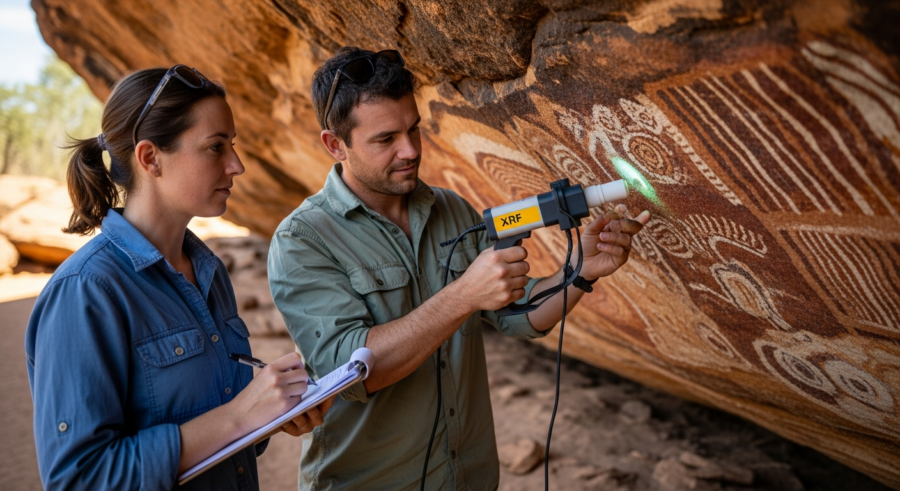
Non-destructive techniques are always preferred, but in some cases, micro-sampling may be necessary to obtain sufficient material for analysis. These samples are typically minute, often less than a milligram, and are taken from areas that are already damaged or where the pigment is flaking.
A variety of analytical techniques are used to characterize the pigments, including X-ray diffraction (XRD), Raman spectroscopy, and scanning electron microscopy with energy-dispersive X-ray spectroscopy (SEM-EDS). XRD is used to identify the crystalline structure of minerals, while Raman spectroscopy provides information about the molecular composition of the pigments.
SEM-EDS allows for the elemental analysis of the pigments, revealing the presence of various metals and other elements. These techniques, often used in combination, provide a comprehensive understanding of the pigment composition.
Before any sampling takes place, a thorough visual inspection of the rock art panel is conducted. This involves documenting the condition of the art, identifying areas of damage or deterioration, and mapping the distribution of different pigments.
Photography and digital imaging techniques are used to create a detailed record of the rock art panel. This provides a baseline for future monitoring and allows researchers to track any changes in the condition of the art over time.
When micro-sampling is necessary, it is typically carried out using a sterile scalpel or a fine needle. The samples are carefully collected and stored in airtight containers to prevent contamination.
The location of each sample is meticulously documented, including its precise coordinates and its relationship to specific motifs or features of the rock art. This ensures that the analytical data can be accurately linked back to the original artwork.
In addition to the techniques mentioned earlier, other analytical methods such as inductively coupled plasma mass spectrometry (ICP-MS) may be used to determine the trace element composition of the pigments. This can provide further information about the sources of the pigments and the techniques used to process them.
The data obtained from the pigment analysis is carefully analyzed and interpreted in the context of other archaeological and ethnographic evidence. This allows researchers to develop a more comprehensive understanding of the rock art and its cultural significance.
The results of the pigment analysis are typically presented in a report that includes detailed descriptions of the analytical methods, the data obtained, and the interpretations drawn from the data. This report is shared with Indigenous communities and other stakeholders to ensure that the research is transparent and accessible.
The ongoing development of new analytical techniques is constantly improving our ability to study rock art pigments with greater precision and accuracy. This is leading to new discoveries and a deeper understanding of the past.
The ethical considerations surrounding rock art analysis are constantly evolving, reflecting the growing awareness of the importance of Indigenous cultural heritage. Researchers are increasingly working in partnership with Indigenous communities to ensure that research is conducted in a way that respects their rights and interests.
The future of rock art analysis lies in collaborative research that integrates scientific expertise with Indigenous knowledge and cultural perspectives. This will lead to a more holistic and nuanced understanding of these ancient artworks.
Common Pigments Found in Australian Rock Art
The palette of pigments used in Australian rock art reflects the diverse geology of the continent. Red and yellow ochres, derived from iron oxides such as hematite and goethite, are among the most commonly found pigments.
White pigments are often made from kaolin clay or gypsum, while black pigments can be derived from charcoal, manganese oxides, or even certain types of iron oxides. The specific minerals and their relative abundance can provide clues about the sources of the pigments and the techniques used to process them.
| Pigment Color | Common Mineral Composition | Geological Source |
|---|---|---|
| Red | Hematite (Fe2O3) | Iron-rich soils and rocks |
| Yellow | Goethite (FeO(OH)) | Weathered iron-rich deposits |
| White | Kaolinite (Al2Si2O5(OH)4) | Clay deposits |
| Black | Charcoal (C) | Burnt wood or organic matter |
| Black | Manganese oxides (MnO2) | Manganese-rich rocks |
| Purple | Lepidocrocite (FeO(OH)) | Weathered iron deposits |
The use of red ochre is particularly significant in Indigenous Australian culture, often associated with blood, life force, and spiritual power. It is used not only in rock art but also in body painting, ceremonial objects, and burial rituals.
Yellow ochre is another common pigment, often used to depict animals, human figures, and abstract designs. Its warm, earthy tones create a sense of depth and texture in the artwork.
White pigments are often used to highlight certain features of the rock art or to create contrasts with the darker pigments. They can also be used to create a sense of luminescence or spirituality.
Black pigments are often used to outline figures, create shadows, or depict specific objects or symbols. The use of charcoal as a pigment provides a direct link to the natural environment and the practice of fire management.
The availability of different pigments varied across different regions of Australia, reflecting the diverse geology of the continent. This led to regional variations in the palette of pigments used in rock art.
The process of preparing pigments often involved grinding, mixing, and heating the raw materials. This required specialized knowledge and skills, which were often passed down through generations.
The use of binders, such as plant resins or animal fats, was essential for ensuring that the pigments adhered to the rock surface. The selection of specific binders was often based on their availability, their adhesive properties, and their cultural significance.
The study of pigment use can provide insights into the technological skills and artistic practices of Indigenous Australian societies. It reveals their deep understanding of the natural world and their ability to transform raw materials into powerful forms of cultural expression.
The preservation of rock art pigments is essential for maintaining the integrity of these ancient artworks. Conservation efforts must focus on protecting the pigments from weathering, erosion, and other forms of damage.
The ongoing research into rock art pigments is constantly expanding our knowledge of the materials used and the techniques employed by Indigenous Australian artists. This is leading to a deeper appreciation of their artistic achievements and their cultural heritage.
Identifying the Mineral and Organic Components of the Pigments
Identifying the mineral and organic components of rock art pigments is crucial for understanding the materials used by ancient artists. Mineral analysis, as described earlier, focuses on identifying the inorganic compounds present in the pigments.
However, organic materials also play a significant role in rock art, often acting as binders or extenders for the pigments. These organic components can include plant resins, beeswax, blood, and other animal products.
Gas chromatography-mass spectrometry (GC-MS) is a powerful technique for identifying these organic compounds. By separating the different molecules in a sample and then identifying them based on their mass-to-charge ratio, GC-MS can reveal the presence of specific plant resins or animal fats.
Infrared spectroscopy (FTIR) is another valuable tool for identifying organic materials. FTIR measures the absorption of infrared light by a sample, providing information about the types of chemical bonds present. This can help to distinguish between different types of organic binders and identify specific plant or animal sources.
The identification of organic components can be particularly challenging due to their low concentrations and the potential for degradation over time. However, advances in analytical techniques are constantly improving our ability to detect and characterize these materials.
The presence of specific organic binders can provide valuable insights into the cultural practices and environmental knowledge of Indigenous Australian societies. For example, the identification of a particular plant resin may indicate that the artists had knowledge of its adhesive properties and its availability in the local environment.
The use of beeswax as a binder is particularly interesting, as it suggests that the artists had knowledge of beekeeping and the properties of beeswax. This can provide information about the social and economic activities of the community.
The identification of blood as a binder is more controversial, as it raises ethical concerns about the use of human remains in rock art. However, if blood is identified, it can provide valuable information about the rituals and beliefs associated with the artwork.
The combination of mineral and organic analysis provides a more complete picture of the materials used in rock art. It allows researchers to understand not only the pigments themselves but also the techniques used to prepare and apply them.
The study of both mineral and organic components contributes to a deeper understanding of the cultural context of rock art. It reveals the knowledge, skills, and beliefs of the artists who created these ancient artworks.
The preservation of both mineral and organic components is essential for maintaining the integrity of rock art. Conservation efforts must take into account the different properties of these materials and their susceptibility to degradation.
The ongoing research into the mineral and organic components of rock art pigments is constantly expanding our knowledge of the materials used and the techniques employed by Indigenous Australian artists. This is leading to a deeper appreciation of their artistic achievements and their cultural heritage.
The future of rock art research lies in the development of new analytical techniques that can provide even more detailed information about the mineral and organic components of pigments. This will lead to new discoveries and a deeper understanding of the past.
Dating the Rock Art Based on Pigment Composition
Dating rock art is a complex and challenging endeavor. Unlike artifacts that can be directly dated using radiocarbon dating, rock art often lacks datable organic material.
However, several indirect methods can be used to estimate the age of rock art based on pigment composition and associated materials. One approach involves dating the organic binders used in the pigments, if present, using radiocarbon dating.
Another method involves dating the formation of oxalate crusts that sometimes form over the rock art. Oxalate crusts are calcium oxalate minerals that precipitate from rainwater and can be dated using uranium-thorium dating.
Additionally, the presence of certain pigments that were only introduced to Australia after European contact can provide a terminus ante quem (latest possible date) for the artwork. For example, the presence of Prussian blue pigment would indicate that the artwork was created after the 18th century.
Radiocarbon dating of organic binders is often the most direct method for dating rock art, but it is not always possible to obtain suitable samples. The organic material must be well-preserved and present in sufficient quantity for accurate dating.
Uranium-thorium dating of oxalate crusts is a more indirect method, but it can provide valuable information about the age of the rock art. The assumption is that the oxalate crust formed after the artwork was created, so the date of the crust provides a minimum age for the art.
The presence of introduced pigments can provide a useful terminus ante quem, but it is important to be aware that these pigments may have been added to existing artwork at a later date. Therefore, the presence of an introduced pigment only indicates that the artwork was modified after that pigment was introduced.
Another dating method involves analyzing the micro-erosion of the rock surface on which the art is painted. The rate of erosion can be estimated based on the type of rock and the environmental conditions, and this can be used to estimate the age of the artwork.
Relative dating methods can also be used to compare the age of different rock art panels within a site. This involves analyzing the superposition of different images and the style of the artwork.
The combination of multiple dating methods can provide a more robust estimate of the age of rock art. By comparing the results of different methods, researchers can identify potential sources of error and refine their estimates.
The dating of rock art is an ongoing process, and new dating methods are constantly being developed. This is leading to a more accurate and precise understanding of the chronology of rock art in Australia.
The accurate dating of rock art is essential for understanding the cultural history of Indigenous Australians. It allows us to trace the development of artistic styles, the migration of people, and the impact of environmental changes on human societies.
The ethical considerations surrounding rock art dating are particularly important, as the dating process can involve destructive sampling. It is essential to consult with Indigenous communities and obtain their free, prior, and informed consent before undertaking any dating work.
Understanding the Sources and Trade of Pigments in Ancient Australia
The study of Analyzing Pigments in Indigenous Australian Rock Art can provide valuable insights into the sources of the materials used and the trade networks that existed in ancient Australia. By analyzing the mineral composition of pigments from different sites, archaeologists can identify potential sources of the raw materials.
If the same rare mineral is found in pigments from geographically distant sites, it suggests that there may have been trade or exchange of pigments between those regions. This can help to reconstruct ancient trade routes and understand the social and economic interactions between different Indigenous groups.
- Geochemical sourcing of ochre
- Analysis of pigment distribution patterns
- Ethnographic records of trade practices
- Oral histories of pigment sources
- Comparison of pigment palettes across regions
Geochemical sourcing involves comparing the trace element composition of pigments from rock art sites with the trace element composition of potential source materials. This can help to identify the specific geological formations from which the pigments were derived.
The analysis of pigment distribution patterns can reveal information about the ways in which pigments were transported and used. For example, if a particular pigment is found in high concentrations at a few sites but is present in lower concentrations at other sites, this may suggest that the pigment was traded from the high-concentration sites to the low-concentration sites.
Ethnographic records of trade practices can provide valuable context for interpreting the archaeological evidence. These records may describe the types of goods that were traded, the routes that were used, and the social relationships between the traders.
Oral histories of pigment sources can provide direct evidence of the locations where pigments were obtained and the methods that were used to extract them. These histories are often passed down through generations and can provide valuable insights into the cultural significance of pigments.
The comparison of pigment palettes across different regions can reveal information about the cultural exchange and interaction between different Indigenous groups. If different regions use different pigments, this may suggest that there was limited contact between them.
The study of pigment sources and trade can also provide insights into the environmental knowledge of Indigenous Australians. The ability to identify and extract specific pigments from the landscape requires a deep understanding of geology, botany, and other natural sciences.
The trade of pigments was likely an important economic activity in ancient Australia, providing access to valuable resources and fostering social relationships between different groups. This trade may have played a role in the spread of ideas, technologies, and cultural practices.
The preservation of pigment sources is essential for protecting the cultural heritage of Indigenous Australians. These sources are often sacred sites and should be managed in a way that respects their cultural significance.
The ongoing research into pigment sources and trade is constantly expanding our knowledge of the economic and social interactions of Indigenous Australians in the past. This is leading to a deeper appreciation of their cultural achievements and their connection to the land.
The Role of Pigments in Understanding Indigenous Australian Culture
Pigments in Indigenous Australian Rock Art are not merely coloring agents, they are integral components of cultural expression and symbolic communication. The choice of specific pigments, their preparation, and their application all hold cultural significance.
Different colors may be associated with different ancestral beings, totemic animals, or spiritual concepts. The act of creating rock art itself is often a ritualized process, with specific protocols and ceremonies associated with the collection, preparation, and application of pigments.
By studying the pigments used in rock art, we can gain a deeper understanding of the cultural beliefs, social structures, and environmental knowledge of Indigenous Australian societies. The pigments can also provide insights into the technological skills and artistic practices of these early artists.
Furthermore, the study of pigment use can shed light on the ways in which Indigenous Australians interacted with their environment. The knowledge of where to find specific pigments, how to extract them, and how to process them reflects a deep understanding of the natural world.
The symbolic meaning of different colors can vary across different regions and cultural groups. It is important to consult with Indigenous communities to understand the specific meanings associated with different pigments in their culture.
The preparation of pigments often involved a complex process of grinding, mixing, and heating the raw materials. This process required specialized knowledge and skills, which were often passed down through generations.
The application of pigments was often a ritualized process, with specific protocols and ceremonies associated with the creation of rock art. This reflects the spiritual significance of the artwork and the importance of following traditional practices.
The study of pigment use can provide insights into the social structures of Indigenous Australian societies. For example, the control of pigment sources may have been associated with certain social groups or individuals.
The pigments used in rock art can also provide information about the trade networks that existed in ancient Australia. The presence of pigments from distant sources suggests that there was trade or exchange between different groups.
The study of pigment use can also shed light on the environmental changes that have occurred in Australia over time. The presence of certain pigments may indicate that the environment was different in the past.
The preservation of rock art pigments is essential for protecting the cultural heritage of Indigenous Australians. Conservation efforts must focus on protecting the pigments from weathering, erosion, and other forms of damage.
The ongoing research into pigment use is constantly expanding our knowledge of the cultural beliefs, social structures, and environmental knowledge of Indigenous Australian societies. This is leading to a deeper appreciation of their cultural heritage.
The future of rock art research lies in collaborative projects that involve Indigenous communities, archaeologists, and other researchers. This will ensure that the research is conducted in a way that respects the cultural values and interests of Indigenous Australians.
Challenges in Analyzing Pigments in Indigenous Australian Rock Art
Analyzing Pigments in Indigenous Australian Rock Art presents several significant challenges. One of the primary challenges is the limited availability of samples for analysis.
Rock art is a finite and irreplaceable resource, and destructive sampling must be minimized to preserve the artwork for future generations. This means that analytical techniques must be highly sensitive and capable of providing meaningful data from very small samples.
Another challenge is the complex composition of the pigments, which often contain a mixture of mineral and organic components. Identifying and characterizing these different components requires a combination of analytical techniques and expertise in both mineralogy and organic chemistry.
Additionally, the rock art is often exposed to harsh environmental conditions, which can alter the pigments and make them more difficult to analyze. Weathering, erosion, and the growth of microorganisms can all affect the composition and appearance of the pigments.
Contamination of samples is another significant challenge. The rock surface may be contaminated with modern materials, such as dust, pollen, or pollutants, which can interfere with the analysis.
The lack of reference materials can also make it difficult to identify the pigments used in rock art. There are relatively few well-characterized collections of pigments from Indigenous Australian sources, which makes it challenging to compare the analytical data with known standards.
The interpretation of analytical data can be complex and subjective. It is important to consider the limitations of the analytical techniques and to interpret the data in the context of other archaeological and ethnographic evidence.
The ethical considerations surrounding rock art analysis can also present challenges. It is essential to consult with Indigenous communities and obtain their free, prior, and informed consent before undertaking any analytical work.
The cost of analytical equipment and expertise can be a barrier to research. High-quality analytical equipment is expensive to purchase and maintain, and skilled analysts are in high demand.
The long-term preservation of rock art is a major challenge. Rock art sites are vulnerable to weathering, erosion, vandalism, and other forms of damage.
The management of rock art sites is also a challenge. It is important to balance the need to protect the sites with the desire to make them accessible to the public.
The ongoing research into rock art analysis is constantly addressing these challenges and developing new methods and techniques. This is leading to a more accurate and comprehensive understanding of rock art.
Ethical Considerations in Rock Art Analysis and Conservation
Ethical considerations are paramount in any research involving Indigenous Australian rock art. These sites are of immense cultural and spiritual significance to Aboriginal and Torres Strait Islander peoples, and research must be conducted in a way that respects their rights and interests.
It is essential to consult with Indigenous communities and obtain their free, prior, and informed consent before undertaking any research on rock art sites. This includes providing clear and accessible information about the research objectives, methods, and potential impacts, and ensuring that communities have the opportunity to participate in the research process.
The analysis of pigments and the dating of rock art must be conducted in a way that minimizes damage to the artwork and the surrounding environment. Non-destructive techniques should be used whenever possible, and destructive sampling should only be undertaken with the explicit consent of the relevant Indigenous communities.
The results of the research should be shared with Indigenous communities in a timely and culturally appropriate manner. This includes providing communities with access to the data and interpretations, and ensuring that their perspectives are incorporated into any publications or presentations.
Researchers must be aware of the potential for their work to be misused or misinterpreted. The results of rock art analysis should not be used to undermine Indigenous land rights or to promote racist or discriminatory ideologies.
The ownership of rock art sites and the cultural knowledge associated with them rests with Indigenous communities. Researchers should respect this ownership and should not claim ownership of the data or interpretations derived from their research.
The conservation of rock art sites must be undertaken in a way that respects Indigenous cultural values and beliefs. Conservation treatments should not alter the appearance or meaning of the artwork without the consent of the relevant Indigenous communities.
Access to rock art sites should be managed in a way that protects the sites from damage and disturbance. Indigenous communities should be involved in the management of access and should have the right to restrict access to certain sites.
The interpretation of rock art should be based on a combination of scientific evidence and Indigenous knowledge. Researchers should work in partnership with Indigenous communities to develop interpretations that are accurate and culturally sensitive.
The training of future rock art researchers should include ethical considerations as a core component. Researchers should be trained to respect Indigenous cultural values and to conduct research in a responsible and ethical manner.
The dissemination of rock art research should be done in a way that promotes understanding and appreciation of Indigenous culture. Researchers should work to educate the public about the importance of rock art and the need to protect these sites.
The ongoing dialogue between researchers and Indigenous communities is essential for ensuring that rock art research is conducted in a way that is ethical and beneficial to all parties. This dialogue should be based on mutual respect, trust, and a commitment to working together.
Conservation Strategies for Preserving Rock Art
Conserving Indigenous Australian rock art is a critical task, given the threats posed by natural processes and human activities. Conservation strategies must be carefully tailored to the specific conditions of each site, taking into account the type of rock, the nature of the pigments, and the surrounding environment.
One of the most important conservation measures is to control access to rock art sites. This can involve fencing off sensitive areas, restricting the number of visitors, and providing education to visitors about the importance of preserving the art.
Another key strategy is to manage the vegetation around rock art sites. Overgrown vegetation can damage the rock surfaces, promote the growth of microorganisms, and increase the risk of fire.
In some cases, it may be necessary to undertake direct conservation treatments to stabilize the pigments or repair damaged rock surfaces. These treatments must be carefully selected and applied to avoid causing further damage to the artwork.
Regular monitoring of rock art sites is essential