
In Northern European panel paintings, what often appears as a muted, earthy green in skies or robes was once a striking, brilliant blue. This dramatic shift is not an artist’s original choice but a fascinating chemical transformation of the pigment azurite.
This azurite-malachite transformation reveals a complex story of art, chemistry, and environmental factors. Understanding this blue-to-green pigment change helps us appreciate the original appearance of historical works and highlights challenges in preserving copper carbonate art.
Conservators and art historians use scientific methods to uncover these hidden truths, peering beneath centuries of chemical alteration. Azurite degradation in paintings exemplifies how pigments interact with their environment, offering a unique window into past masters’ materials and techniques.
The azurite-to-malachite transformation affects countless masterpieces, altering their intended visual impact. This widespread phenomenon makes studying azurite degradation critical for art conservation, informing restoration approaches and understanding artistic intent.
Recognizing the original blue beneath the current green helps reconstruct the artist’s vision, often revealing startling differences. These subtle yet profound changes in azurite-malachite transformed panel paintings challenge our perceptions of authenticity, urging us to consider cultural heritage’s dynamic nature.
What Azurite Is and Why It Was Used in Northern European Art
Azurite, a natural copper carbonate mineral, was favored by Northern European artists for its deep blue color, intensity, and versatility. It offered a valuable alternative to the more expensive ultramarine, derived from lapis lazuli imported from Afghanistan.
Readily available across Europe, mined from locations like France, Hungary, and Germany, azurite was a practical choice. Its abundance allowed artists to incorporate vibrant blues without prohibitive costs, influencing its widespread adoption in altarpieces and religious works.
Used extensively from the medieval period through the Renaissance, azurite painted skies, draperies, and precious objects. Its granular texture also created interesting optical effects when layered or mixed.
Azurite’s appearance varied with grinding fineness: coarse grinding produced a darker, intense blue, while fine particles yielded a lighter, sometimes greenish-blue. This tonal range offered artists flexibility, contributing to the nuanced beauty of azurite-malachite transformed panel paintings.
Painters like Jan van Eyck and Rogier van der Weyden incorporated azurite into masterpieces, relying on its brilliant hue for spiritual significance and visual splendor. Blue often symbolized heaven, truth, or the Virgin Mary.
Azurite preparation involved crushing the mineral into powder and washing it to remove impurities. This ensured pigment purity and good mixing with binding media, essential for desired color and stability on the panel.
Applied in multiple layers for depth and luminosity, artists sometimes underpainted or used glazes to enhance azurite’s richness. These techniques show a sophisticated understanding of materials, even if unaware of future azurite degradation.
Azurite’s optical properties created different effects depending on light; it could appear almost iridescent, adding dimension. This dynamic quality was highly valued for creating lifelike and engaging images.
Despite its beauty, azurite possessed inherent instability, becoming apparent over centuries. This susceptibility meant many original blues would not endure. The blue-to-green pigment change is now a hallmark of historical works, offering clues to their age and environment.
Northern European painters’ aesthetic choices were deeply intertwined with azurite’s material properties. Their careful application showed mastery, even as its long-term stability proved challenging. This legacy makes copper carbonate art compelling for conservators today.
The Chemistry Behind the Blue-to-Green Transformation
The azurite-to-malachite transformation is a well-documented chemical process. Both are basic copper carbonate minerals, differing in hydration and crystal structure. Azurite is Cu3(CO3)2(OH)2, while malachite is Cu2(CO3)(OH)2, with a slightly different component ratio.
This blue-to-green change occurs primarily through hydration and structural rearrangement. Azurite absorbs environmental water, slowly converting to the more stable malachite form over decades or centuries, leading to observed azurite degradation in paintings.
| Property | Azurite (Blue) | Malachite (Green) |
|---|---|---|
| Chemical Formula | Cu3(CO3)2(OH)2 | Cu2(CO3)(OH)2 |
| Crystal System | Monoclinic | Monoclinic |
| Color | Deep blue | Bright green |
| Copper to Carbonate Ratio | 3:2 | 2:1 |
Environmental and Binding-Medium Factors That Accelerate the Change
Several environmental conditions accelerate azurite-malachite transformation in panel paintings. High humidity is a primary culprit, providing water molecules for the hydration reaction. Paintings in damp conditions often show more pronounced greening.
Fluctuations in relative humidity also damage pigment structure, promoting chemical conversion through wetting and drying cycles. Stable climate control is thus essential for long-term preservation of azurite-containing artworks.
Light exposure, especially ultraviolet radiation, contributes to azurite degradation. Though not a direct cause of chemical conversion, light weakens pigment structure, increasing susceptibility to other environmental stresses. Museums therefore keep light levels low around sensitive works.
Atmospheric pollutants like sulfur dioxide can catalyze the transformation. These airborne chemicals react with copper carbonate, creating an acidic environment favoring malachite formation. Poor air quality in historical settings contributed to observed changes.
The binding medium significantly impacts pigment stability. Aging oil binders, particularly linseed oil, become slightly acidic. This acidity encourages the blue-to-green change over centuries, making oil paintings more vulnerable.
Conversely, azurite mixed with egg tempera or glue binders sometimes shows greater stability. These aqueous binders are less acidic, offering a more protective pigment environment. This highlights the complex interplay between pigment and medium.
Azurite particle size influences reactivity; finer ground azurite has a larger surface area, presenting more sites for chemical reactions. Finely prepared blue areas might thus show more extensive azurite degradation than coarser applications.
Artist’s technique, like paint layer thickness, also matters. Thin azurite glazes might be more susceptible to environmental factors than thick, opaque applications. These subtle choices continue to influence copper carbonate art’s condition today.
Other pigments in mixtures can affect azurite’s stability, creating microenvironments that either protect or accelerate transformation. This complex interaction makes predicting azurite’s exact behavior challenging in mixed media contexts.
The long-term appearance of azurite-malachite transformed panel paintings is a direct consequence of these interwoven factors. Understanding these influences is critical for developing effective conservation strategies, mitigating degradation, and preserving these artworks.
Case Examples: Altarpieces and Panel Works Where This Was Documented
Jan van Eyck’s “Ghent Altarpiece” is a prime example of azurite degradation. The robes of the Virgin Mary and other figures, originally vivid blue, now display distinct greenish tones, altering the masterpiece’s emotional resonance and visual hierarchy.
Scientific analysis confirms widespread azurite-malachite transformation in the altarpiece. This monumental work exemplifies how extensively this chemical shift affects a painting’s overall appearance, underscoring challenges in interpreting original color palettes.
Rogier van der Weyden’s “Descent from the Cross” also evidences this blue-to-green pigment change. Blues in the sky and Virgin’s mantle have shifted to a duller, greenish hue, subtly altering the artist’s intended somber mood.
Advanced imaging techniques reveal underlying azurite beneath the malachite layer in these areas. Peering through altered surfaces provides a clearer picture of initial artistic choices, helping reconstruct the painting’s historical aesthetic.
Hans Memling’s “Last Judgment” altarpiece presents another instance; several passages, originally brilliant blue, now show significant greening. This change impacts celestial and earthly distinctions within the composition.
Robert Campin’s “Annunciation” (Mérode Altarpiece) shows similar observations. Deep blues in the Virgin’s dress and distant landscape have undergone noticeable azurite degradation, altering the perception of depth and symbolism.
Many 15th and 16th-century Dutch and Flemish portraits now show greenish blue backgrounds or clothing elements. These widespread occurrences highlight the pervasive nature of this pigment transformation, affecting numerous historical artworks across the region.
Petrus Christus’s “Madonna and Child” also features visibly changed blue robes. The once vibrant blue now appears as a subdued green, altering the central figures’ visual impact. These examples demonstrate azurite’s consistent instability over time.
Art historians and conservators meticulously document these changes, creating detailed maps of pigment alterations. This documentation is crucial for understanding a painting’s history, informing future conservation decisions, and providing a comprehensive record of its material evolution.
These case studies reinforce that many Northern European panel paintings’ current appearance differs significantly from their original state. Recognizing this widespread azurite-malachite transformation allows for a more informed appreciation, encouraging us to imagine their past glory and understand their present condition.
Analytical Methods Used to Detect Azurite Under Malachite Overgrowth
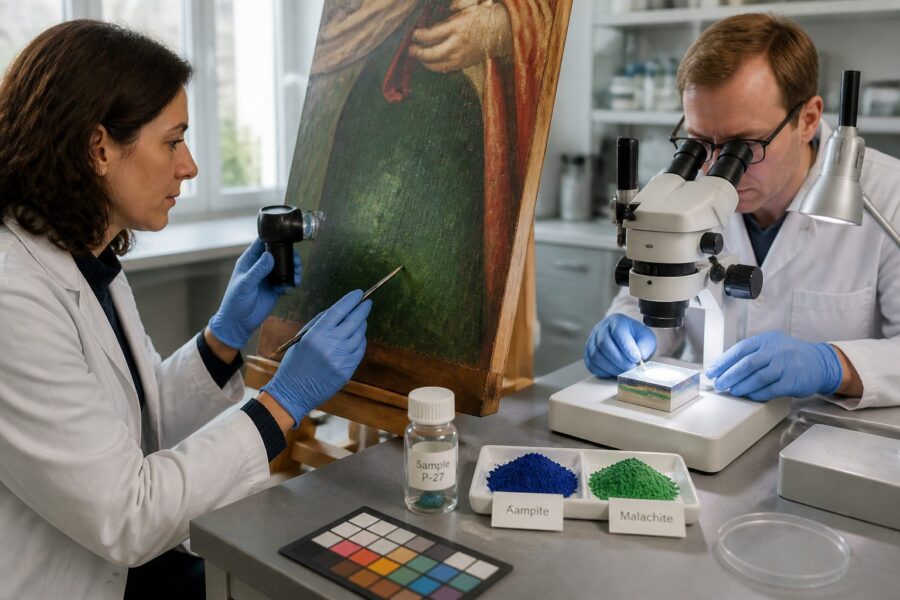
Detecting azurite beneath malachite overgrowth requires sophisticated non-invasive analytical techniques. Conservators cannot simply scrape away the green layer without damaging original paint, so modern science offers several ways to identify the hidden blue pigment.
These methods allow researchers to understand azurite degradation without interfering with the artwork. They provide valuable information on pigment chemical composition and distribution, essential for preserving historical integrity non-destructively.
- X-ray Fluorescence (XRF) Spectroscopy: Identifies elemental composition, specifically copper.
- Raman Spectroscopy: Distinguishes between azurite and malachite based on molecular vibrations.
- Fourier-Transform Infrared (FTIR) Spectroscopy: Detects characteristic absorption bands for each copper carbonate.
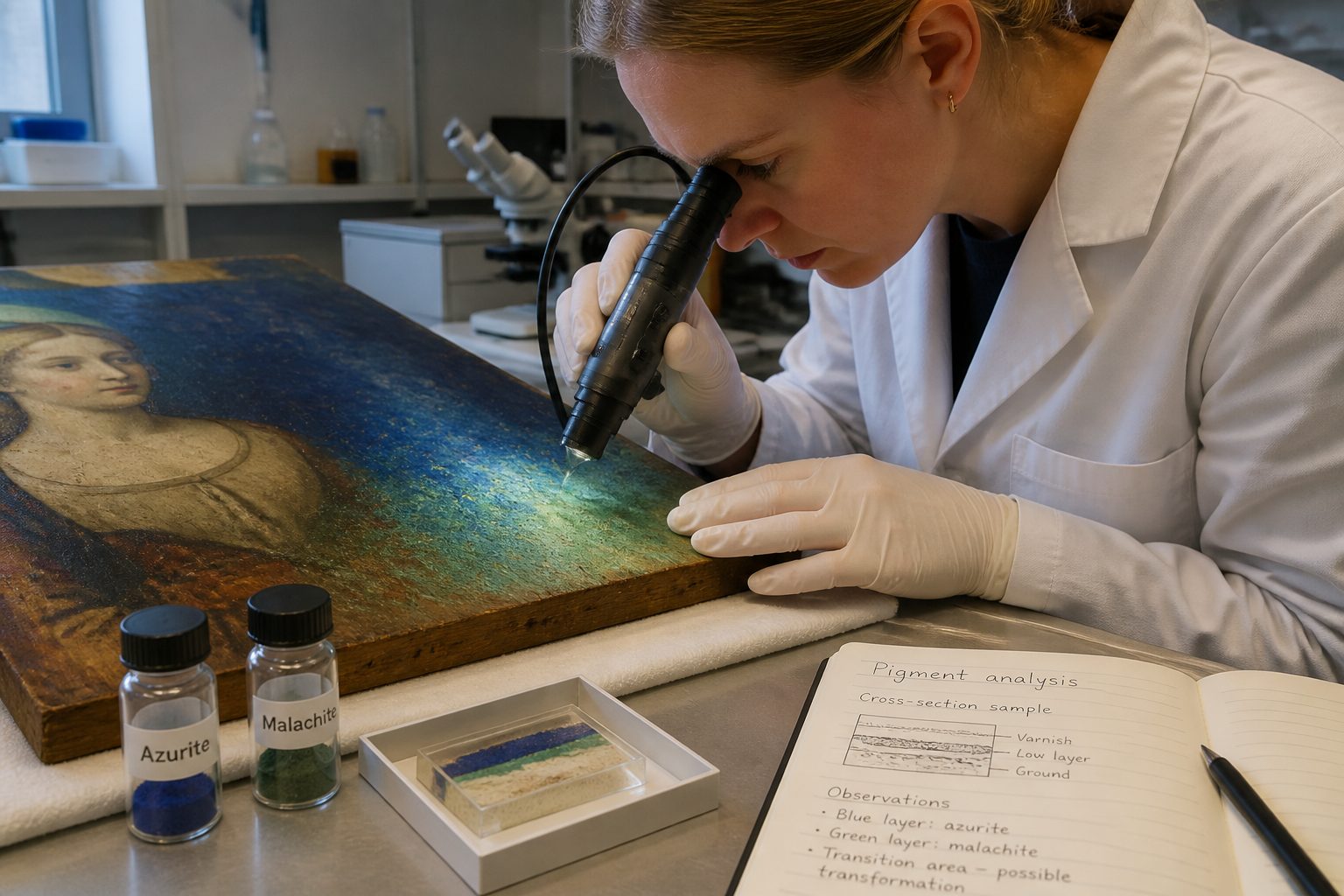
- Cross-Sectional Microscopy: Examines microscopic paint samples to identify layers and particle morphology.
- Hyperspectral Imaging: Captures detailed spectral information across a wide range, revealing hidden layers.
- Ultraviolet (UV) Fluorescence: Different fluorescence patterns can indicate pigment types or alterations.
- Neutron Activation Analysis (NAA): Highly sensitive for trace elements, useful for pigment identification.
Conservation Strategies to Stabilize Partially Transformed Azurite
Stabilizing partially transformed azurite is a complex challenge. The primary goal is to halt or slow the ongoing azurite-malachite transformation without altering the existing surface, requiring careful consideration of the artwork’s state and environment.
Strict environmental control is the most effective strategy. Maintaining stable temperature and relative humidity prevents further azurite hydration. Museums achieve this with sophisticated climate control systems in galleries and storage.
Controlling light exposure is crucial for preventive conservation. Reducing visible light intensity and filtering harmful UV radiation minimizes pigment stress, mitigating light-induced azurite degradation.
Experimental treatments involve consolidants or protective coatings to encapsulate pigment particles, limiting interaction with moisture and pollutants. However, such interventions require extensive testing for long-term stability and reversibility.
Binding medium choice during restoration is significant. Conservators select materials chemically compatible with original paint layers, ensuring they won’t accelerate further blue-to-green change, often using traditional, well-tested mediums.
Microclimate frames or display cases offer additional protection for vulnerable works. These specialized enclosures create a localized, stable environment, actively regulating humidity and filtering air pollutants for enhanced copper carbonate art preservation.
Cleaning azurite-containing areas requires extreme care. Aggressive agents or mechanical abrasion can damage delicate pigment layers. Conservators often opt for dry cleaning or very gentle aqueous solutions.
Monitoring azurite-malachite transformed panel paintings over time is a key conservation strategy. Regular inspections and scientific analyses track ongoing changes, informing adjustments to environmental controls or preventive measures.
Re-touching or inpainting transformed azurite areas is debated. Conservators usually match the current appearance rather than ‘correcting’ to the original blue. This respects the painting’s material history and avoids speculative restorations.
The best conservation strategy combines strict environmental control, careful handling, and ongoing scientific monitoring. These measures ensure the longevity of precious artworks, preserving the subtle beauty of azurite degradation as part of their story.
What the Transformation Tells Us About Original Appearance
The azurite-malachite transformation offers profound insights into original appearance. Knowing green areas were once blue fundamentally changes our understanding of the artist’s initial color scheme, often leading to a re-evaluation of the painting’s visual impact.
Imagine a vibrant blue sky or intense blue robe now muted green. The emotional and symbolic weight of these colors would have been drastically different. The blue-to-green change means many works today don’t fully convey the artist’s intended message or mood.
Blue often symbolized divinity, truth, or wealth in Northern European art. When this blue shifts to green, those powerful connotations diminish or are lost. The altered color scheme can mislead viewers about the painting’s original context and meaning.
Widespread azurite degradation suggests a bolder, more colorful past aesthetic. Artists likely aimed for striking contrasts and rich, saturated hues now only partially visible. Our modern perception of these old masters might be skewed by centuries of chemical change.
Reconstructing original appearance helps art historians understand artistic intent more accurately. It allows better interpretation of color symbolism and visual strategies, adding a new layer to art historical scholarship.
The transformation highlights artistic materials’ transient nature. Pigments, though seemingly permanent, are subject to chemistry and environmental interactions. This reminds us that artworks are dynamic entities evolving over time.
Understanding the blue-to-green change informs conservation ethics. Should conservators restore original blue or preserve the aged painting? Most lean towards stabilization, recognizing transformation as part of the artwork’s history.
Knowledge of these changes often leads to new interpretations. A painting subdued today might have been remarkably vivid when created, challenging assumptions about artistic styles of specific periods or individuals.
Scientific analysis identifies materials and unlocks a deeper appreciation for the creative process and historical context of copper carbonate art. It bridges past and present, allowing us to glimpse art as its creators intended.
Ultimately, azurite’s transformation reminds us of artworks’ hidden lives. It encourages looking beyond the surface to consider each painting’s complex journey, enriching our engagement with these irreplaceable cultural treasures.
Conclusion
The azurite-malachite transformation in panel paintings represents a captivating intersection of art history, chemistry, and conservation science. It reveals how time and environmental conditions profoundly alter an artwork’s visual identity, a silent narrative etched onto countless masterpieces.
From brilliant blues to muted greens, azurite degradation in paintings is a story of both loss and discovery. It prompts us to look beyond the surface, appreciating these historical objects’ dynamic life and enhancing our appreciation for the original artistic vision.
Ongoing efforts to analyze, document, and stabilize these changes are critical for preserving cultural heritage. Conservators and scientists use cutting-edge analytical methods to decipher copper carbonate art’s chemical secrets, ensuring future generations understand and enjoy these artworks in their fullest context.
While centuries of chemical reactions cannot be reversed, further degradation can be mitigated through careful climate control and conservation strategies. Recognizing original vibrant blues beneath current green surfaces allows richer, more informed engagement with these precious works, offering a deeper connection to their creators.
The azurite-to-malachite transformation powerfully reminds us that art is not static. It is a living testament to human creativity and nature’s relentless forces. This complex interplay makes studying azurite-malachite transformed panel paintings an endlessly fascinating field.