
This synergy allows for cross-validation of findings, leading to more robust conclusions about the materials and techniques used by the artist. The comprehensive data obtained from these combined methods can yield deeper insights into the artwork’s history and condition.
For example, XRF can provide elemental composition data, while OCT reveals the stratigraphy of the paint layers. Together, these methodologies enhance the understanding of the artist’s choices and the painting’s overall condition.
Moreover, integrating OCT data with other imaging techniques can also help identify previous restoration efforts and their impact on the artwork. This holistic approach ensures that conservators have the information they need to make informed preservation decisions.
As technology continues to advance, the integration of OCT with other imaging modalities will likely expand. This trend will enhance the capabilities of conservators, leading to improved outcomes in the preservation of cultural heritage.
Future Developments in OCT Resolution and Penetration Depth
As the field of optical coherence tomography continues to evolve, significant advancements in resolution and penetration depth are anticipated. Ongoing research aims to improve the imaging capabilities of OCT, allowing for even more detailed analysis of paint layers.
Innovations such as swept-source OCT and multi-wavelength imaging techniques are being explored to enhance both depth and lateral resolution. These developments hold the potential to push the boundaries of non-invasive stratigraphy further, particularly in complex artworks.
Additionally, advancements in data processing algorithms may lead to improved image reconstruction, allowing conservators to visualize intricate details more effectively. This progress will ultimately enhance the quality of pigment layer analysis and broaden the applications of OCT in conservation.
As these technologies advance, OCT will likely become an indispensable tool in art conservation, providing deeper insights into the materials and techniques used by artists throughout history. The future of OCT in cultural heritage conservation appears bright, promising further innovations and applications.
By using portable OCT systems, conservators can perform real-time assessments of artworks in their original contexts. This capability enhances the understanding of the artwork’s condition and informs immediate preservation needs.
Moreover, on-site imaging minimizes the risk of damage associated with transportation and handling. The ability to analyze artworks in situ ensures that conservators can make informed decisions without compromising their integrity.
As portable OCT technology continues to advance, its applications in cultural heritage conservation are expected to grow. This development will allow for even more detailed investigations and analyses of historical artifacts in their natural environments.
Ultimately, the integration of portable OCT systems into conservation practices represents a significant leap forward in the field. The convenience and efficiency of on-site imaging will enhance the overall quality of conservation efforts.
Integrating OCT Data With Other Imaging Modalities
The integration of optical coherence tomography data with other imaging modalities can enhance the understanding of artworks significantly. By combining OCT with techniques such as X-ray fluorescence (XRF) or infrared reflectography, conservators can obtain a multi-dimensional view of the painting.
This synergy allows for cross-validation of findings, leading to more robust conclusions about the materials and techniques used by the artist. The comprehensive data obtained from these combined methods can yield deeper insights into the artwork’s history and condition.
For example, XRF can provide elemental composition data, while OCT reveals the stratigraphy of the paint layers. Together, these methodologies enhance the understanding of the artist’s choices and the painting’s overall condition.
Moreover, integrating OCT data with other imaging techniques can also help identify previous restoration efforts and their impact on the artwork. This holistic approach ensures that conservators have the information they need to make informed preservation decisions.
As technology continues to advance, the integration of OCT with other imaging modalities will likely expand. This trend will enhance the capabilities of conservators, leading to improved outcomes in the preservation of cultural heritage.
Future Developments in OCT Resolution and Penetration Depth
As the field of optical coherence tomography continues to evolve, significant advancements in resolution and penetration depth are anticipated. Ongoing research aims to improve the imaging capabilities of OCT, allowing for even more detailed analysis of paint layers.
Innovations such as swept-source OCT and multi-wavelength imaging techniques are being explored to enhance both depth and lateral resolution. These developments hold the potential to push the boundaries of non-invasive stratigraphy further, particularly in complex artworks.
Additionally, advancements in data processing algorithms may lead to improved image reconstruction, allowing conservators to visualize intricate details more effectively. This progress will ultimately enhance the quality of pigment layer analysis and broaden the applications of OCT in conservation.
As these technologies advance, OCT will likely become an indispensable tool in art conservation, providing deeper insights into the materials and techniques used by artists throughout history. The future of OCT in cultural heritage conservation appears bright, promising further innovations and applications.
In such cases, the depth of imaging may be compromised, leading to reduced resolution and clarity of the internal structures. This limitation can restrict the effectiveness of OCT in accurately characterizing certain artworks.
Additionally, the presence of thick varnishes or layers of paint with high refractive indices can further complicate the analysis. These factors can lead to artifacts in the imaging data, potentially obscuring critical information about the paint layers.
Despite these challenges, ongoing research aims to improve OCT technology and address these limitations. As techniques evolve, the capabilities of OCT in difficult conditions are expected to expand, making it an even more valuable tool in art conservation.
Portable OCT Systems for On-Site Museum and Archive Work
The development of portable optical coherence tomography systems has revolutionized the way conservators conduct analyses in museums and archives. These mobile units allow for on-site imaging, reducing the need to transport sensitive artworks.
By using portable OCT systems, conservators can perform real-time assessments of artworks in their original contexts. This capability enhances the understanding of the artwork’s condition and informs immediate preservation needs.
Moreover, on-site imaging minimizes the risk of damage associated with transportation and handling. The ability to analyze artworks in situ ensures that conservators can make informed decisions without compromising their integrity.
As portable OCT technology continues to advance, its applications in cultural heritage conservation are expected to grow. This development will allow for even more detailed investigations and analyses of historical artifacts in their natural environments.
Ultimately, the integration of portable OCT systems into conservation practices represents a significant leap forward in the field. The convenience and efficiency of on-site imaging will enhance the overall quality of conservation efforts.
Integrating OCT Data With Other Imaging Modalities
The integration of optical coherence tomography data with other imaging modalities can enhance the understanding of artworks significantly. By combining OCT with techniques such as X-ray fluorescence (XRF) or infrared reflectography, conservators can obtain a multi-dimensional view of the painting.
This synergy allows for cross-validation of findings, leading to more robust conclusions about the materials and techniques used by the artist. The comprehensive data obtained from these combined methods can yield deeper insights into the artwork’s history and condition.
For example, XRF can provide elemental composition data, while OCT reveals the stratigraphy of the paint layers. Together, these methodologies enhance the understanding of the artist’s choices and the painting’s overall condition.
Moreover, integrating OCT data with other imaging techniques can also help identify previous restoration efforts and their impact on the artwork. This holistic approach ensures that conservators have the information they need to make informed preservation decisions.
As technology continues to advance, the integration of OCT with other imaging modalities will likely expand. This trend will enhance the capabilities of conservators, leading to improved outcomes in the preservation of cultural heritage.
Future Developments in OCT Resolution and Penetration Depth
As the field of optical coherence tomography continues to evolve, significant advancements in resolution and penetration depth are anticipated. Ongoing research aims to improve the imaging capabilities of OCT, allowing for even more detailed analysis of paint layers.
Innovations such as swept-source OCT and multi-wavelength imaging techniques are being explored to enhance both depth and lateral resolution. These developments hold the potential to push the boundaries of non-invasive stratigraphy further, particularly in complex artworks.
Additionally, advancements in data processing algorithms may lead to improved image reconstruction, allowing conservators to visualize intricate details more effectively. This progress will ultimately enhance the quality of pigment layer analysis and broaden the applications of OCT in conservation.
As these technologies advance, OCT will likely become an indispensable tool in art conservation, providing deeper insights into the materials and techniques used by artists throughout history. The future of OCT in cultural heritage conservation appears bright, promising further innovations and applications.
By analyzing the different reflection properties of various materials, OCT can provide detailed images of both underdrawings and ground layers. This information enriches the understanding of the artist’s process and can significantly impact restoration strategies.
For instance, the identification of an underdrawing may reveal the artist’s original intentions, highlighting changes made during the painting process. Such insights can guide conservators in their efforts to preserve the authenticity of the artwork.
Furthermore, understanding the composition and structure of ground layers is crucial for ensuring the long-term stability of the artwork. By employing OCT, conservators can assess the condition of these foundational layers without causing harm to the painting.
This capability to perform non-invasive stratigraphy is invaluable in the field of art conservation. It not only enhances the knowledge of artistic techniques but also aids in the development of effective preservation practices.
Limitations of OCT in Highly Scattering or Opaque Paint Systems
While optical coherence tomography offers numerous advantages, it is not without limitations. One significant challenge arises when analyzing highly scattering or opaque paint systems, which can hinder the penetration of the light used in OCT.
In such cases, the depth of imaging may be compromised, leading to reduced resolution and clarity of the internal structures. This limitation can restrict the effectiveness of OCT in accurately characterizing certain artworks.
Additionally, the presence of thick varnishes or layers of paint with high refractive indices can further complicate the analysis. These factors can lead to artifacts in the imaging data, potentially obscuring critical information about the paint layers.
Despite these challenges, ongoing research aims to improve OCT technology and address these limitations. As techniques evolve, the capabilities of OCT in difficult conditions are expected to expand, making it an even more valuable tool in art conservation.
Portable OCT Systems for On-Site Museum and Archive Work
The development of portable optical coherence tomography systems has revolutionized the way conservators conduct analyses in museums and archives. These mobile units allow for on-site imaging, reducing the need to transport sensitive artworks.
By using portable OCT systems, conservators can perform real-time assessments of artworks in their original contexts. This capability enhances the understanding of the artwork’s condition and informs immediate preservation needs.
Moreover, on-site imaging minimizes the risk of damage associated with transportation and handling. The ability to analyze artworks in situ ensures that conservators can make informed decisions without compromising their integrity.
As portable OCT technology continues to advance, its applications in cultural heritage conservation are expected to grow. This development will allow for even more detailed investigations and analyses of historical artifacts in their natural environments.
Ultimately, the integration of portable OCT systems into conservation practices represents a significant leap forward in the field. The convenience and efficiency of on-site imaging will enhance the overall quality of conservation efforts.
Integrating OCT Data With Other Imaging Modalities
The integration of optical coherence tomography data with other imaging modalities can enhance the understanding of artworks significantly. By combining OCT with techniques such as X-ray fluorescence (XRF) or infrared reflectography, conservators can obtain a multi-dimensional view of the painting.
This synergy allows for cross-validation of findings, leading to more robust conclusions about the materials and techniques used by the artist. The comprehensive data obtained from these combined methods can yield deeper insights into the artwork’s history and condition.
For example, XRF can provide elemental composition data, while OCT reveals the stratigraphy of the paint layers. Together, these methodologies enhance the understanding of the artist’s choices and the painting’s overall condition.
Moreover, integrating OCT data with other imaging techniques can also help identify previous restoration efforts and their impact on the artwork. This holistic approach ensures that conservators have the information they need to make informed preservation decisions.
As technology continues to advance, the integration of OCT with other imaging modalities will likely expand. This trend will enhance the capabilities of conservators, leading to improved outcomes in the preservation of cultural heritage.
Future Developments in OCT Resolution and Penetration Depth
As the field of optical coherence tomography continues to evolve, significant advancements in resolution and penetration depth are anticipated. Ongoing research aims to improve the imaging capabilities of OCT, allowing for even more detailed analysis of paint layers.
Innovations such as swept-source OCT and multi-wavelength imaging techniques are being explored to enhance both depth and lateral resolution. These developments hold the potential to push the boundaries of non-invasive stratigraphy further, particularly in complex artworks.
Additionally, advancements in data processing algorithms may lead to improved image reconstruction, allowing conservators to visualize intricate details more effectively. This progress will ultimately enhance the quality of pigment layer analysis and broaden the applications of OCT in conservation.
As these technologies advance, OCT will likely become an indispensable tool in art conservation, providing deeper insights into the materials and techniques used by artists throughout history. The future of OCT in cultural heritage conservation appears bright, promising further innovations and applications.
Using OCT, conservators can create detailed profiles of these layers, identifying their composition and thickness. This information can inform decisions about conservation treatments, ensuring that the original aesthetics of the artwork are respected.
By analyzing varnish layers, conservators can determine whether previous restoration efforts were successful or if they have caused damage. This insight is vital for planning future conservation treatments and preserving the artwork’s historical value.
Moreover, OCT can differentiate between various glazing techniques used by the artist, such as layering transparent colors to create depth. Understanding these techniques allows conservators to maintain the integrity of the artist’s original vision.
- Mapping varnish thickness
- Identifying glazing techniques
- Assessing previous restorations
- Ensuring aesthetic integrity
- Informing treatment decisions
Identifying Underdrawings and Ground Layers Without Sampling
Optical coherence tomography provides a unique capability to identify underdrawings and ground layers without the need for physical sampling. This non-invasive approach allows conservators to explore deeper layers of paintings, revealing the artist’s initial sketches and ground preparations.
By analyzing the different reflection properties of various materials, OCT can provide detailed images of both underdrawings and ground layers. This information enriches the understanding of the artist’s process and can significantly impact restoration strategies.
For instance, the identification of an underdrawing may reveal the artist’s original intentions, highlighting changes made during the painting process. Such insights can guide conservators in their efforts to preserve the authenticity of the artwork.
Furthermore, understanding the composition and structure of ground layers is crucial for ensuring the long-term stability of the artwork. By employing OCT, conservators can assess the condition of these foundational layers without causing harm to the painting.
This capability to perform non-invasive stratigraphy is invaluable in the field of art conservation. It not only enhances the knowledge of artistic techniques but also aids in the development of effective preservation practices.
Limitations of OCT in Highly Scattering or Opaque Paint Systems
While optical coherence tomography offers numerous advantages, it is not without limitations. One significant challenge arises when analyzing highly scattering or opaque paint systems, which can hinder the penetration of the light used in OCT.
In such cases, the depth of imaging may be compromised, leading to reduced resolution and clarity of the internal structures. This limitation can restrict the effectiveness of OCT in accurately characterizing certain artworks.
Additionally, the presence of thick varnishes or layers of paint with high refractive indices can further complicate the analysis. These factors can lead to artifacts in the imaging data, potentially obscuring critical information about the paint layers.
Despite these challenges, ongoing research aims to improve OCT technology and address these limitations. As techniques evolve, the capabilities of OCT in difficult conditions are expected to expand, making it an even more valuable tool in art conservation.
Portable OCT Systems for On-Site Museum and Archive Work
The development of portable optical coherence tomography systems has revolutionized the way conservators conduct analyses in museums and archives. These mobile units allow for on-site imaging, reducing the need to transport sensitive artworks.
By using portable OCT systems, conservators can perform real-time assessments of artworks in their original contexts. This capability enhances the understanding of the artwork’s condition and informs immediate preservation needs.
Moreover, on-site imaging minimizes the risk of damage associated with transportation and handling. The ability to analyze artworks in situ ensures that conservators can make informed decisions without compromising their integrity.
As portable OCT technology continues to advance, its applications in cultural heritage conservation are expected to grow. This development will allow for even more detailed investigations and analyses of historical artifacts in their natural environments.
Ultimately, the integration of portable OCT systems into conservation practices represents a significant leap forward in the field. The convenience and efficiency of on-site imaging will enhance the overall quality of conservation efforts.
Integrating OCT Data With Other Imaging Modalities
The integration of optical coherence tomography data with other imaging modalities can enhance the understanding of artworks significantly. By combining OCT with techniques such as X-ray fluorescence (XRF) or infrared reflectography, conservators can obtain a multi-dimensional view of the painting.
This synergy allows for cross-validation of findings, leading to more robust conclusions about the materials and techniques used by the artist. The comprehensive data obtained from these combined methods can yield deeper insights into the artwork’s history and condition.
For example, XRF can provide elemental composition data, while OCT reveals the stratigraphy of the paint layers. Together, these methodologies enhance the understanding of the artist’s choices and the painting’s overall condition.
Moreover, integrating OCT data with other imaging techniques can also help identify previous restoration efforts and their impact on the artwork. This holistic approach ensures that conservators have the information they need to make informed preservation decisions.
As technology continues to advance, the integration of OCT with other imaging modalities will likely expand. This trend will enhance the capabilities of conservators, leading to improved outcomes in the preservation of cultural heritage.
Future Developments in OCT Resolution and Penetration Depth
As the field of optical coherence tomography continues to evolve, significant advancements in resolution and penetration depth are anticipated. Ongoing research aims to improve the imaging capabilities of OCT, allowing for even more detailed analysis of paint layers.
Innovations such as swept-source OCT and multi-wavelength imaging techniques are being explored to enhance both depth and lateral resolution. These developments hold the potential to push the boundaries of non-invasive stratigraphy further, particularly in complex artworks.
Additionally, advancements in data processing algorithms may lead to improved image reconstruction, allowing conservators to visualize intricate details more effectively. This progress will ultimately enhance the quality of pigment layer analysis and broaden the applications of OCT in conservation.
As these technologies advance, OCT will likely become an indispensable tool in art conservation, providing deeper insights into the materials and techniques used by artists throughout history. The future of OCT in cultural heritage conservation appears bright, promising further innovations and applications.
In contrast, optical coherence tomography offers a non-invasive alternative that preserves the integrity of the artwork. This modern approach allows for comprehensive analysis without altering the physical state of the painting.
Moreover, OCT can provide real-time imaging, allowing conservators to visually assess the condition of multiple layers simultaneously. This capability not only enhances the efficiency of the analysis but also minimizes the risk of unintended damage.
Additionally, OCT can visualize layers that might be inaccessible through traditional methods, such as underdrawings or ground layers. This depth of analysis can lead to new insights into the artist’s techniques and the materials they used.
Ultimately, while traditional cross-section sampling remains valuable in some contexts, OCT represents a significant advancement in the field of conservation. The ability to perform non-invasive stratigraphy is a game-changer for art historians and conservators alike.
Case Applications: Mapping Varnish and Glazing Layers
One of the most exciting applications of optical coherence tomography is in the mapping of varnish and glazing layers in paintings. These layers often play a crucial role in the overall appearance and preservation of artworks.
Using OCT, conservators can create detailed profiles of these layers, identifying their composition and thickness. This information can inform decisions about conservation treatments, ensuring that the original aesthetics of the artwork are respected.
By analyzing varnish layers, conservators can determine whether previous restoration efforts were successful or if they have caused damage. This insight is vital for planning future conservation treatments and preserving the artwork’s historical value.
Moreover, OCT can differentiate between various glazing techniques used by the artist, such as layering transparent colors to create depth. Understanding these techniques allows conservators to maintain the integrity of the artist’s original vision.
- Mapping varnish thickness
- Identifying glazing techniques
- Assessing previous restorations
- Ensuring aesthetic integrity
- Informing treatment decisions
Identifying Underdrawings and Ground Layers Without Sampling
Optical coherence tomography provides a unique capability to identify underdrawings and ground layers without the need for physical sampling. This non-invasive approach allows conservators to explore deeper layers of paintings, revealing the artist’s initial sketches and ground preparations.
By analyzing the different reflection properties of various materials, OCT can provide detailed images of both underdrawings and ground layers. This information enriches the understanding of the artist’s process and can significantly impact restoration strategies.
For instance, the identification of an underdrawing may reveal the artist’s original intentions, highlighting changes made during the painting process. Such insights can guide conservators in their efforts to preserve the authenticity of the artwork.
Furthermore, understanding the composition and structure of ground layers is crucial for ensuring the long-term stability of the artwork. By employing OCT, conservators can assess the condition of these foundational layers without causing harm to the painting.
This capability to perform non-invasive stratigraphy is invaluable in the field of art conservation. It not only enhances the knowledge of artistic techniques but also aids in the development of effective preservation practices.
Limitations of OCT in Highly Scattering or Opaque Paint Systems
While optical coherence tomography offers numerous advantages, it is not without limitations. One significant challenge arises when analyzing highly scattering or opaque paint systems, which can hinder the penetration of the light used in OCT.
In such cases, the depth of imaging may be compromised, leading to reduced resolution and clarity of the internal structures. This limitation can restrict the effectiveness of OCT in accurately characterizing certain artworks.
Additionally, the presence of thick varnishes or layers of paint with high refractive indices can further complicate the analysis. These factors can lead to artifacts in the imaging data, potentially obscuring critical information about the paint layers.
Despite these challenges, ongoing research aims to improve OCT technology and address these limitations. As techniques evolve, the capabilities of OCT in difficult conditions are expected to expand, making it an even more valuable tool in art conservation.
Portable OCT Systems for On-Site Museum and Archive Work
The development of portable optical coherence tomography systems has revolutionized the way conservators conduct analyses in museums and archives. These mobile units allow for on-site imaging, reducing the need to transport sensitive artworks.
By using portable OCT systems, conservators can perform real-time assessments of artworks in their original contexts. This capability enhances the understanding of the artwork’s condition and informs immediate preservation needs.
Moreover, on-site imaging minimizes the risk of damage associated with transportation and handling. The ability to analyze artworks in situ ensures that conservators can make informed decisions without compromising their integrity.
As portable OCT technology continues to advance, its applications in cultural heritage conservation are expected to grow. This development will allow for even more detailed investigations and analyses of historical artifacts in their natural environments.
Ultimately, the integration of portable OCT systems into conservation practices represents a significant leap forward in the field. The convenience and efficiency of on-site imaging will enhance the overall quality of conservation efforts.
Integrating OCT Data With Other Imaging Modalities
The integration of optical coherence tomography data with other imaging modalities can enhance the understanding of artworks significantly. By combining OCT with techniques such as X-ray fluorescence (XRF) or infrared reflectography, conservators can obtain a multi-dimensional view of the painting.
This synergy allows for cross-validation of findings, leading to more robust conclusions about the materials and techniques used by the artist. The comprehensive data obtained from these combined methods can yield deeper insights into the artwork’s history and condition.
For example, XRF can provide elemental composition data, while OCT reveals the stratigraphy of the paint layers. Together, these methodologies enhance the understanding of the artist’s choices and the painting’s overall condition.
Moreover, integrating OCT data with other imaging techniques can also help identify previous restoration efforts and their impact on the artwork. This holistic approach ensures that conservators have the information they need to make informed preservation decisions.
As technology continues to advance, the integration of OCT with other imaging modalities will likely expand. This trend will enhance the capabilities of conservators, leading to improved outcomes in the preservation of cultural heritage.
Future Developments in OCT Resolution and Penetration Depth
As the field of optical coherence tomography continues to evolve, significant advancements in resolution and penetration depth are anticipated. Ongoing research aims to improve the imaging capabilities of OCT, allowing for even more detailed analysis of paint layers.
Innovations such as swept-source OCT and multi-wavelength imaging techniques are being explored to enhance both depth and lateral resolution. These developments hold the potential to push the boundaries of non-invasive stratigraphy further, particularly in complex artworks.
Additionally, advancements in data processing algorithms may lead to improved image reconstruction, allowing conservators to visualize intricate details more effectively. This progress will ultimately enhance the quality of pigment layer analysis and broaden the applications of OCT in conservation.
As these technologies advance, OCT will likely become an indispensable tool in art conservation, providing deeper insights into the materials and techniques used by artists throughout history. The future of OCT in cultural heritage conservation appears bright, promising further innovations and applications.
In typical OCT systems, the depth resolution can reach a few micrometers, allowing for precise characterization of pigment layers. This capability is essential for understanding the stratigraphy of paintings, as different materials may have varying refractive indices.
| Resolution Type | Typical Value | Importance in Conservation |
|---|---|---|
| Depth Resolution | 5-10 µm | Distinguishes between thin layers |
| Lateral Resolution | 10-15 µm | Clarifies features within a layer |
| Overall Imaging Speed | Up to 100 fps | Facilitates real-time analysis |
| Wavelength of Light | 800-1300 nm | Optimizes penetration depth |
The lateral resolution of OCT is equally significant, as it defines how well the system can resolve fine details within the paint layers. This capability is crucial when analyzing artworks with intricate designs or layered techniques, allowing conservators to document the artist’s methods and materials accurately.
Achieving a balance between depth and lateral resolution is vital for effective paint layer profiling. By understanding these parameters, conservators can better utilize OCT technology to inform their preservation strategies.
Comparing OCT to Traditional Cross-Section Sampling Methods
Traditional cross-section sampling methods involve physically removing a small portion of the artwork to analyze its composition. While these methods provide detailed information, they come with significant risks, including potential damage to the artwork and loss of historical integrity.
In contrast, optical coherence tomography offers a non-invasive alternative that preserves the integrity of the artwork. This modern approach allows for comprehensive analysis without altering the physical state of the painting.
Moreover, OCT can provide real-time imaging, allowing conservators to visually assess the condition of multiple layers simultaneously. This capability not only enhances the efficiency of the analysis but also minimizes the risk of unintended damage.
Additionally, OCT can visualize layers that might be inaccessible through traditional methods, such as underdrawings or ground layers. This depth of analysis can lead to new insights into the artist’s techniques and the materials they used.
Ultimately, while traditional cross-section sampling remains valuable in some contexts, OCT represents a significant advancement in the field of conservation. The ability to perform non-invasive stratigraphy is a game-changer for art historians and conservators alike.
Case Applications: Mapping Varnish and Glazing Layers
One of the most exciting applications of optical coherence tomography is in the mapping of varnish and glazing layers in paintings. These layers often play a crucial role in the overall appearance and preservation of artworks.
Using OCT, conservators can create detailed profiles of these layers, identifying their composition and thickness. This information can inform decisions about conservation treatments, ensuring that the original aesthetics of the artwork are respected.
By analyzing varnish layers, conservators can determine whether previous restoration efforts were successful or if they have caused damage. This insight is vital for planning future conservation treatments and preserving the artwork’s historical value.
Moreover, OCT can differentiate between various glazing techniques used by the artist, such as layering transparent colors to create depth. Understanding these techniques allows conservators to maintain the integrity of the artist’s original vision.
- Mapping varnish thickness
- Identifying glazing techniques
- Assessing previous restorations
- Ensuring aesthetic integrity
- Informing treatment decisions
Identifying Underdrawings and Ground Layers Without Sampling
Optical coherence tomography provides a unique capability to identify underdrawings and ground layers without the need for physical sampling. This non-invasive approach allows conservators to explore deeper layers of paintings, revealing the artist’s initial sketches and ground preparations.
By analyzing the different reflection properties of various materials, OCT can provide detailed images of both underdrawings and ground layers. This information enriches the understanding of the artist’s process and can significantly impact restoration strategies.
For instance, the identification of an underdrawing may reveal the artist’s original intentions, highlighting changes made during the painting process. Such insights can guide conservators in their efforts to preserve the authenticity of the artwork.
Furthermore, understanding the composition and structure of ground layers is crucial for ensuring the long-term stability of the artwork. By employing OCT, conservators can assess the condition of these foundational layers without causing harm to the painting.
This capability to perform non-invasive stratigraphy is invaluable in the field of art conservation. It not only enhances the knowledge of artistic techniques but also aids in the development of effective preservation practices.
Limitations of OCT in Highly Scattering or Opaque Paint Systems
While optical coherence tomography offers numerous advantages, it is not without limitations. One significant challenge arises when analyzing highly scattering or opaque paint systems, which can hinder the penetration of the light used in OCT.
In such cases, the depth of imaging may be compromised, leading to reduced resolution and clarity of the internal structures. This limitation can restrict the effectiveness of OCT in accurately characterizing certain artworks.
Additionally, the presence of thick varnishes or layers of paint with high refractive indices can further complicate the analysis. These factors can lead to artifacts in the imaging data, potentially obscuring critical information about the paint layers.
Despite these challenges, ongoing research aims to improve OCT technology and address these limitations. As techniques evolve, the capabilities of OCT in difficult conditions are expected to expand, making it an even more valuable tool in art conservation.
Portable OCT Systems for On-Site Museum and Archive Work
The development of portable optical coherence tomography systems has revolutionized the way conservators conduct analyses in museums and archives. These mobile units allow for on-site imaging, reducing the need to transport sensitive artworks.
By using portable OCT systems, conservators can perform real-time assessments of artworks in their original contexts. This capability enhances the understanding of the artwork’s condition and informs immediate preservation needs.
Moreover, on-site imaging minimizes the risk of damage associated with transportation and handling. The ability to analyze artworks in situ ensures that conservators can make informed decisions without compromising their integrity.
As portable OCT technology continues to advance, its applications in cultural heritage conservation are expected to grow. This development will allow for even more detailed investigations and analyses of historical artifacts in their natural environments.
Ultimately, the integration of portable OCT systems into conservation practices represents a significant leap forward in the field. The convenience and efficiency of on-site imaging will enhance the overall quality of conservation efforts.
Integrating OCT Data With Other Imaging Modalities
The integration of optical coherence tomography data with other imaging modalities can enhance the understanding of artworks significantly. By combining OCT with techniques such as X-ray fluorescence (XRF) or infrared reflectography, conservators can obtain a multi-dimensional view of the painting.
This synergy allows for cross-validation of findings, leading to more robust conclusions about the materials and techniques used by the artist. The comprehensive data obtained from these combined methods can yield deeper insights into the artwork’s history and condition.
For example, XRF can provide elemental composition data, while OCT reveals the stratigraphy of the paint layers. Together, these methodologies enhance the understanding of the artist’s choices and the painting’s overall condition.
Moreover, integrating OCT data with other imaging techniques can also help identify previous restoration efforts and their impact on the artwork. This holistic approach ensures that conservators have the information they need to make informed preservation decisions.
As technology continues to advance, the integration of OCT with other imaging modalities will likely expand. This trend will enhance the capabilities of conservators, leading to improved outcomes in the preservation of cultural heritage.
Future Developments in OCT Resolution and Penetration Depth
As the field of optical coherence tomography continues to evolve, significant advancements in resolution and penetration depth are anticipated. Ongoing research aims to improve the imaging capabilities of OCT, allowing for even more detailed analysis of paint layers.
Innovations such as swept-source OCT and multi-wavelength imaging techniques are being explored to enhance both depth and lateral resolution. These developments hold the potential to push the boundaries of non-invasive stratigraphy further, particularly in complex artworks.
Additionally, advancements in data processing algorithms may lead to improved image reconstruction, allowing conservators to visualize intricate details more effectively. This progress will ultimately enhance the quality of pigment layer analysis and broaden the applications of OCT in conservation.
As these technologies advance, OCT will likely become an indispensable tool in art conservation, providing deeper insights into the materials and techniques used by artists throughout history. The future of OCT in cultural heritage conservation appears bright, promising further innovations and applications.
Optical Coherence Tomography (OCT) has emerged as a groundbreaking technology in various fields, including medical imaging and cultural heritage conservation. By providing high-resolution, cross-sectional images of materials, OCT allows for detailed analysis without the need for invasive sampling methods.
This non-invasive imaging technique utilizes light waves to capture micrometer-resolution images of the internal structures of materials. It has become particularly valuable in the conservation of historical artworks, where understanding pigment layers is crucial for preservation and restoration efforts.
As cultural heritage professionals seek more sophisticated methods for analysis, the integration of OCT into conservation practices becomes increasingly relevant. This blog will explore the applications of OCT in the analysis of historical pigments and its impact on conservation science.
What Optical Coherence Tomography Is and How It Works
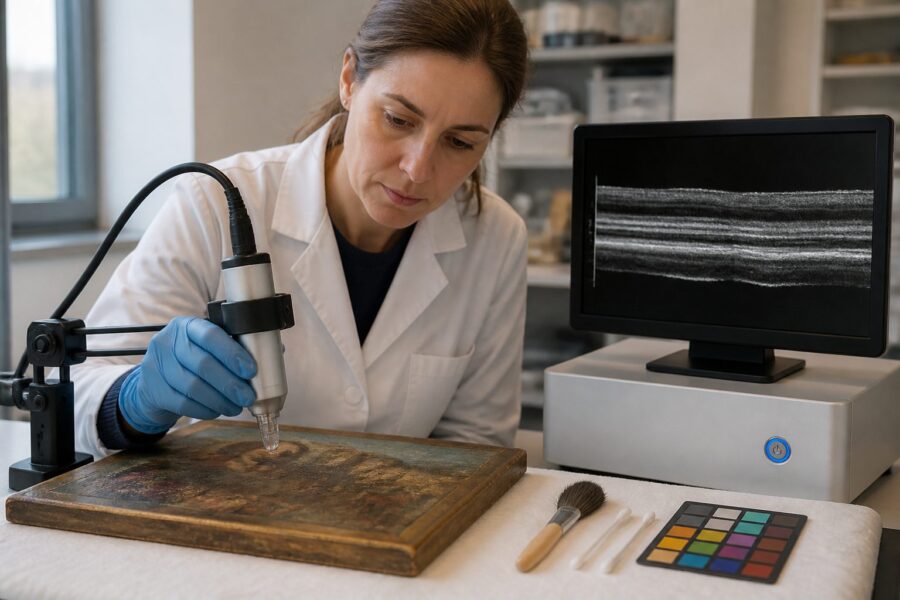
Optical Coherence Tomography (OCT) is a non-invasive imaging technique that captures high-resolution images of biological and non-biological materials. The technology relies on the principle of interferometry, where light is split into two paths: one directed at the sample and the other at a reference mirror.
When the light reflects off the sample and returns, it combines with light from the reference arm, creating an interference pattern. This pattern is analyzed to generate cross-sectional images, revealing the internal structure of the material being examined.
The high depth resolution of OCT allows for precise imaging of individual layers within complex structures, making it especially useful for analyzing paint layers in artworks. By capturing images at varying depths, OCT provides a detailed view of how different pigments and coatings interact within the artwork.
In addition, OCT operates in real-time, allowing conservators to visualize the structure of the artwork during the examination process. This immediate feedback can guide conservation strategies and inform decisions about restoration techniques.
With its ability to produce high-resolution, cross-sectional images, OCT serves as a powerful tool in the field of cultural heritage conservation. The technology has revolutionized the way conservators analyze and understand layered materials, improving the overall quality of preservation efforts.
Adapting OCT for Cultural Heritage and Conservation Science
As the demand for non-invasive analysis techniques grows, OCT has been adapted specifically for cultural heritage applications. Researchers and conservators have modified traditional OCT systems to optimize them for examining the unique characteristics of historical artworks.
These adaptations include adjusting the wavelength of light used and refining the imaging settings to enhance the visibility of different pigment layers. Such modifications ensure that the OCT systems can effectively penetrate various paint formulations and varnishes.
One notable advancement in OCT technology is the development of spectral-domain OCT, which provides improved sensitivity and resolution. This innovation allows for better differentiation between closely spaced layers of paints and coatings, crucial for accurate pigment layer analysis.
Furthermore, OCT can be combined with other imaging techniques, such as reflectance imaging and fluorescence microscopy, to provide a more comprehensive analysis of artworks. This integration facilitates a multi-faceted approach to understanding complex paint systems in cultural heritage artifacts.
The continual development of OCT technology promises to enhance its application in conservation science. As more conservators adopt OCT for pigment layer analysis, it will undoubtedly lead to better preservation practices and a deeper understanding of historical artworks.
Depth Resolution and Lateral Resolution in Paint Layer Profiling
In the realm of optical coherence tomography, depth resolution and lateral resolution play critical roles in paint layer imaging. Depth resolution refers to the ability to distinguish between layers of different thicknesses, while lateral resolution pertains to the clarity of features within a single layer.
In typical OCT systems, the depth resolution can reach a few micrometers, allowing for precise characterization of pigment layers. This capability is essential for understanding the stratigraphy of paintings, as different materials may have varying refractive indices.
| Resolution Type | Typical Value | Importance in Conservation |
|---|---|---|
| Depth Resolution | 5-10 µm | Distinguishes between thin layers |
| Lateral Resolution | 10-15 µm | Clarifies features within a layer |
| Overall Imaging Speed | Up to 100 fps | Facilitates real-time analysis |
| Wavelength of Light | 800-1300 nm | Optimizes penetration depth |
The lateral resolution of OCT is equally significant, as it defines how well the system can resolve fine details within the paint layers. This capability is crucial when analyzing artworks with intricate designs or layered techniques, allowing conservators to document the artist’s methods and materials accurately.
Achieving a balance between depth and lateral resolution is vital for effective paint layer profiling. By understanding these parameters, conservators can better utilize OCT technology to inform their preservation strategies.
Comparing OCT to Traditional Cross-Section Sampling Methods
Traditional cross-section sampling methods involve physically removing a small portion of the artwork to analyze its composition. While these methods provide detailed information, they come with significant risks, including potential damage to the artwork and loss of historical integrity.
In contrast, optical coherence tomography offers a non-invasive alternative that preserves the integrity of the artwork. This modern approach allows for comprehensive analysis without altering the physical state of the painting.
Moreover, OCT can provide real-time imaging, allowing conservators to visually assess the condition of multiple layers simultaneously. This capability not only enhances the efficiency of the analysis but also minimizes the risk of unintended damage.
Additionally, OCT can visualize layers that might be inaccessible through traditional methods, such as underdrawings or ground layers. This depth of analysis can lead to new insights into the artist’s techniques and the materials they used.
Ultimately, while traditional cross-section sampling remains valuable in some contexts, OCT represents a significant advancement in the field of conservation. The ability to perform non-invasive stratigraphy is a game-changer for art historians and conservators alike.
Case Applications: Mapping Varnish and Glazing Layers
One of the most exciting applications of optical coherence tomography is in the mapping of varnish and glazing layers in paintings. These layers often play a crucial role in the overall appearance and preservation of artworks.
Using OCT, conservators can create detailed profiles of these layers, identifying their composition and thickness. This information can inform decisions about conservation treatments, ensuring that the original aesthetics of the artwork are respected.
By analyzing varnish layers, conservators can determine whether previous restoration efforts were successful or if they have caused damage. This insight is vital for planning future conservation treatments and preserving the artwork’s historical value.
Moreover, OCT can differentiate between various glazing techniques used by the artist, such as layering transparent colors to create depth. Understanding these techniques allows conservators to maintain the integrity of the artist’s original vision.
- Mapping varnish thickness
- Identifying glazing techniques
- Assessing previous restorations
- Ensuring aesthetic integrity
- Informing treatment decisions
Identifying Underdrawings and Ground Layers Without Sampling
Optical coherence tomography provides a unique capability to identify underdrawings and ground layers without the need for physical sampling. This non-invasive approach allows conservators to explore deeper layers of paintings, revealing the artist’s initial sketches and ground preparations.
By analyzing the different reflection properties of various materials, OCT can provide detailed images of both underdrawings and ground layers. This information enriches the understanding of the artist’s process and can significantly impact restoration strategies.
For instance, the identification of an underdrawing may reveal the artist’s original intentions, highlighting changes made during the painting process. Such insights can guide conservators in their efforts to preserve the authenticity of the artwork.
Furthermore, understanding the composition and structure of ground layers is crucial for ensuring the long-term stability of the artwork. By employing OCT, conservators can assess the condition of these foundational layers without causing harm to the painting.
This capability to perform non-invasive stratigraphy is invaluable in the field of art conservation. It not only enhances the knowledge of artistic techniques but also aids in the development of effective preservation practices.
Limitations of OCT in Highly Scattering or Opaque Paint Systems
While optical coherence tomography offers numerous advantages, it is not without limitations. One significant challenge arises when analyzing highly scattering or opaque paint systems, which can hinder the penetration of the light used in OCT.
In such cases, the depth of imaging may be compromised, leading to reduced resolution and clarity of the internal structures. This limitation can restrict the effectiveness of OCT in accurately characterizing certain artworks.
Additionally, the presence of thick varnishes or layers of paint with high refractive indices can further complicate the analysis. These factors can lead to artifacts in the imaging data, potentially obscuring critical information about the paint layers.
Despite these challenges, ongoing research aims to improve OCT technology and address these limitations. As techniques evolve, the capabilities of OCT in difficult conditions are expected to expand, making it an even more valuable tool in art conservation.
Portable OCT Systems for On-Site Museum and Archive Work
The development of portable optical coherence tomography systems has revolutionized the way conservators conduct analyses in museums and archives. These mobile units allow for on-site imaging, reducing the need to transport sensitive artworks.
By using portable OCT systems, conservators can perform real-time assessments of artworks in their original contexts. This capability enhances the understanding of the artwork’s condition and informs immediate preservation needs.
Moreover, on-site imaging minimizes the risk of damage associated with transportation and handling. The ability to analyze artworks in situ ensures that conservators can make informed decisions without compromising their integrity.
As portable OCT technology continues to advance, its applications in cultural heritage conservation are expected to grow. This development will allow for even more detailed investigations and analyses of historical artifacts in their natural environments.
Ultimately, the integration of portable OCT systems into conservation practices represents a significant leap forward in the field. The convenience and efficiency of on-site imaging will enhance the overall quality of conservation efforts.
Integrating OCT Data With Other Imaging Modalities
The integration of optical coherence tomography data with other imaging modalities can enhance the understanding of artworks significantly. By combining OCT with techniques such as X-ray fluorescence (XRF) or infrared reflectography, conservators can obtain a multi-dimensional view of the painting.
This synergy allows for cross-validation of findings, leading to more robust conclusions about the materials and techniques used by the artist. The comprehensive data obtained from these combined methods can yield deeper insights into the artwork’s history and condition.
For example, XRF can provide elemental composition data, while OCT reveals the stratigraphy of the paint layers. Together, these methodologies enhance the understanding of the artist’s choices and the painting’s overall condition.
Moreover, integrating OCT data with other imaging techniques can also help identify previous restoration efforts and their impact on the artwork. This holistic approach ensures that conservators have the information they need to make informed preservation decisions.
As technology continues to advance, the integration of OCT with other imaging modalities will likely expand. This trend will enhance the capabilities of conservators, leading to improved outcomes in the preservation of cultural heritage.
Future Developments in OCT Resolution and Penetration Depth
As the field of optical coherence tomography continues to evolve, significant advancements in resolution and penetration depth are anticipated. Ongoing research aims to improve the imaging capabilities of OCT, allowing for even more detailed analysis of paint layers.
Innovations such as swept-source OCT and multi-wavelength imaging techniques are being explored to enhance both depth and lateral resolution. These developments hold the potential to push the boundaries of non-invasive stratigraphy further, particularly in complex artworks.
Additionally, advancements in data processing algorithms may lead to improved image reconstruction, allowing conservators to visualize intricate details more effectively. This progress will ultimately enhance the quality of pigment layer analysis and broaden the applications of OCT in conservation.
As these technologies advance, OCT will likely become an indispensable tool in art conservation, providing deeper insights into the materials and techniques used by artists throughout history. The future of OCT in cultural heritage conservation appears bright, promising further innovations and applications.