
In the realm of art conservation and historical pigment analysis, understanding the composition of materials is paramount. This knowledge guides conservation efforts, informs authentication processes, and deepens our appreciation for artistic techniques of the past. One analytical technique that plays a crucial role in this field is thin layer chromatography pigment (TLC), a powerful method for separating and identifying the organic components within complex pigment mixtures.
This article will provide a comprehensive overview of TLC, exploring its principles, applications, and significance in the study of historical pigments. By understanding the capabilities and limitations of this technique, conservators, art historians, and scientists can gain invaluable insights into the materials and methods employed by artists throughout history.
TLC is more than just a separation technique; it is a window into the past, offering a glimpse into the creative processes and material choices of artists long gone. Through careful analysis and interpretation of TLC results, we can unlock the secrets held within historical pigments and contribute to the preservation of our cultural heritage.
Understanding the Principles of Thin Layer Chromatography
Thin layer chromatography pigment is a versatile separation technique used to isolate and identify components within a mixture. The fundamental principle behind TLC lies in the differential migration of compounds based on their interactions with a stationary phase and a mobile phase.
The stationary phase is a thin layer of adsorbent material, typically silica gel or alumina, coated onto a flat, inert support like glass or aluminum. The mobile phase is a solvent or mixture of solvents that travels up the stationary phase, carrying the sample components along with it.
As the mobile phase moves, the individual components of the sample interact with both the stationary and mobile phases. Compounds with a stronger affinity for the stationary phase will move more slowly, while those with a greater affinity for the mobile phase will migrate further up the plate.
This differential migration leads to the separation of the mixture into distinct spots or bands, each representing a different component. The distance each component travels relative to the solvent front is quantified by its retardation factor (Rf value), which is a characteristic property that can aid in identification.
The interaction between the compounds and the stationary phase is primarily based on adsorption. Adsorption is a surface phenomenon where molecules adhere to the surface of the solid stationary phase.
The strength of adsorption depends on the polarity of the compound and the polarity of the stationary phase. Polar compounds will interact more strongly with polar stationary phases, leading to slower migration.
The mobile phase, on the other hand, competes with the stationary phase for the binding of the compounds. The more polar the mobile phase, the more effectively it can elute polar compounds from the stationary phase.
Therefore, the choice of mobile phase is crucial for achieving optimal separation. The mobile phase is often a mixture of solvents with varying polarities, allowing for fine-tuning of the separation process.
The Rf value is a critical parameter in TLC, representing the ratio of the distance traveled by the compound to the distance traveled by the solvent front. Ideally, Rf values should fall between 0.2 and 0.8 for optimal separation and accurate measurement.
Compounds with Rf values close to 0 are strongly retained by the stationary phase, while those with Rf values close to 1 are weakly retained and move with the solvent front. Understanding these principles is key to effectively using TLC for pigment analysis.
Preparing Pigment Samples for TLC Analysis
Proper sample preparation is essential for successful TLC analysis of pigments. The goal is to extract the organic components of the pigment into a suitable solvent without altering their chemical structure.
The first step involves carefully selecting a solvent or solvent mixture that can effectively dissolve the organic pigments of interest. Common solvents used for pigment extraction include acetone, ethanol, pyridine, and dimethylformamide (DMF), often used in combination to optimize solubility.
The pigment sample, typically a small amount scraped from a painting or other artifact, is then mixed with the chosen solvent. The mixture is often heated gently or sonicated to aid in the dissolution of the pigments.
After extraction, the sample is filtered or centrifuged to remove any insoluble materials, such as inorganic binders or degradation products. The resulting solution, containing the extracted organic pigments, is then ready for application onto the TLC plate.
The selection of the appropriate solvent is critical and depends on the nature of the pigments being analyzed. For example, more polar solvents like pyridine or DMF are often required to extract highly polar pigments, such as those found in certain dyes.
The extraction process should be optimized to ensure complete dissolution of the pigments without causing any degradation. Gentle heating and sonication can aid in the extraction process, but excessive heat or prolonged sonication can lead to unwanted chemical changes.
Filtering or centrifuging the sample is an important step to remove any particulate matter that could interfere with the TLC separation. Insoluble binders, fillers, or degradation products can cause streaking or tailing on the TLC plate, making it difficult to accurately identify the pigments.
The concentration of the extracted pigment solution is also a crucial factor to consider. If the concentration is too low, the spots may be faint and difficult to visualize. If the concentration is too high, the spots may be overloaded and cause poor separation.
In some cases, it may be necessary to perform a pre-concentration step, such as evaporation under a gentle stream of nitrogen, to increase the concentration of the pigment solution. This should be done carefully to avoid loss of volatile compounds.
Finally, it’s essential to use high-quality solvents and glassware to avoid contamination of the sample. Contaminants can interfere with the TLC separation and lead to inaccurate results. Proper sample preparation is the foundation for reliable TLC analysis of pigments.
Performing TLC Separations and Visualization
Once the pigment sample is prepared, the next step is to perform the TLC separation. This involves applying a small amount of the sample solution onto the TLC plate and allowing the components to separate under the influence of the mobile phase.
The sample is typically applied as a small spot near the bottom of the plate using a fine capillary tube or microsyringe. The plate is then placed in a developing chamber containing the chosen mobile phase, ensuring that the solvent level is below the application spot.
| Step | Description | Considerations |
|---|---|---|
| 1. Sample Application | Apply pigment extract as a small spot. | Use a consistent volume and location. |
| 2. Development | Place plate in developing chamber with mobile phase. | Ensure chamber is saturated with solvent vapor. |
| 3. Visualization | Observe separated spots under UV or visible light. | Use appropriate visualization techniques for different pigments. |
| 4. Rf Calculation | Calculate Rf values for each separated spot. | Measure distances accurately and consistently. |
The application of the sample spot is a critical step that can significantly affect the quality of the separation. The spot should be small and compact to ensure sharp and well-defined bands.
The developing chamber should be saturated with solvent vapor to ensure uniform migration of the mobile phase. This can be achieved by lining the chamber with filter paper soaked in the mobile phase.
The development time will depend on the mobile phase and the desired separation. It’s important to monitor the solvent front and stop the development before it reaches the top of the plate.
Once the development is complete, the plate should be allowed to dry thoroughly before visualization. This will prevent the solvent from interfering with the visualization process.
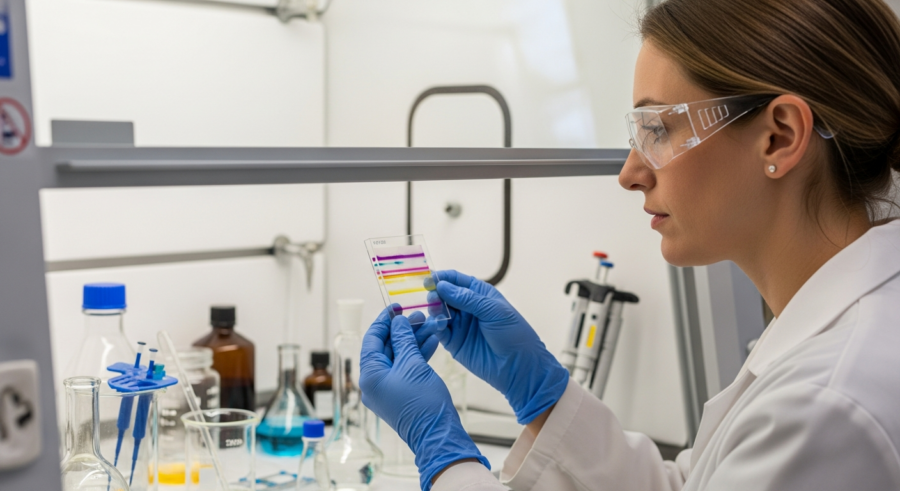
Visualization techniques vary depending on the nature of the pigments being analyzed. Many organic pigments are visible under UV light, while others require staining or spraying with a visualizing reagent.
Common visualization reagents include iodine vapor, which can react with many organic compounds to produce colored spots. Other reagents are specific for certain functional groups or classes of compounds.
Accurate measurement of the distances traveled by the spots and the solvent front is essential for calculating Rf values. These measurements should be made carefully using a ruler or digital imaging software.
The Rf values should be reproducible and consistent for a given compound under specific TLC conditions. Variations in Rf values can indicate changes in the experimental conditions or the presence of interfering compounds.
Identifying Pigments Based on Rf Values
After the TLC plate has been developed and the separated spots visualized, the next step is to identify the pigments present in the sample. This is typically done by comparing the Rf values of the separated spots to those of known pigment standards.
The Rf value is calculated by dividing the distance traveled by the pigment spot by the distance traveled by the solvent front. This value is characteristic of a particular compound under specific TLC conditions, including the stationary phase, mobile phase, and temperature.
By running known pigment standards alongside the unknown sample on the same TLC plate, it is possible to directly compare the Rf values and identify the pigments present in the sample. This comparison is most reliable when the standards and unknowns are run under identical conditions.
It’s important to note that Rf values can be influenced by several factors, including the purity of the solvents, the activity of the stationary phase, and the presence of other compounds in the sample. Therefore, it’s crucial to use high-quality materials and to carefully control the experimental conditions to ensure accurate and reliable results.
The use of authentic pigment standards is crucial for accurate identification. These standards should be obtained from reputable sources and their purity should be verified.
It’s also important to consider the possibility of co-migration, where two or more pigments have similar Rf values under the chosen TLC conditions. In such cases, it may be necessary to use a different mobile phase or a different visualization technique to differentiate between the pigments.
The color and intensity of the spots can also provide valuable information about the identity and concentration of the pigments. However, these observations should be interpreted with caution, as the color and intensity can be affected by factors such as the pH of the mobile phase and the presence of interfering compounds.
In some cases, it may be necessary to use a combination of TLC and other analytical techniques, such as UV-Vis spectroscopy or mass spectrometry, to confirm the identity of the pigments. These techniques can provide complementary information that can help to resolve ambiguities in the TLC results.
Creating a library of Rf values for known pigments under different TLC conditions can be a valuable resource for pigment identification. This library can be used to quickly and easily identify pigments in unknown samples.
Finally, it’s important to document the TLC results carefully, including the experimental conditions, the Rf values, and any other relevant observations. This documentation will help to ensure the reproducibility and reliability of the results.
Advanced Techniques in TLC Pigment Analysis
While basic TLC is a valuable tool, several advanced techniques can enhance its capabilities for pigment analysis. These techniques offer improved separation, sensitivity, and identification capabilities.
One such technique is two-dimensional TLC, where the plate is developed in one direction, then rotated 90 degrees and developed again using a different solvent system. This can significantly improve the separation of complex mixtures by exploiting different selectivity characteristics of the two solvent systems.
Another powerful technique is high-performance thin layer chromatography (HPTLC), which uses plates with smaller particle sizes and more uniform packing. This results in sharper separations, higher resolution, and improved quantitative capabilities.
Furthermore, TLC can be coupled with other analytical techniques, such as mass spectrometry (TLC-MS) or infrared spectroscopy (TLC-IR), to provide more definitive identification of the separated pigments. These hyphenated techniques allow for the direct analysis of the spots on the TLC plate, providing valuable structural information about the pigments present.
Two-dimensional TLC is particularly useful for separating complex mixtures of pigments that cannot be resolved by one-dimensional TLC. The choice of the two solvent systems is crucial for achieving optimal separation.
HPTLC offers several advantages over conventional TLC, including faster separation times, higher sensitivity, and improved reproducibility. The smaller particle size of the HPTLC plates results in sharper bands and better resolution.
TLC-MS is a powerful technique that combines the separation capabilities of TLC with the identification capabilities of mass spectrometry. This allows for the direct identification of the pigments present in the separated spots.
TLC-IR is another hyphenated technique that combines TLC with infrared spectroscopy. This technique provides information about the functional groups present in the pigments, which can aid in their identification.
Another advanced technique is over-pressure layer chromatography (OPLC), which uses external pressure to force the mobile phase through the stationary phase. This results in faster separation times and improved resolution.
These advanced techniques can provide valuable information about the composition of historical pigments, helping conservators and art historians to better understand and preserve our cultural heritage. The selection of the appropriate technique will depend on the specific research question and the nature of the pigments being analyzed.
Applications of TLC in Pigment Analysis
Thin layer chromatography pigment has a wide range of applications in the analysis of historical pigments. It is used by conservators, art historians, and scientists to gain insights into the materials and techniques used by artists throughout history.
One of the primary applications of TLC is in the identification of organic pigments in paintings, manuscripts, and other artifacts. By comparing the Rf values of unknown pigments to those of known standards, it is possible to determine the composition of the pigments used by the artist.
- Identifying organic pigments in artworks
- Distinguishing between different pigment sources
- Detecting pigment degradation products
- Authenticating artworks and detecting forgeries
- Studying artists’ materials and techniques
TLC can also be used to study the degradation of organic pigments over time. By identifying the degradation products, conservators can develop appropriate conservation strategies to preserve these artifacts.
Another important application of TLC is in the authentication of artworks. By comparing the pigments used in a painting to those known to have been used by the purported artist, it is possible to determine whether the painting is genuine or a forgery.
TLC can also be used to study the materials and techniques used by artists throughout history. By analyzing the pigments used in different artworks, it is possible to gain insights into the artistic practices of different cultures and time periods.
In the field of textile conservation, TLC is used to identify the dyes used in historical textiles. This information can be used to develop appropriate cleaning and conservation treatments for these fragile artifacts.
TLC is also used in the analysis of archaeological pigments, providing information about the materials used by ancient civilizations. This can help to reconstruct ancient technologies and trade routes.
Furthermore, TLC can be used to monitor the effectiveness of conservation treatments. By analyzing the pigments before and after treatment, it is possible to assess whether the treatment has had any adverse effects on the pigments.
The versatility and simplicity of TLC make it a valuable tool for a wide range of applications in pigment analysis. Its ability to provide information about the composition, degradation, and authenticity of pigments makes it an essential technique for conservators, art historians, and scientists.
Advantages and Limitations of TLC
Like any analytical technique, thin layer chromatography pigment has its own set of advantages and limitations. Understanding these strengths and weaknesses is crucial for interpreting TLC results and making informed decisions about its application.
One of the key advantages of TLC is its simplicity and low cost. The equipment required is relatively inexpensive, and the technique is easy to learn and perform, making it accessible to a wide range of researchers and conservators.
Another advantage of TLC is its versatility. It can be used to analyze a wide variety of organic pigments, and the mobile phase can be easily adjusted to optimize the separation of different compounds. It also requires very little sample, which is ideal when studying rare or precious artifacts.
However, TLC also has some limitations. It is primarily a qualitative or semi-quantitative technique, and its sensitivity is lower compared to other analytical methods like high-performance liquid chromatography (HPLC). Also, the identification of pigments relies heavily on comparing Rf values to standards, which may not always be available or reliable.
The qualitative nature of TLC means that it is difficult to accurately determine the concentration of pigments in a sample. While it is possible to estimate the relative amounts of different pigments based on the size and intensity of the spots, this is not a precise measurement.
The sensitivity of TLC can be a limitation when analyzing samples with very low concentrations of pigments. In such cases, it may be necessary to use more sensitive techniques like HPLC or mass spectrometry.
The reliance on Rf values for pigment identification can also be problematic. Rf values can be affected by a variety of factors, including the temperature, humidity, and the composition of the mobile phase. This can make it difficult to compare Rf values obtained in different laboratories or under different conditions.
The availability of authentic pigment standards is another limitation. Many historical pigments are no longer commercially available, and obtaining authentic standards can be difficult or impossible.
Despite these limitations, TLC remains a valuable tool for pigment analysis. Its simplicity, versatility, and low cost make it a useful technique for preliminary screening and for identifying major components in complex mixtures. When used in conjunction with other analytical techniques, TLC can provide valuable insights into the composition and degradation of historical pigments.
Case Studies: TLC in Action
Examining real-world case studies demonstrates the practical application and impact of TLC in pigment analysis. These examples showcase how TLC has contributed to art historical research and conservation efforts.
One notable case involves the analysis of illuminated manuscripts from the medieval period. TLC was used to identify the organic pigments used to create the vibrant colors in these manuscripts, revealing the use of pigments such as madder lake, indigo, and weld. This information provided insights into the trade routes and artistic practices of the time.
In another case, TLC was employed to investigate the authenticity of a purported Van Gogh painting. Analysis of the pigments revealed the presence of a synthetic organic pigment that was not available during Van Gogh’s lifetime, indicating that the painting was a forgery.
Furthermore, TLC has been used to study the degradation of pigments in historical textiles. By identifying the degradation products of organic dyes, conservators can develop appropriate conservation strategies to preserve these fragile artifacts.
In a study of Renaissance paintings, TLC was used to identify the pigments used by different artists, revealing variations in their palettes and techniques. This information helped to attribute unsigned paintings to specific artists.
TLC has also been used to analyze the pigments used in ancient Egyptian artifacts, providing insights into the materials and technologies used by this ancient civilization. The analysis of pigments from tombs and temples has revealed the use of a wide range of natural and synthetic pigments.
In the conservation of a 17th-century tapestry, TLC was used to identify the dyes that had faded over time. This information allowed conservators to select appropriate dyes for retouching the tapestry and restoring its original appearance.
TLC was instrumental in identifying the pigments used in a series of fake watercolors attributed to J.M.W. Turner. The presence of modern synthetic pigments proved the artworks were not authentic.
These case studies demonstrate the diverse applications of TLC in pigment analysis. From authenticating artworks to studying ancient civilizations, TLC has proven to be a valuable tool for conservators, art historians, and scientists.
The Future of TLC in Pigment Analysis
As analytical techniques continue to evolve, the future of TLC in pigment analysis looks promising. Ongoing developments in instrumentation, methodology, and data analysis are expanding the capabilities and applications of this technique.
One area of advancement is the development of more sensitive and selective detection methods for TLC. Techniques such as surface-enhanced Raman spectroscopy (SERS) and matrix-assisted laser desorption/ionization mass spectrometry (MALDI-MS) are being integrated with TLC to provide more detailed information about the chemical composition of pigments.
Another trend is the use of miniaturized TLC systems, which require even smaller sample volumes and can be used for on-site analysis of artworks and artifacts. These portable systems offer the potential to perform non-destructive analysis in museums and galleries, minimizing the need for sample removal.
Furthermore, the development of comprehensive databases of pigment Rf values and spectral data is facilitating the identification process and improving the accuracy of TLC analysis. These databases provide a valuable resource for researchers and conservators around the world.
The integration of artificial intelligence (AI) and machine learning (ML) is also expected to play a significant role in the future of TLC. AI and ML algorithms can be used to analyze complex TLC data, identify patterns, and predict the identity of unknown pigments.
The development of new stationary phases with improved separation capabilities is another area of ongoing research. These new stationary phases will allow for the separation of even more complex mixtures of pigments.
The use of 3D-printed TLC plates is also being explored. This technology allows for the creation of customized TLC plates with specific properties, such as tailored pore sizes and surface chemistries.
The combination of TLC with other microanalytical techniques, such as micro-Raman spectroscopy and micro-X-ray fluorescence, is expected to become more common in the future. These combined techniques will provide a more comprehensive understanding of the composition and degradation of historical pigments.
The development of standardized protocols and reference materials for TLC analysis will improve the reproducibility and comparability of results across different laboratories. This will facilitate the sharing of data and the development of collaborative research projects.
The future of TLC in pigment analysis is bright, with ongoing developments promising to expand the capabilities and applications of this versatile technique. These advancements will contribute to a better understanding of art history and to the preservation of our cultural heritage.
Conclusion
Thin layer chromatography pigment is a valuable tool for separating and identifying organic pigments in art conservation and historical pigment analysis. Its simplicity, versatility, and low cost make it an accessible technique for researchers and conservators.
By providing insights into the composition of pigments, TLC contributes to our understanding of artistic techniques, aids in authentication efforts, and informs conservation strategies. As analytical techniques continue to advance, the future of TLC in pigment analysis looks bright, with ongoing developments expanding its capabilities and applications.
From identifying the materials used by ancient civilizations to authenticating masterpieces, TLC has played a crucial role in our understanding of art history. Its ability to provide valuable information about the composition and degradation of pigments makes it an indispensable tool for conservators and art historians.
While TLC has its limitations, its advantages make it a valuable technique for preliminary screening and for identifying major components in complex mixtures. When used in conjunction with other analytical techniques, TLC can provide a comprehensive understanding of the materials and techniques used by artists throughout history.
The ongoing developments in TLC, such as the integration of AI and ML, the development of new stationary phases, and the combination with other microanalytical techniques, promise to further enhance its capabilities and applications in the future.
As we continue to explore the rich tapestry of art history, TLC will undoubtedly remain a valuable tool for unlocking the secrets held within historical pigments and for preserving our cultural heritage for future generations. The continued refinement and application of TLC ensures its enduring relevance in the field of art conservation and pigment analysis.