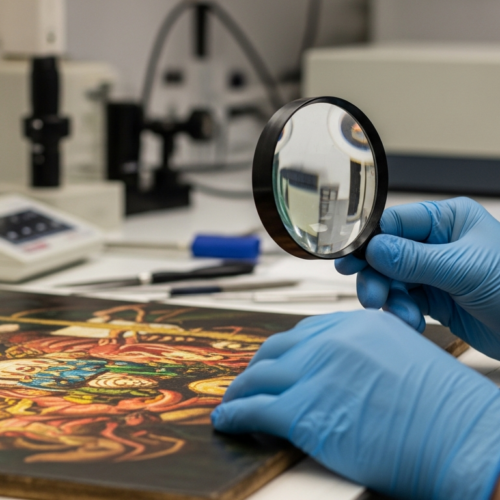


Historical pigments offer a window into the past, revealing the artistic techniques and cultural values of bygone eras. Many of these pigments, however, contain elements that pose health risks, and among them, manganese-containing pigments stand out due to their potential neurological effects.
Understanding the potential hazards associated with these pigments is essential for conservators, art historians, and anyone working with historical artifacts. This article will explore the use of manganese in historical pigments, the mechanisms by which manganese exposure can affect the nervous system, and the symptoms of manganism, a neurological disorder caused by manganese poisoning.
We will also discuss safe handling and storage practices, air quality monitoring, and medical surveillance strategies to minimize the risks associated with working with these pigments. By understanding the manganese pigment hazards, we can better protect ourselves and preserve our cultural heritage for future generations.
The Use of Manganese in Historical Pigments
Manganese has been used as a pigment for millennia, dating back to prehistoric times. Early humans utilized manganese dioxide, also known as pyrolusite, to create black pigments for cave paintings and body adornment.
In ancient Egypt, manganese was used to produce brown and black pigments for pottery and glass. The Romans also employed manganese in glassmaking, using it as a decolorizing agent to remove the green tint caused by iron impurities.
During the Renaissance, manganese pigments gained popularity among artists for their versatility and unique color properties. Umber, a natural earth pigment containing iron and manganese oxides, was widely used for its warm brown tones and ability to create shadows and depth in paintings.
Another manganese-containing pigment, manganese violet, was developed in the mid-19th century and quickly became a favorite among Impressionist and Post-Impressionist painters. Its delicate violet hue provided a valuable alternative to other violet pigments, which were often unstable or toxic.
The use of manganese in pigments wasn’t always well-documented, leading to potential risks for artists and artisans. Many historical texts lack detailed information on the composition and toxicity of pigments. This lack of information made it difficult to assess the potential health hazards associated with their use.

The widespread availability of manganese-containing pigments contributed to their popularity among artists. These pigments were relatively inexpensive and easy to obtain compared to other pigments, such as ultramarine, which was derived from lapis lazuli. This made manganese pigments a practical choice for many artists, especially those working on a limited budget.
Beyond artistic applications, manganese compounds were also used in various industrial processes, including textile dyeing and the production of ceramics. This broader usage meant that exposure to manganese wasn’t limited to artists alone, but also extended to workers in these industries. Understanding these diverse applications helps us appreciate the scope of potential exposure.
The specific shades and characteristics of manganese pigments varied depending on the source and processing methods. Different types of manganese oxides, for instance, produced a range of brown, black, and even violet hues. These variations allowed artists to achieve a wide spectrum of colors and effects in their artwork.
How Manganese Affects the Nervous System
Manganese is an essential trace element that plays a crucial role in various physiological processes, including enzyme function, bone development, and nutrient metabolism. However, excessive exposure to manganese can lead to neurotoxicity, primarily affecting the basal ganglia, a group of brain structures involved in motor control, learning, and emotional regulation.
The exact mechanisms by which manganese damages the nervous system are not fully understood, but several pathways have been implicated. One key mechanism involves the accumulation of manganese in mitochondria, the powerhouses of cells, leading to oxidative stress and impaired energy production.
Manganese can also interfere with the metabolism of dopamine, a neurotransmitter essential for motor control and reward-motivated behavior. Disruption of dopamine signaling in the basal ganglia is thought to contribute to the motor and cognitive impairments seen in manganism.
Furthermore, manganese can induce inflammation and excitotoxicity, a process in which neurons are damaged by excessive stimulation. These effects can further exacerbate neuronal damage and contribute to the progression of manganism.
The blood-brain barrier, which normally protects the brain from harmful substances, can be compromised by excessive manganese exposure. This allows manganese to enter the brain more easily, increasing the risk of neurotoxicity. The integrity of this barrier is crucial for brain health.
Manganese’s impact on dopamine metabolism is particularly significant due to dopamine’s critical role in motor control. The basal ganglia rely heavily on dopamine for smooth and coordinated movements. Disruptions in dopamine signaling lead to motor deficits similar to those seen in Parkinson’s disease.
Oxidative stress, caused by the accumulation of manganese in mitochondria, damages cellular components like proteins, lipids, and DNA. This damage contributes to neuronal dysfunction and cell death. Antioxidants may play a role in mitigating these effects.
The inflammatory response triggered by manganese exposure further exacerbates neuronal damage. Chronic inflammation can lead to long-term neurological problems. Managing inflammation is a key aspect of minimizing manganese’s neurotoxic effects.
Symptoms of Manganism (Manganese Poisoning)
Manganism, or manganese poisoning, is a neurological disorder caused by chronic exposure to high levels of manganese. The symptoms of manganism are often progressive and can vary depending on the duration and intensity of exposure.
Early symptoms of manganism may include psychiatric disturbances, such as irritability, anxiety, depression, and hallucinations. Motor symptoms typically develop later and can include muscle rigidity, tremors, slow movements (bradykinesia), and postural instability.
| Symptom Category | Specific Symptoms | Description |
|---|---|---|
| Psychiatric | Irritability, Anxiety, Hallucinations | Mood changes and perceptual disturbances |
| Motor | Muscle rigidity, Tremors, Bradykinesia | Movement-related difficulties |
| Cognitive | Memory loss, Confusion, Impaired judgment | Decline in mental abilities |
| Speech | Slurred speech, Difficulty articulating | Problems with clear communication |
As manganism progresses, individuals may develop a characteristic gait disturbance known as the “cock-walk,” in which they walk with a stiff, unsteady gait and tend to fall backward. Cognitive impairments, such as memory loss, confusion, and impaired judgment, can also occur in advanced stages of the disease.
The psychiatric symptoms of manganism can often be misdiagnosed as other mental health disorders. This can delay proper diagnosis and treatment. Careful evaluation is crucial.
The motor symptoms of manganism are often similar to those seen in Parkinson’s disease, making differential diagnosis challenging. A thorough neurological examination and exposure history are essential for accurate diagnosis.
The “cock-walk” gait is a distinctive feature of manganism, but it may not be present in all cases. Its absence doesn’t rule out the possibility of manganese poisoning. It is a late-stage symptom.
Cognitive impairments in manganism can significantly impact daily life, affecting memory, attention, and decision-making abilities. These cognitive deficits can be debilitating.
Factors Influencing Manganese Toxicity
Several factors can influence the toxicity of manganese, including the route of exposure, the chemical form of manganese, and individual susceptibility. Inhalation of manganese-containing dusts and fumes is a primary route of exposure in occupational settings, such as mining, welding, and pigment production.
The chemical form of manganese also plays a role in its toxicity, with some forms being more readily absorbed and accumulated in the brain than others. For example, manganese dioxide (MnO2), a common component of manganese pigments, is relatively insoluble and poorly absorbed, while other forms, such as manganese chloride (MnCl2), are more soluble and easily absorbed.
Individual susceptibility to manganese toxicity can vary due to genetic factors, age, and pre-existing health conditions. Children and older adults may be more vulnerable to the effects of manganese exposure due to differences in their physiology and metabolism.
People with liver disease or iron deficiency may also be at increased risk of manganese toxicity, as these conditions can affect the body’s ability to regulate manganese levels. It’s not just about the pigment itself, but also about the individual handling it.
The duration and frequency of exposure are also critical factors. Chronic, low-level exposure can be just as harmful as acute, high-level exposure. Cumulative exposure is a major concern.
Genetic variations in genes involved in manganese transport and metabolism can influence individual susceptibility. Some people may be genetically predisposed to accumulating more manganese in their brains.
Age-related changes in brain function and metabolism can also affect manganese toxicity. Older adults may have a reduced capacity to clear manganese from their brains.
Pre-existing neurological conditions can potentially increase vulnerability to the neurotoxic effects of manganese. The brain is already compromised.
Safe Handling and Storage of Manganese Pigments
To minimize the risk of manganese exposure, it is essential to implement safe handling and storage practices when working with historical pigments. Always wear appropriate personal protective equipment (PPE), such as gloves, respirators, and eye protection, to prevent direct contact with pigments and inhalation of dusts.
Work in a well-ventilated area or use a local exhaust ventilation system to remove airborne particles. Avoid creating dust when handling pigments, and use wet cleaning methods instead of dry sweeping or vacuuming to minimize dust dispersal.
Store manganese pigments in tightly sealed containers in a cool, dry place away from incompatible materials. Label all containers clearly with the pigment name, chemical composition, and hazard warnings.
Develop and implement a written hazard communication program that includes information on the potential health hazards of manganese pigments, safe handling procedures, and emergency response protocols. This protects both the conservator and the artwork.
Gloves should be made of a material that is impermeable to manganese, such as nitrile or neoprene. Avoid using latex gloves, as they may not provide adequate protection. Check for glove degradation regularly.
Respirators should be properly fitted and certified to protect against manganese-containing dusts and fumes. A qualified professional should conduct respirator fit testing. The correct filter is essential.
Local exhaust ventilation systems should be designed to capture dust and fumes at the source. Regular maintenance and inspection of ventilation systems are crucial. Ensure proper airflow.
Hazard communication programs should include training on the proper use of PPE, safe handling procedures, and emergency response protocols. Employees should be able to demonstrate their understanding of these procedures.
Monitoring Air Quality for Manganese Particles
Regular monitoring of air quality is crucial to assess the effectiveness of control measures and ensure that manganese exposure levels are below permissible limits. Air sampling should be conducted in areas where manganese pigments are handled or stored to measure the concentration of airborne manganese particles.
Use calibrated air sampling equipment and follow established sampling protocols to collect representative samples. Analyze air samples using appropriate analytical techniques, such as atomic absorption spectroscopy or inductively coupled plasma mass spectrometry, to determine the concentration of manganese.
- Regular air sampling
- Use calibrated equipment
- Follow established protocols
- Appropriate analysis techniques
- Compare results to standards
Compare air monitoring results to occupational exposure limits (OELs) established by regulatory agencies, such as the Occupational Safety and Health Administration (OSHA) or the National Institute for Occupational Safety and Health (NIOSH). If air monitoring results exceed OELs, implement additional control measures to reduce manganese exposure.
Air sampling should be conducted by qualified professionals with experience in industrial hygiene. Proper sample collection and analysis are crucial for accurate results. Expertise is essential.
Air sampling equipment should be regularly calibrated to ensure accuracy. Calibration records should be maintained. Maintain a rigorous quality control program.
Sampling protocols should specify the sampling duration, location, and frequency. These parameters should be tailored to the specific work environment and tasks. Consider worst-case scenarios.
If air monitoring results exceed OELs, immediate action should be taken to identify and correct the source of the exposure. This may involve improving ventilation, modifying work practices, or providing additional PPE.
Medical Surveillance for Manganese Exposure
Medical surveillance programs can help detect early signs of manganese toxicity and prevent the progression of manganism. Medical evaluations should include a comprehensive medical history, physical examination, and neurological assessment.
Laboratory tests, such as blood and urine manganese levels, can be used to assess manganese exposure. However, these tests have limitations, as manganese levels in blood and urine may not always correlate with manganese levels in the brain.
Neuroimaging techniques, such as magnetic resonance imaging (MRI), can be used to detect changes in the basal ganglia that are characteristic of manganese toxicity. Neuropsychological testing can assess cognitive function and identify subtle cognitive impairments.
Individuals with suspected manganese toxicity should be referred to a neurologist or occupational medicine physician for further evaluation and management. Early diagnosis and intervention are critical to improve outcomes and prevent long-term neurological damage.
Medical surveillance programs should be tailored to the specific risks of the workplace. The frequency and type of medical evaluations should be based on the level of manganese exposure.
Medical history should include information on previous manganese exposure, neurological symptoms, and other relevant medical conditions. A detailed occupational history is essential.
Neurological assessments should include tests of motor function, coordination, and cognitive function. Standardized neurological tests should be used. Track changes over time.
Neuropsychological testing can help identify subtle cognitive impairments that may not be detected by other methods. This can provide an early warning sign. Early detection is key.
Alternative Pigments and Conservation Strategies
When possible, consider using alternative pigments that do not contain manganese or other hazardous substances. Many modern pigments offer similar color properties and stability to historical pigments, without the associated health risks.
When working with historical artifacts containing manganese pigments, prioritize preventive conservation measures to minimize the need for intervention. This may include controlling environmental factors, such as temperature, humidity, and light exposure, to prevent pigment degradation and release of manganese particles.
Employ non-invasive or minimally invasive conservation techniques whenever possible to reduce the risk of exposure to manganese pigments. If intervention is necessary, carefully plan and execute the treatment to minimize dust generation and exposure.
Document all conservation treatments thoroughly, including the materials and methods used, to provide a record for future conservators. A thorough record helps ensure long-term preservation and safety.
Researching the stability and lightfastness of alternative pigments is crucial before using them in conservation treatments. The long-term performance of the alternative should be well-understood.
Environmental monitoring should be conducted to ensure that temperature, humidity, and light levels are within acceptable ranges. Regular monitoring helps prevent deterioration.
Non-invasive techniques, such as surface cleaning with soft brushes and gentle solvents, can often remove surface dirt and grime without disturbing the pigment layer. Less is often more.
Documentation should include photographs, written descriptions, and analytical data. This provides a comprehensive record of the treatment. Transparency is essential.
Research and Future Directions
Further research is needed to better understand the mechanisms of manganese neurotoxicity and to develop more effective strategies for preventing and treating manganism. Studies are underway to identify biomarkers that can detect early signs of manganese exposure and predict individual susceptibility to manganese toxicity.
Researchers are also exploring the potential of chelating agents and other therapeutic interventions to remove manganese from the brain and reduce its toxic effects. Advances in analytical techniques and imaging technologies are enabling more precise characterization of historical pigments and assessment of manganese exposure risks.
Collaboration between conservators, scientists, and medical professionals is essential to advance our understanding of manganese pigment hazards and to develop best practices for protecting human health and preserving our cultural heritage. A multidisciplinary approach offers the best chance for success.
Continued education and training are also vital to ensure that conservators and others working with historical pigments are aware of the risks and equipped with the knowledge and skills to handle these materials safely. It’s about protecting both the art and the people who care for it.
Developing more sensitive and specific biomarkers for manganese exposure is a critical research priority. This would allow for earlier detection and intervention. Biomarkers are essential.
Investigating the long-term effects of low-level manganese exposure is also important. Understanding the cumulative impact is crucial. Longitudinal studies are needed.
Developing new and improved chelating agents is a promising avenue for therapeutic intervention. These agents could help remove manganese from the brain. More research is needed.
Promoting interdisciplinary collaboration is essential for addressing the complex challenges associated with manganese pigment hazards. This requires breaking down silos. Communication is key.
Conclusion
Manganese-containing pigments have played a significant role in art history, but their potential neurological effects pose a serious concern for those who work with them. By understanding the risks associated with manganese exposure, implementing safe handling and storage practices, and monitoring air quality, we can minimize the potential for manganism and protect our health.
Medical surveillance programs, alternative pigment choices, and ongoing research efforts are also essential components of a comprehensive strategy to address manganese pigment hazards. It is our responsibility to safeguard both our cultural heritage and the well-being of those who preserve it.